Topic 1.5 Notes – Vectors and Motion in Two Dimensions
1. What a Vector Is and How It Breaks into Components
A vector has both magnitude (how much) and direction (which way). Examples you see constantly in AP Physics 1:
- Displacement
- Velocity
- Acceleration
- Force
In two dimensions, any vector can be represented as the resultant of two perpendicular components, usually along the x- and y-axes.
You choose a coordinate system. Most of the time:
- +x → horizontal right
- +y → vertical up
That choice determines your signs.
Resolving a Vector into Components
If a vector A has magnitude and makes an angle measured from the +x axis:
These come straight from right-triangle trig:
And the components relate back through the Pythagorean theorem:
Geometrically, you can think of the vector as the hypotenuse of a right triangle, with and as the legs:
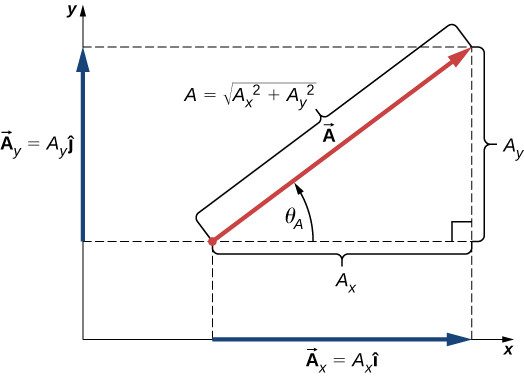
Quick example:
A 12 m/s velocity at 30° above horizontal:
Rebuilding the Resultant from Components
If instead you’re given and :
Be careful with signs and quadrants. If is negative, your angle is not in the first quadrant. On tests, students often get the magnitude right and the direction wrong.
The key idea: once broken into components, x and y behave independently. That’s what makes 2D motion manageable.
2. Motion in Two Dimensions Means Two Independent 1D Motions
Any object moving in a plane is just doing two 1D motions at the same time.
You apply the regular kinematics equations separately in x and y:
The process always goes like this:
- Break initial velocity into and .
- Identify and .
- Use the equations separately.
- Remember time is the same in both directions.
The independence of x and y is one of the most tested ideas in this unit.
3. Projectile Motion
Projectile motion is a special case of 2D motion where:
No air resistance. Gravity is the only force.
Horizontal Motion
- Constant velocity
There is no horizontal acceleration.
Vertical Motion
- Constant acceleration downward
- Treated exactly like free fall
- At the highest point,
Here’s the full picture with velocity components, maximum height, and range labeled:
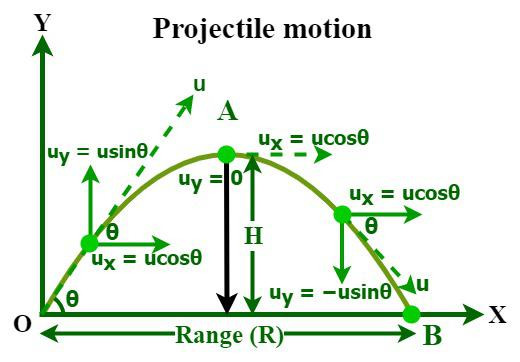
Projectile motion with velocity components, maximum height (H), and range (R)
Horizontal vs Vertical Comparison
| Horizontal (x) | Vertical (y) |
|---|---|
| No acceleration | Acceleration = −g |
| Velocity constant | Velocity changes |
| Displacement depends on time | Motion like free fall |
If the projectile lands at the same height it was launched:
- Time up = time down
- Range depends on both and time in air
- Maximum height depends only on
A common AP-style conceptual question asks what happens to range if launch angle changes but speed stays the same. You should know that complementary angles like 30° and 60° give the same range on level ground.
