Topic 6.2 Notes – Torque and Work
1. How Torque Transfers Energy
You already know in linear motion:
Work happens only if a force acts through a displacement.
Rotation works the same way. A torque can transfer energy into or out of a rigid system if it acts through an angular displacement.
If nothing rotates, no work is done. Even a huge torque does zero work if .
Direction matters
Energy transfer depends on the relative directions of torque and rotation:
- Same direction (torque helps rotation)
→ Positive work
→ Energy added to the system
→ Rotational kinetic energy increases - Opposite direction (torque resists rotation)
→ Negative work
→ Energy removed from the system
→ Rotational kinetic energy decreases
Picture a spinning fan:
- The motor applies torque in the direction of rotation → speeds up → positive work.
- Friction in the bearings applies torque opposite the motion → slows down → negative work.
That sign idea shows up constantly in quizzes and FRQs.
2. The Work-Torque Equation
Constant Torque
When torque is constant, the work done is:
Where:
- = work (joules)
- = torque (N·m)
- = angular displacement (radians only)
Radians are required because they are dimensionless. If you use degrees, your answer will be wrong.
Quick example
A turntable experiences a constant torque of and rotates .
If that torque was opposite the direction of rotation, the work would be .
Doubling torque doubles the work. Doubling the angle doubles the work. It’s directly proportional.
Sign of Work
Suppose counterclockwise is positive.
- Wheel rotates counterclockwise.
- A clockwise torque is applied.
- The wheel continues rotating counterclockwise but slows down.
Torque and displacement have opposite signs.
That means .
On AP questions, when they ask where the lost rotational energy went, the answer is often thermal energy due to friction.
3. Multiple Torques and Net Work
Most real systems have more than one torque acting.
First, find the net torque:
If the net torque is constant over the interval:
Important ideas:
- Only torques acting during the rotation do work.
- If net torque is positive → rotational kinetic energy increases.
- If net torque is negative → rotational kinetic energy decreases.
This connects directly to the rotational work-energy theorem:
If you see torque and a change in rotational speed in the same problem, this equation is probably hiding there.
4. Work from Torque vs Angular Position Graphs
Sometimes torque isn’t constant. Instead, you’re given a graph of torque vs angular position.
Here’s what that looks like for a rotation from to radians:
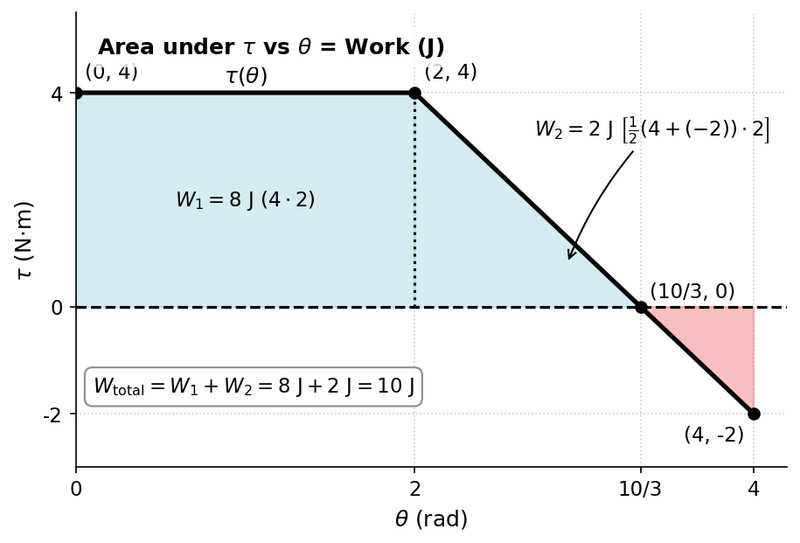
What the graph means
- The area under the curve equals the work done.
- Area above the axis → positive work.
- Area below the axis → negative work.
This is exactly like area under an vs graph in linear motion.
How to calculate it
- Identify the angular interval.
- Break the region into rectangles, triangles, or trapezoids.
- Calculate each area.
- Add positive and negative areas (with signs).
Using the graph above:
- From to rad:
Rectangle area
- From to rad:
This region is a trapezoid because torque changes linearly from to .
Trapezoid area:
(Equivalently, splitting at the point where the graph crosses the axis gives of positive area and of negative area, which still totals .)
Total work from to rad:
Students often forget to subtract the negative area. The AP loves giving a graph where torque changes sign so you must account for both.
5. Big Picture Connections
Torque is the rotational way to move energy around.
- Force through distance → changes linear kinetic energy.
- Torque through angle → changes rotational kinetic energy.
- Area under graph → work.
- Sign tells you whether energy is added or removed.
When rotation and energy show up together, think about work done by torque immediately.
