Topic 1.2 Notes – Displacement, Velocity, and Acceleration
1. The Object Model and Position
Treating objects as point particles
In kinematics, we use the object model. That means:
- Ignore size, shape, and internal motion.
- Treat the object as a single point.
- Keep important properties like mass or charge.
This works when rotation or deformation doesn’t affect what you’re analyzing. A car driving down a straight road can be treated as a point. We only care about its position as a function of time, not how its wheels spin.
Position and coordinate systems
Position tells you where the object is relative to a reference point.
To describe position, you must choose:
- An origin
- A positive direction (usually right or up)
Position can be positive, negative, or zero depending on your choice.
If you move the origin, the numbers change, but the physical motion does not. This is something teachers love to test conceptually. The motion is real. The coordinate system is your choice.
2. Displacement
What displacement is
Displacement is the change in position.
- It’s a vector.
- It can be positive, negative, or zero.
- It depends only on initial and final position.
Quick example:
If and ,
The negative sign tells you the direction.
Displacement vs distance
| Displacement | Distance |
|---|---|
| Change in position | Total path traveled |
| Vector (has direction) | Scalar (no direction) |
| Can be zero even if motion happened | Always positive |
If you walk 10 m east and 10 m west:
- Displacement = 0
- Distance = 20 m
On MCQs, they love giving motion that reverses direction. Always check whether they want distance or displacement.
Interpreting displacement physically
- The sign tells direction relative to your axis.
- Large displacement does not mean a long path.
- In 1D motion, displacement completely describes how position changed.
That idea leads directly to velocity.
3. Average Velocity
What average velocity means
Average velocity tells you how fast and in what direction position changes over a time interval.
- Vector quantity
- Units: m/s
- Uses total displacement over total time
It only cares about the starting and ending positions.
If , then , even if the object moved the whole time.
Velocity vs average speed
| Velocity | Average Speed |
|---|---|
| Vector | Scalar |
| Based on displacement | Based on total distance |
| Can be negative | Always positive |
Students mix this up constantly. Speed ignores direction completely.
Reading velocity from position-time graphs
On a position-time graph, velocity comes from the slope.
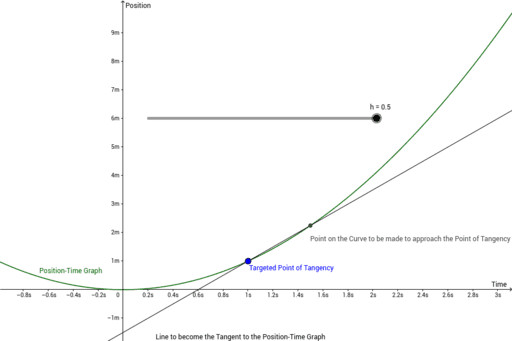
Slope on a position-time graph represents velocity
- Average velocity = slope of the secant line between two points on the curve.
- Positive slope → positive velocity.
- Zero slope → object at rest.
- Steeper slope → larger magnitude velocity.
On FRQs, if they ask for “justify,” say: The slope of a position-time graph represents velocity because slope equals change in position over change in time.
4. Average Acceleration
What acceleration is
Acceleration is the rate of change of velocity.
- Vector quantity
- Units: m/s²
An object accelerates if:
- Its speed changes
- Its direction changes
- Or both
Constant velocity means zero acceleration.
Direction of acceleration
Acceleration points in the direction of Δv, not necessarily the direction of motion.
- Velocity becoming more positive → positive acceleration.
- Velocity becoming more negative → negative acceleration.
- Moving right but slowing down → acceleration is left.
“Deceleration” just means acceleration opposite the motion.
Reading acceleration from velocity-time graphs
On a velocity-time graph, acceleration is built into the slope.
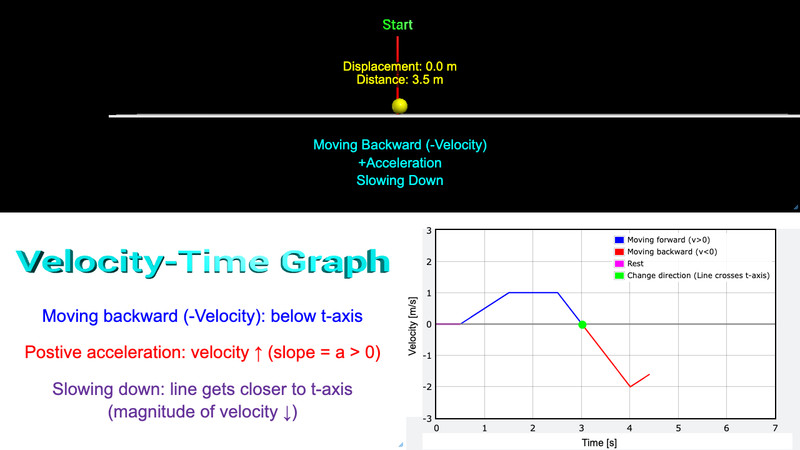
Velocity-time graph with varying slopes
- Average acceleration = slope of the graph.
- Horizontal line → zero acceleration.
- Upward slope → positive acceleration.
- Downward slope → negative acceleration.
- Steeper slope → larger acceleration magnitude.
5. Instantaneous vs Average Quantities
Average values use two endpoints.
Instantaneous values describe what’s happening at one moment.
- Instantaneous velocity = slope of tangent on position-time graph.
- Instantaneous acceleration = slope of tangent on velocity-time graph.
- As , average values approach instantaneous values.
On the AP exam, they often shrink the time interval and ask what happens to the calculated value. The answer is that it approaches the instantaneous value.
