Topic 6.3 Notes – Angular Momentum and Angular Impulse
1. What Angular Momentum Is
Angular momentum (L) measures how much rotational motion something has about a specific axis or point.
- Symbol:
- Units:
- In AP Physics 1, treat direction using 1D sign conventions (clockwise vs. counterclockwise as +/−). You won’t use full 3D vector math.
Two things increase angular momentum:
- Larger rotational inertia (harder to spin)
- Faster rotation
And one huge idea:
Angular momentum always depends on the axis or reference point you choose.
Change the axis → you usually change .
2. How to Calculate Angular Momentum
There are two common cases. You need to recognize which situation you’re in.
a. Rigid object rotating about a fixed axis
If something is spinning as a solid object (disk, rod, wheel):
- = moment of inertia about that axis
- = angular velocity
If is constant, then changing means changing .
Example idea:
If a wheel with larger spins at the same as a smaller one, the larger wheel has more angular momentum.
On tests, they may give you or expect you to know common formulas (like for a disk or hoop).
b. Object moving in a straight line (about a point)
An object does not need to spin to have angular momentum.
A particle moving past a point has angular momentum about that point:
- = distance from reference point
- = mass
- = speed
- = angle between the radius line and velocity
Key physical meanings:
- If motion is directly toward or away from the point, then →
- Maximum when motion is perpendicular to the radius
- Increasing , , or increases
In the diagram below, the velocity is broken into components parallel and perpendicular to the radius. Only the perpendicular component contributes to angular momentum, which is why the formula can also be thought of as .
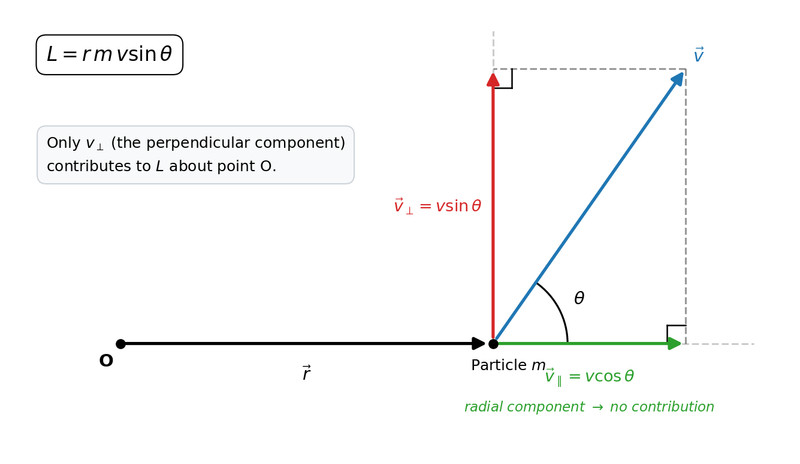
Angular momentum of a particle about point O
AP loves asking about how changes if the reference point changes. Same motion, different point → different → different .
3. What Angular Impulse Is
Angular impulse tells you how much torque changes angular momentum over time.
- Units: , same as
- Direction follows the same sign as torque
So:
- Bigger torque → bigger change in
- Longer time → bigger change in
This is the rotational version of linear impulse .
Angular impulse from graphs
If you’re given a torque vs. time graph, the area under the curve equals angular impulse.
For example, a constant positive torque applied over a time interval creates a rectangular area. That shaded area represents .
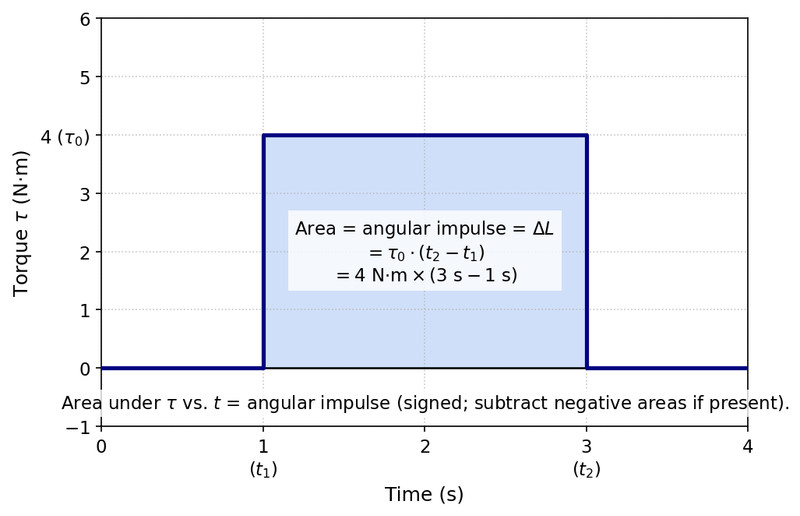
Torque vs. time graph showing angular impulse as area
- Rectangle →
- Irregular shape → find total area (add and subtract if below axis)
Students often forget to subtract negative regions. If torque is negative, the area counts as negative impulse.
4. The Rotational Impulse-Momentum Theorem
This is the central equation of the topic:
Also written as:
That means:
Net angular impulse equals change in angular momentum.
If , then .
That’s conservation of angular momentum.
Link to Newton’s Second Law (rotation)
The rotational form of Newton’s second law is:
If is constant:
So this whole topic connects directly to . The impulse-momentum equation just comes from applying that over a time interval.
Reading angular momentum graphs
If you see an vs. time graph, think slope first. The slope of the graph tells you the net torque.
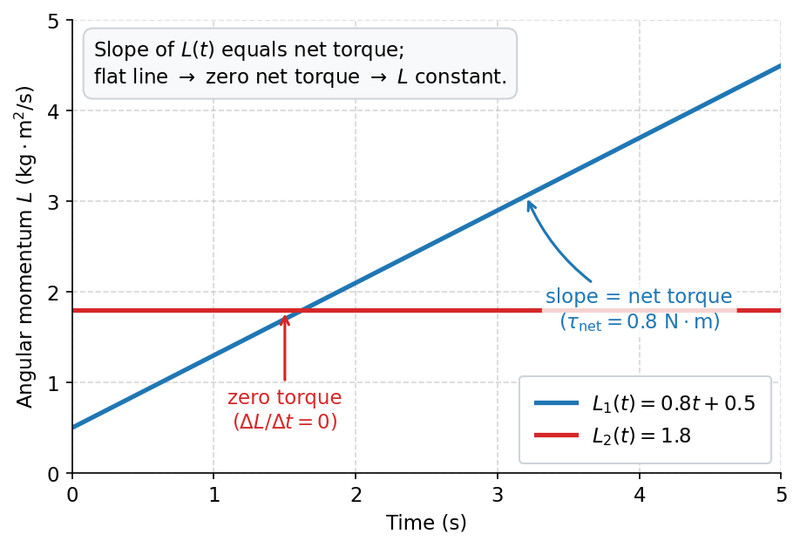
Angular momentum vs. time graph
- Slope = net torque
- Steeper slope → larger torque
- Flat line → zero net torque (angular momentum constant)
This shows up often in conceptual multiple-choice questions.
