Topic 7.2 Notes – Frequency and Period of SHM
1. Period and Frequency in Simple Harmonic Motion
In simple harmonic motion (SHM), an object moves back and forth around equilibrium in a repeating cycle. To describe how quickly that cycle repeats, we use two closely related quantities.
Period
The period is the time for one complete cycle.
Back to the same position, moving in the same direction.
- Units: seconds (s)
- Think: time per cycle
- Larger → slower oscillation
If it takes 0.8 s to go out, back, and return to the starting motion state, then .
Frequency
The frequency is how many cycles happen each second.
- Units: hertz (Hz) where
- Think: cycles per second
- Larger → faster oscillation
If something oscillates 5 times every second, then .
Their Relationship
They are inverses:
If frequency doubles, period is cut in half. On multiple-choice questions, they love giving you one and asking for the other. Don’t overthink it-just flip it.
2. Period of a Mass-Spring Oscillator
A mass attached to an ideal spring oscillates because of the restoring force from Hooke’s Law, . That restoring force leads to SHM.
Here’s the period:
- = mass (kg)
- = spring constant (N/m)
Notice what’s missing. There’s no amplitude.
What changes the period?
Mass
- Larger mass → longer period → slower oscillation
- If mass becomes 4 times bigger → period doubles
Physically, more mass means more inertia. The spring pulls with the same stiffness, but the mass resists acceleration more.
Spring constant
- Larger (stiffer spring) → shorter period
- If becomes 4 times bigger → period is cut in half
A stiffer spring pulls harder for the same displacement, so the system snaps back faster.
Amplitude
For an ideal spring, amplitude does not affect the period.
This is a classic AP trap. A bigger stretch means more force, but also more distance to travel. The math balances out so the time stays the same.
Picture the standard horizontal setup with equilibrium at :
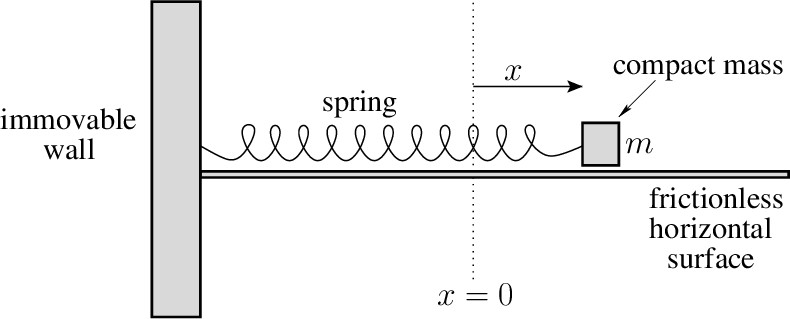
Horizontal mass-spring oscillator on a frictionless surface
3. Period of a Simple Pendulum (Small Angle Only)
A simple pendulum is a small bob on a light string of length , swinging under gravity.
For small angles (about 15° or less), it behaves like SHM.
- = length (m)
- = gravitational field strength (m/s²)
Again, notice what’s missing: mass.
What changes the period?
Length
- Longer pendulum → longer period
- If length becomes 4 times larger → period doubles
A longer pendulum travels along a longer arc and takes more time to complete a swing.
Gravity
- Larger → shorter period
- On the Moon (smaller ) → pendulum swings more slowly
Stronger gravity pulls the bob back toward equilibrium more aggressively.
Mass
Mass does not affect the period.
More mass increases inertia, but it also increases gravitational force by the same factor. The ratio stays the same, so the timing doesn’t change.
Small-angle requirement
This formula only works for small angles. At large angles, the period increases slightly with amplitude. On the AP exam, assume small angles unless told otherwise.
Here’s the system you should visualize. The restoring force comes from the component of gravity along the arc, labeled in the diagram.
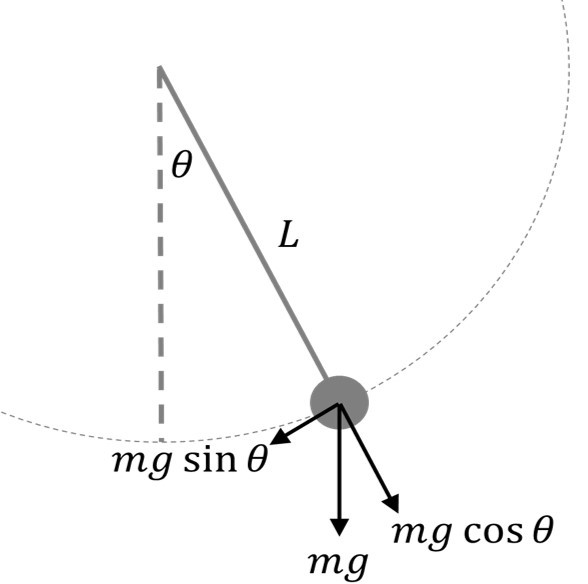
Simple pendulum with forces resolved into components
4. Comparing Spring and Pendulum Systems
| System | Period | Depends On | Does NOT Depend On |
|---|---|---|---|
| Mass-Spring | mass , spring constant | amplitude | |
| Pendulum (small angle) | length , gravity | mass, amplitude |
Both follow the same pattern:
- Spring: inertia = mass, restoring = stiffness
- Pendulum: inertia relates to length, restoring = gravity
On free-response questions, you may need to explain in words why a variable affects the period. Always tie it to inertia or strength of restoring force. That physical reasoning earns points.
