Topic 3.1 Notes – Translational Kinetic Energy
1. What Translational Kinetic Energy Is
When an object moves from one place to another, its center of mass is moving. The energy associated with that motion is translational kinetic energy.
It depends on two things:
- Mass → how much matter the object has
- Velocity → how fast it’s moving (relative to something)
The equation you must know:
Units
- in kilograms (kg)
- in meters per second (m/s)
- in joules (J)
How mass and velocity affect K
- Double the mass → kinetic energy doubles.
- Double the speed → kinetic energy becomes four times larger.
Velocity is squared, so speed has a much bigger impact than mass.
Quick example:
- 2 kg cart at 3 m/s →
- Same cart at 6 m/s →
The speed doubled. The energy quadrupled.
If , then . No motion, no translational kinetic energy.
Here’s what that equation looks like for a 1 kg object:
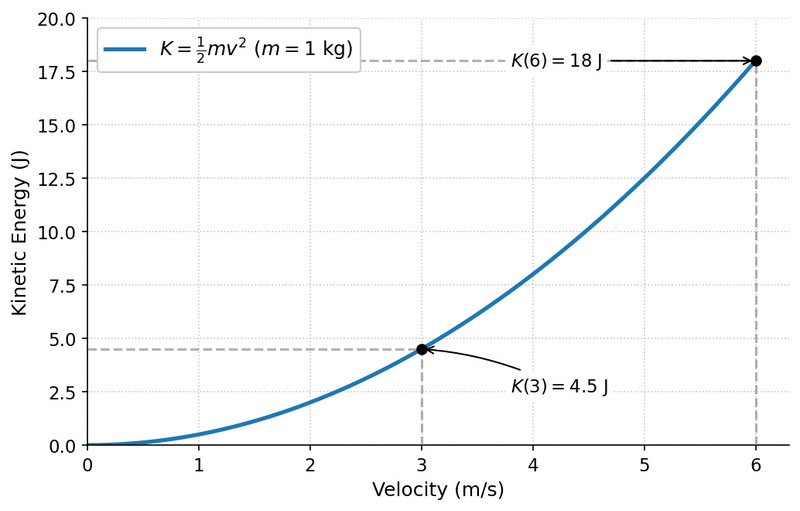
Kinetic energy vs. velocity for
Notice the curved shape. As velocity increases, the graph gets steeper. That curve is why small increases in speed can dramatically increase energy.
2. Kinetic Energy Is a Scalar
Velocity is a vector. It has direction.
Kinetic energy is a scalar. It has magnitude only.
Because the equation uses :
- and give the same kinetic energy.
- Kinetic energy is never negative.
Two identical cars moving east and west at the same speed have the same kinetic energy, even though their velocities point opposite directions.
Adding kinetic energy in a system
If two objects are moving, total kinetic energy is just:
You add the numbers directly. No vector math.
Students mix this up with momentum every year. Momentum depends on direction. Kinetic energy does not. If you’re ever putting a negative sign in a KE calculation, something has gone wrong.
3. Kinetic Energy Depends on Frame of Reference
Velocity is always measured relative to something. Since kinetic energy depends on velocity, it also depends on the observer.
The relative velocity equation:
That relative velocity is what goes into .
Same object, different observers
Imagine a 3 kg suitcase moving at 4 m/s relative to the ground.
- Person standing still:
- Person walking alongside at 4 m/s:
- Relative velocity = 0
- Person walking at 1 m/s in same direction:
- Relative velocity = 3 m/s
All three answers are correct in their own inertial frames.
The diagram below shows all three observers and their relative velocities to the same suitcase.
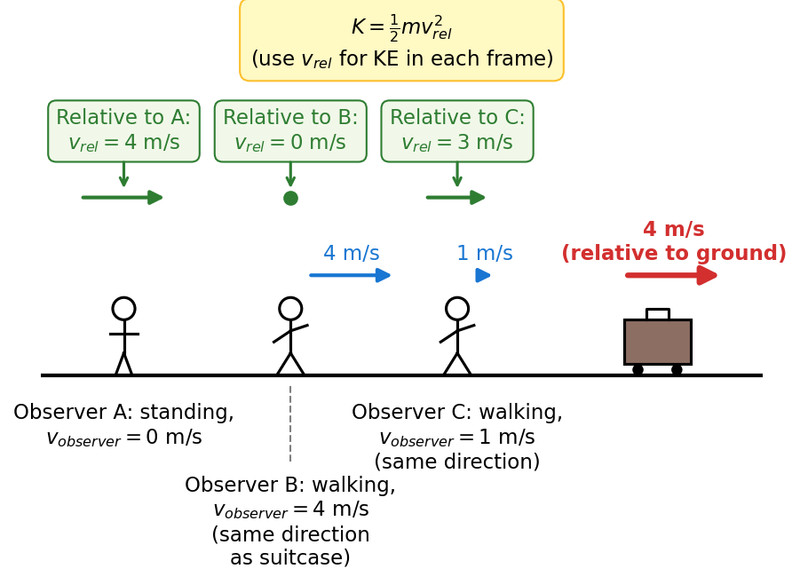
Same suitcase viewed from three inertial frames
What stays true
Even though kinetic energy changes between frames, the laws of physics still work in every inertial frame. Conservation of energy still holds. You just have to stay in one frame for the entire problem.
On AP-style collision questions, if they switch frames on you, you must recalculate velocity before plugging into the KE equation. That step is often where points are lost.
4. How Translational Kinetic Energy Connects to Bigger Ideas
Translational kinetic energy links motion to forces.
Soon you’ll use the Work-Energy Theorem:
Forces cause acceleration.
Acceleration changes velocity.
Changing velocity changes kinetic energy.
Because of the relationship, increasing speed slightly can require a large amount of work. That’s why stopping a fast-moving car takes much more energy than stopping a slow one.
Kinetic energy becomes central in:
- Collisions
- Mechanical energy conservation
- Work calculations
- Energy bar charts and system analysis
This is one of the core equations of the entire course.
