Topic 2.9 Notes – Circular Motion
1. What Circular Motion Is
Imagine swinging a ball on a string in a horizontal circle. The ball’s speed might be constant, but its velocity is not, because velocity includes direction.
- Velocity is always tangent to the circle.
- Because direction changes continuously, there must be acceleration.
- The object stays a constant radius from the center.
Two types of acceleration can exist:
- Centripetal acceleration → changes direction
- Tangential acceleration → changes speed
If speed is constant, that’s uniform circular motion (UCM). In UCM, only centripetal acceleration exists.
Here’s the geometry of that motion. In the diagram, the red arrows show the velocity tangent to the circle, and the blue arrows show the acceleration pointing inward toward the center.
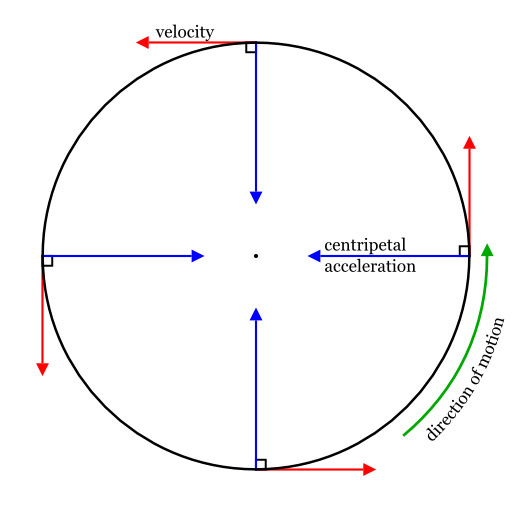
Velocity tangent to the circle; centripetal acceleration toward the center
That inward arrow is the key idea of this whole topic.
2. The Two Acceleration Components in Circular Motion
Centripetal Acceleration
Centripetal acceleration:
- Always points toward the center
- Is perpendicular to velocity
- Changes direction, not speed
Magnitude:
This relationship matters:
- Double the speed → acceleration increases by a factor of 4
- Larger radius → smaller centripetal acceleration
Newton’s 2nd Law toward the center gives:
Important: “Centripetal force” is not a new force. It just means the net inward force. It could be tension, gravity, friction, normal force, or components of those.
Tangential Acceleration
Tangential acceleration:
- Points along the tangent
- Changes speed
- Can be in the same direction as velocity (speeding up) or opposite (slowing down)
If tangential acceleration is zero, the motion is uniform circular motion.
Net Acceleration
When both components exist, total acceleration is the vector sum. The left diagram emphasizes the inward centripetal component, and the right diagram shows how the inward and tangential components combine to produce a net acceleration that is angled.
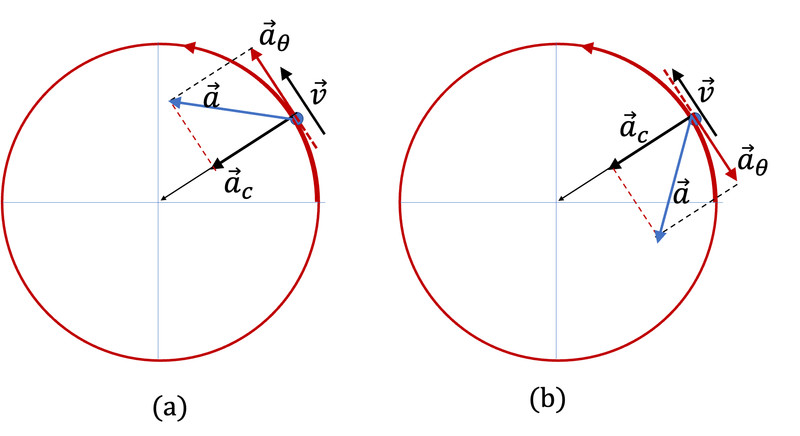
Centripetal and tangential acceleration components
On tests, they may ask for direction of net acceleration. Think vector addition, not just “toward center.”
3. Where the Centripetal Force Comes From
Always draw a free-body diagram first and apply Newton’s 2nd Law toward the center.
Vertical Loop
At the top, the minimum speed happens when the normal force is zero.
Gravity alone provides centripetal force:
If the speed is smaller, the object loses contact.
Banked Curves (Frictionless, Quantitative)
On a properly designed banked curve:
- The horizontal component of the normal force supplies centripetal force.
- No friction needed at the design speed.
Steeper angle → supports higher speed.
Larger radius → requires smaller centripetal acceleration.
If friction is present, you only describe it qualitatively for AP Physics 1.
Conical Pendulum
For a mass on a string moving in a horizontal circle:
The horizontal component of tension is the centripetal force.
Circular Orbits
For satellites in circular orbit:
Satellite mass cancels. Orbital motion depends only on the central mass.
4. Period and Frequency in Uniform Circular Motion
Only applies when speed is constant.
Period = time for one revolution
Frequency = revolutions per second
Bigger radius at same speed → longer period.
Faster speed → shorter period.
5. Kepler’s Third Law for Circular Orbits
For circular orbits:
Key relationship:
If orbital radius increases, period increases dramatically.
Only the central mass matters.
You do not need Kepler’s 1st or 2nd laws for AP Physics 1.
