Topic 3.5 Notes – Power
1. What Power Is
Power is the rate at which energy changes with respect to time.
If energy changes quickly, power is large. If energy changes slowly, power is small.
Mathematically,
- Units: watts (W)
- Scalar quantity (no direction), but it can be positive or negative depending on whether energy is entering or leaving the system.
Think in terms of systems:
- Energy transferred into a system
Example: a motor increasing a car’s kinetic energy. - Energy transferred out of a system
Example: brakes removing kinetic energy. - Energy converted within a system
Example: gravitational potential energy turning into kinetic energy as something falls.
Power answers one question: How fast is the energy changing?
2. The Three Power Equations You Must Know
There are three equations, and choosing the right one depends on what the problem gives you.
a. Average Power from Energy Change
Use this when you’re told:
- A change in kinetic energy
- A change in potential energy
- Total energy transferred over a time interval
Example:
A 2 kg object gains 40 J of kinetic energy in 5 s.
That means energy is increasing at 8 joules per second.
b. Average Power from Work
Because work is energy transfer by a force, we can also write:
And since , this is the same idea in mechanical form.
Use this when:
- You calculate work using
- A force acts over a displacement during a time interval
If a 50 N force pulls an object 10 m in 4 s (force parallel to motion):
c. Instantaneous Power from a Force
This one shows up a lot on conceptual questions:
- is the component of force parallel to velocity
- is instantaneous velocity
- is the angle between force and velocity
This gives power at that instant, not over a time interval.
In the example below, the pulling force is angled above the horizontal. If the box moves horizontally, only the horizontal component of the force does work and contributes to power.
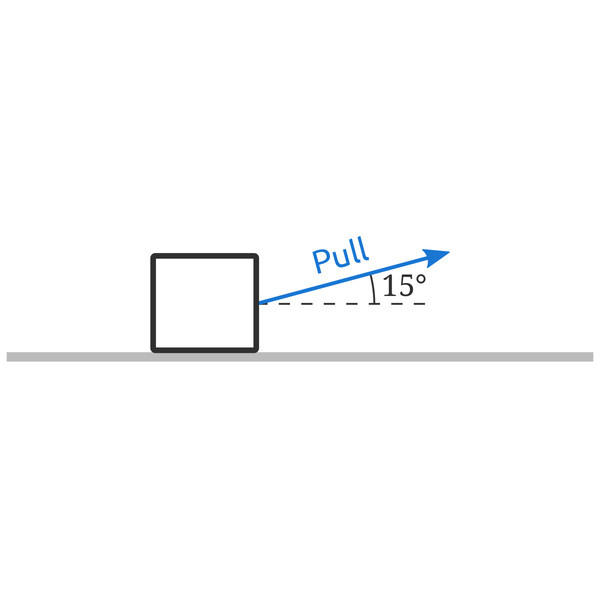
Force at an angle to the direction of motion
Only the component of force in the direction of motion transfers energy.
If velocity is zero at that instant, power is zero even if a force exists.
3. How to Interpret the Sign of Power
From :
Positive Power
- Force and velocity point in the same general direction.
- Energy is entering the system.
- Kinetic energy increases.
Example: a car engine pushing forward while the car moves forward.
Negative Power
- Force opposite the velocity.
- Energy leaves the system.
- Kinetic energy decreases.
Example: friction acting on a sliding box.
Zero Power
- Force perpendicular to velocity.
- No energy transfer.
Classic case: centripetal force in circular motion.
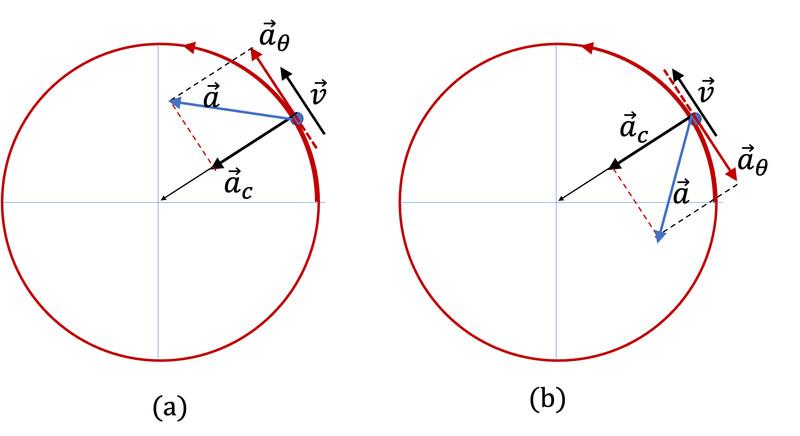
Centripetal force and tangential velocity in circular motion
In circular motion, the velocity is tangent to the circle and the centripetal force points toward the center. Since they are perpendicular, .
The force changes direction of motion, not speed, so kinetic energy stays constant.
This is a favorite multiple-choice trap.
4. Power in Common AP Physics Situations
Lifting at Constant Speed
If you lift an object straight up at constant speed:
- Net force = 0
- Applied force =
Even though acceleration is zero, power is not zero because energy is being converted from chemical energy to gravitational potential energy.
Moving at Constant Speed on Level Ground
- Net force = 0
- Engine force balances friction
- Kinetic energy is constant
But the engine still produces power:
Where does that energy go?
Into thermal energy due to friction and air resistance.
Students often think zero acceleration means zero power. It doesn’t.
Accelerating Object
When net force is not zero:
So
Power tells you how quickly kinetic energy increases.
