Topic 7.1 Notes – Defining Simple Harmonic Motion (SHM)
1. What Simple Harmonic Motion Is
Periodic motion
Periodic motion repeats itself in equal time intervals.
- One complete back-and-forth cycle takes a period .
- Examples: a pendulum swinging, a mass on a spring, a vibrating ruler.
Not all periodic motion is SHM. The motion must meet a stricter condition.
Simple harmonic motion
Simple harmonic motion is periodic motion where:
- The object oscillates about an equilibrium position.
- There is a restoring force.
- The restoring force is proportional to displacement from equilibrium.
The defining equation is:
- is displacement from equilibrium.
- is a constant (for springs, the spring constant).
- The negative sign means the force points toward equilibrium.
If the force is not proportional to , it is not SHM, even if it repeats.
2. Equilibrium Position and Restoring Force
Equilibrium position
The equilibrium position is where the net force is zero.
- If you place the object there and let go gently, it stays there.
- In SHM, motion always happens around this point.
For example:
- Spring: where it is neither stretched nor compressed.
- Pendulum: the lowest point.
Restoring force
A restoring force always acts in the direction opposite the displacement.
- If , then .
- If , then .
That direction is what makes the object reverse and oscillate.
Here’s what that looks like for a horizontal mass-spring system.
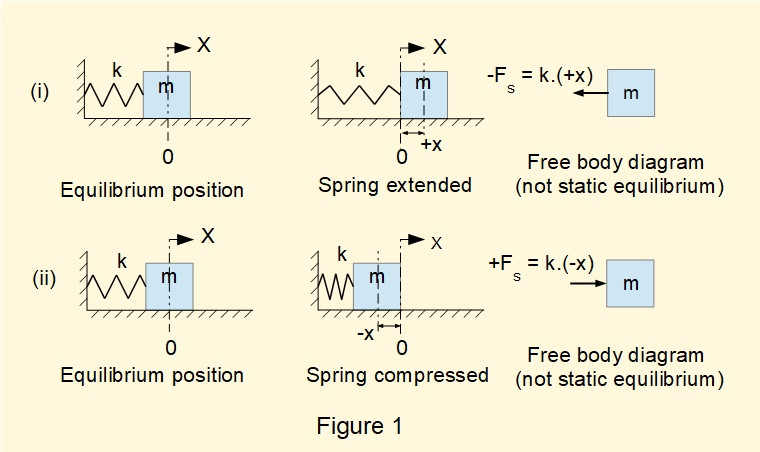
Restoring force for a mass-spring system
At , the spring is at equilibrium and the net force is zero. When the mass is displaced to the right (), the spring is stretched and the restoring force points left. When displaced to the left (), the spring is compressed and the restoring force points right.
The farther you pull it, the stronger the restoring force. That linear increase in force is what produces true SHM.
3. The Mathematical Model of SHM
When the restoring force follows , the motion becomes sinusoidal.
Position
- is amplitude (maximum displacement).
- is angular frequency.
- depends on initial conditions.
The motion is always sinusoidal in ideal SHM.
Velocity
- Maximum speed occurs at equilibrium.
- .
- Velocity is zero at .
Acceleration
The most important relationship:
Acceleration is proportional to displacement and always points toward equilibrium. That proportional acceleration is another way to define SHM.
On FRQs, you often need to explain this in words: Because the acceleration is proportional to and opposite the displacement, the motion is simple harmonic.
4. Two Systems That Exhibit SHM
Mass-spring system
For a horizontal spring:
Important trends:
- Larger → larger .
- Larger → smaller .
- Amplitude does not affect period.
That last one shows up constantly in conceptual questions.
Simple pendulum (small angles only)
For small angular displacements (about or less), the restoring torque is proportional to angle, so it behaves like SHM.
Key facts:
- Period depends on length, not mass.
- Larger → larger .
- Only valid for small angles.
If the angle is large, the restoring force is no longer proportional, and it’s no longer ideal SHM. The AP will state or imply “small angle” when they want you to use this model.
The diagram below shows a pendulum displaced by a small angle . The component of gravity along the arc acts as the restoring force, always pointing back toward equilibrium.
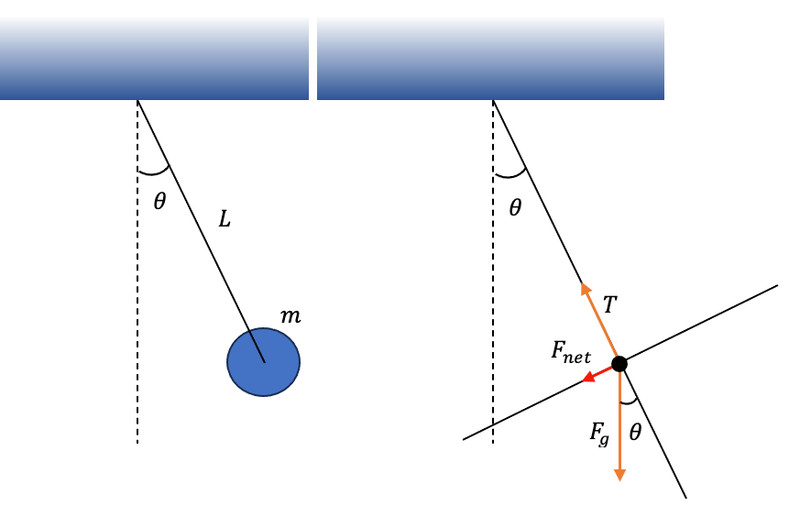
Simple pendulum and force diagram at small angle
