Topic 3.2 Notes – Work
1. What Work Is
Work is the amount of energy transferred into or out of a system by a force acting over a displacement.
A few key features:
- Mechanical energy transfer only (for AP Physics 1). You should know energy can become thermal or sound, but you won’t analyze heat transfer in detail here.
- Scalar quantity → no direction, just a number with units.
- Measured in joules (J).
Work can be:
- Positive → energy added to the system (force component in direction of motion).
- Negative → energy removed (force component opposite motion).
- Zero → either no displacement or force is perpendicular to displacement.
If you push hard on a wall and it doesn’t move, the work you do on the wall is zero. Force alone is not enough. There must be displacement.
2. Work by Constant Forces
The Work Equation
For a constant force:
- = magnitude of force
- = displacement of the point of application
- = angle between force and displacement
Only the component of the force parallel to the displacement transfers energy.
Break the force into components:
Then:
Parallel vs Perpendicular
- Parallel component
- Changes kinetic energy.
- Determines sign of work.
- Perpendicular component
- Does no work.
- Can change direction without changing speed.
Classic example: centripetal force in circular motion. The force points inward, velocity is tangent. They are perpendicular, so the force does zero work and speed stays constant.
That idea shows up a lot in multiple choice questions.
3. Conservative vs Nonconservative Forces
This is where work connects directly to potential energy.
Conservative Forces
Examples:
- Gravity
- Spring force
Properties:
- Path-independent → only initial and final positions matter.
- Work over a closed loop = 0.
- Associated with potential energy (PE).
- If the system returns to its original configuration:
Relationship you must know:
If gravity does positive work, gravitational potential energy decreases.
On FRQs, you often need to say in words: The work done by gravity depends only on the change in height, not the path taken.
Nonconservative Forces
Examples:
- Friction
- Air resistance
Properties:
- Path-dependent.
- Work around a closed loop ≠ 0.
- Not associated with potential energy.
- Usually convert mechanical energy into thermal energy or sound.
For kinetic friction:
Energy dissipated ≈
Students often forget it’s path length, not displacement.
Here’s the comparison clearly:
| Property | Conservative | Nonconservative |
|---|---|---|
| Path dependence | Independent of path | Depends on path |
| Closed loop work | Zero | Not zero |
| Has potential energy? | Yes | No |
| Examples | Gravity, spring | Friction, air resistance |
4. The Work-Energy Theorem
This is the core equation of the topic:
The change in kinetic energy equals the sum of the work done by all forces.
Expanded:
Interpretation:
- Net work > 0 → speed increases.
- Net work < 0 → speed decreases.
- Net work = 0 → speed unchanged.
Quick example: A 2 kg object speeds up from 3 m/s to 5 m/s.
Net work done = 16 J.
Systems vs Objects
If the center of mass and the point where the force is applied move the same distance, model it as a single object. Only kinetic energy changes.
If parts move differently (like compressing a spring), internal energy changes too.
This distinction shows up in paragraph responses.
5. Work from Force-Displacement Graphs
Work equals the area under an vs. displacement graph.
In the graph below, the shaded region between the two vertical dashed lines represents the work done over that interval of displacement.
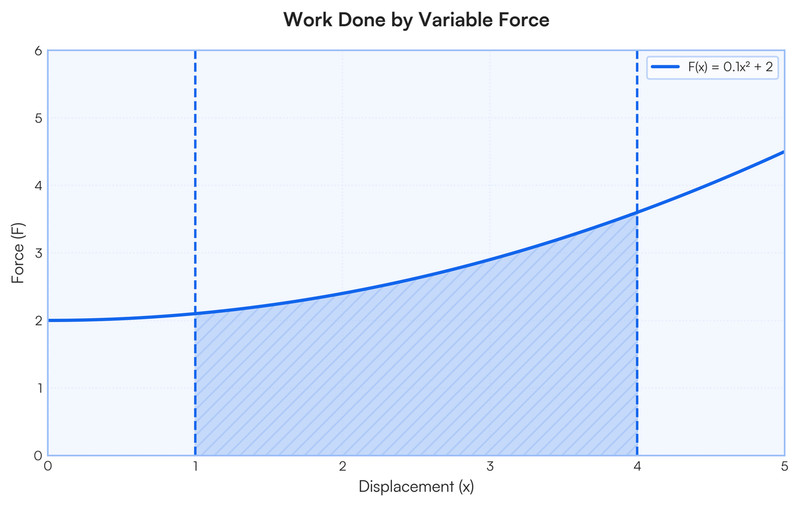
Work as area under an vs. graph
- Constant force → rectangle.
- Increasing force → triangular or curved area.
- Area above axis → positive work.
- Area below axis → negative work.
This works even if the force changes.
Connect it back: Total area under the graph = .
So if the total shaded area is zero, kinetic energy doesn’t change.
