Topic 8.1 Notes – Internal Structure and Density
1. What a Fluid Is
A fluid is any substance that has no fixed shape. If you put it in a container, it takes the container’s shape. That includes liquids and gases.
The reason comes from the interactions between atoms and molecules.
Particle Model Refresher
What separates solids, liquids, and gases is the strength of intermolecular forces and how much freedom particles have to move.
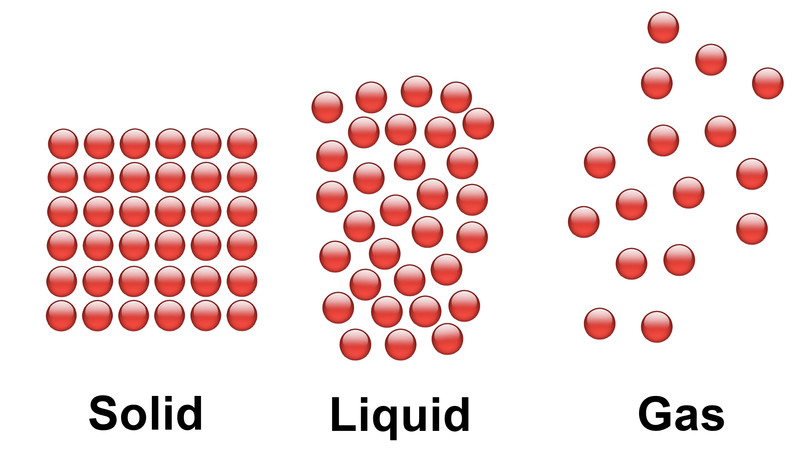
Particle model of solids, liquids, and gases
- Solids
- Strong intermolecular forces
- Particles vibrate in fixed positions
- Fixed shape and fixed volume
- Liquids
- Medium-strength intermolecular forces
- Particles stay close but slide past each other
- Fixed volume, no fixed shape
- Gases
- Very weak intermolecular forces
- Particles move freely and are far apart
- No fixed shape, no fixed volume
Looking at the diagram, notice how particle spacing and arrangement change from left to right. That microscopic structure explains the macroscopic properties listed above.
A key phrase you might see is that fluids deform continuously under shear stress. That means if you apply a sideways force, they keep flowing instead of resisting like a solid would.
2. Properties of Liquids and Gases
Liquids and gases are both fluids, but they behave differently in important ways.
Shape and Volume
| Liquids | Gases | |
|---|---|---|
| Shape | Take shape of container | Take shape of container |
| Volume | Fixed volume | No fixed volume (expand to fill container) |
| Surface | Form a level top surface (due to gravity) | No defined surface inside container |
| Compressibility | Very low (nearly incompressible) | High (volume changes easily with pressure) |
Particle Spacing and Motion
- Liquids: particles are close together, constantly rearranging.
- Gases: particles are far apart, moving randomly at high speeds.
Flow Behavior
Both:
- Flow from high pressure to low pressure
- Cannot resist shear stress long-term
- Adjust shape to match their container
The compressibility difference becomes important later when we assume fluids are “ideal.”
3. Density
Density connects mass and volume. It tells you how tightly packed matter is.
- = density
- = mass
- = volume
- SI unit: kg/m³
- Also common: g/cm³
Density is a ratio, not a force and not a weight.
Quick Example
A sample has mass 2.4 kg and volume 0.003 m³.
You divide mass by volume. Always check units.
What Density Tells You
Density predicts floating and sinking.
- If → floats
- If → sinks
- If equal → neutrally buoyant
You are comparing densities, not masses. A huge ship floats because its average density (including air inside) is less than water.
How Density Changes
Density changes if mass or volume changes.
- Increase temperature → particles spread out → volume increases → density decreases (for most substances).
- Increase pressure → volume decreases → density increases.
- This effect is much stronger for gases than liquids.
On most AP Physics 1 problems, liquids are treated as having constant density unless told otherwise.
4. The Ideal Fluid Model
In physics, we simplify real fluids using a model called an ideal fluid.
An ideal fluid has two properties:
Incompressible
- Density is constant.
- Volume does not change with pressure.
- Good approximation for liquids.
Zero Viscosity
- No internal friction.
- No energy lost as thermal energy due to fluid motion.
- Layers of fluid slide past each other without resistance.
Because of these assumptions:
- Flow is treated as smooth (laminar).
- Conservation of energy works cleanly in fluid systems.
Real fluids have viscosity and gases are compressible, but unless a problem says otherwise, you usually assume the fluid is ideal and incompressible.
