Topic 3.3 Notes – Potential Energy
1. What Potential Energy Is
Potential energy is energy stored in a system because of the relative positions of objects that interact through conservative forces.
That word system matters. A single object doesn’t “have” potential energy by itself. A ball and Earth together have gravitational potential energy because they interact gravitationally.
Conservative forces
A force is conservative if:
- The work it does depends only on initial and final positions, not the path.
- Energy can be fully recovered when the system returns to its original configuration.
- We can define a potential energy function for it.
Common AP examples:
- Gravity
- Ideal spring force
Nonconservative forces (like friction):
- Depend on path
- Convert mechanical energy into thermal energy
- Do not have a useful potential energy function
If friction is in the system, mechanical energy is not conserved.
Scalar nature
Potential energy is a scalar.
- No direction.
- You just add values algebraically.
- Only depends on configuration, not motion history.
That’s why energy equations are often simpler than force equations.
2. The Zero of Potential Energy
The zero level of potential energy is a choice you make.
Only changes in potential energy affect physics:
You can shift every value up or down by a constant and nothing physical changes.
Common choices:
- For near-Earth gravity → ground as
- For springs → equilibrium as
- For planetary gravity → at
On tests, they sometimes define an unusual zero. Don’t panic. Just use their reference consistently.
3. Forms of Potential Energy You Must Know
a. Elastic Potential Energy (Ideal Spring)
For a spring stretched or compressed from equilibrium:
- = spring constant
- = displacement from equilibrium
Key features:
- Depends on , so it’s always positive.
- Stretching and compressing by the same amount store the same energy.
- Energy grows quickly as increases.
If a 200 N/m spring is stretched 0.10 m:
Small stretch → noticeable energy.
b. Gravitational Potential Energy Near Earth
When height changes are small compared to Earth’s radius:
- = mass
- = gravitational field
- = vertical displacement
Important:
- Only vertical height matters.
- Linear relationship.
- Rising →
- Falling →
If a 3 kg object rises 2 m:
c. Gravitational Potential Energy Between Two Masses
For planets, moons, satellites:
- = center-to-center distance
- Zero defined at infinity
Key ideas:
- Always negative (gravity is attractive).
- As increases, becomes less negative.
- As decreases, becomes more negative.
This graph shows how changes with distance :
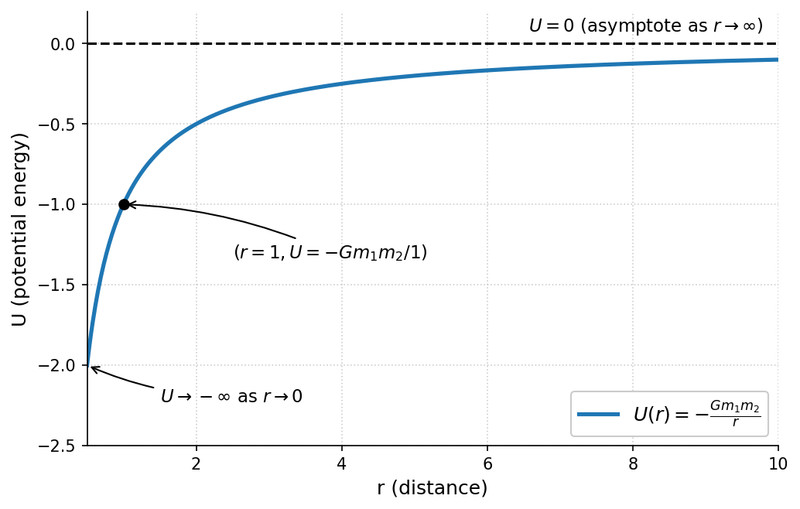
Gravitational potential energy vs. distance,
Notice how the curve approaches as becomes very large and drops steeply as the objects get very close. That steep drop is why gravity becomes much stronger at small separations.
Do not use for orbit problems. Use the full equation.
4. Total Potential Energy in Multi-Object Systems
If more than two objects interact, total potential energy is the sum of all pairwise interactions.
For three objects A, B, C:
Steps:
- Identify every interacting pair.
- Use the correct formula for each.
- Add them algebraically.
Potential energy is additive because it’s scalar.
This idea shows up in conceptual questions where they ask what happens if one object is moved. You must think about which pairwise distances change.
5. How Potential Energy Connects to Motion
When only conservative forces act:
If decreases, increases. If increases, decreases.
Examples:
- A falling object speeds up because gravitational decreases.
- A compressed spring launches an object as spring turns into .
- A projectile slows while rising because becomes gravitational .
In written explanations, you must describe the system. For example:
“As the object rises, the gravitational potential energy of the object-Earth system increases, so its kinetic energy decreases to conserve mechanical energy.”
That wording earns points.
