Topic 2.7 Notes – Kinetic and Static Friction
1. What Friction Is
Friction is a contact force that resists relative motion, or attempted motion, between two surfaces in contact.
At the microscopic level, surfaces aren’t perfectly smooth. Tiny bumps and molecular attractions interact and resist sliding. That’s where friction comes from.
Key features:
- It only exists when two objects are touching.
- It acts parallel to the surface.
- It points opposite the direction of relative motion (or the direction the object would move without friction).
- For AP Physics 1 models, friction does not depend on surface area of contact.
Since friction is a force, it belongs on your free-body diagram.
The diagrams below show a block on a horizontal surface. Focus on the force arrows on the block and how friction changes depending on whether the object is about to move or already sliding. The graph on the right shows how the friction force compares to the applied force.
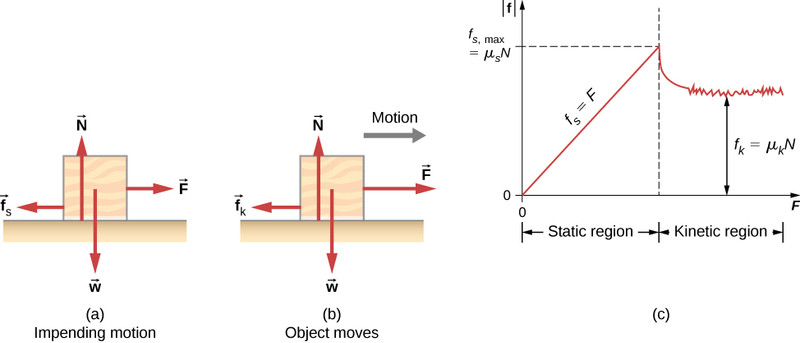
Static vs. kinetic friction and friction vs. applied force graph
One common mistake is assuming friction is always . That depends on which type of friction you’re dealing with.
2. The Normal Force and Coefficients of Friction
Friction depends directly on the normal force, so you have to understand that first.
Normal Force
The normal force is the perpendicular force a surface exerts on an object in contact with it. It always points away from the surface.
It is not automatically equal to .
Examples:
- Horizontal surface, no vertical acceleration
- Incline at angle
- If other vertical forces exist, use Newton’s Second Law in the vertical direction to solve for .
Because friction is proportional to , changing the angle of an incline changes friction.
Coefficient of Friction
The coefficient of friction is a dimensionless number that depends on the pair of materials.
There are two types:
- → static friction coefficient
- → kinetic friction coefficient
For the same surfaces,
That’s why it’s harder to start pushing something than to keep it sliding.
3. Static vs. Kinetic Friction
Here’s the big-picture comparison:
| Feature | Static Friction | Kinetic Friction |
|---|---|---|
| When it acts | No relative motion between surfaces | Surfaces are sliding |
| Equation | ||
| Adjustable? | Yes, up to a maximum | No, fixed value |
| Maximum value | Not applicable |
Static Friction
Static friction acts when surfaces are in contact without slipping.
It adjusts to match the applied force, up to a maximum:
If you push with 20 N and the object doesn’t move, static friction is 20 N in the opposite direction.
Motion begins only when:
The instant the applied force exceeds this value, slipping begins and kinetic friction takes over.
Students lose points by automatically writing . That only applies at the threshold of motion.
Kinetic Friction
Kinetic friction acts when surfaces are sliding relative to each other.
Its magnitude is:
Important properties:
- Opposes the direction of relative motion.
- Does not depend on contact area.
- Usually smaller than maximum static friction.
- Constant for given materials and normal force.
If a box slides across a horizontal floor with no other horizontal forces, then: The negative sign just indicates the acceleration is opposite the motion.
4. Using Friction in Force Analysis
Every friction problem is a Newton’s Second Law problem.
Work through it systematically:
- Draw the free-body diagram.
- Decide whether the situation involves static or kinetic friction.
- Find the normal force.
- Apply in each direction.
Typical cases you’ll see:
- Object at rest → net force is zero, static friction balances other horizontal forces (if below max).
- Object about to move → set applied force equal to .
- Object sliding → use and solve for acceleration.
On FRQs, you often have to explain in words why an object remains at rest. A strong answer mentions that static friction increases as needed, up to , preventing slipping.
