Topic 8.2 Notes – Pressure
1. What Pressure Is
When a force presses on a surface, what matters is how spread out that force is.
Definition
Pressure is the perpendicular force per unit area:
- is the component of force perpendicular to the surface.
- Parallel forces do not change pressure on that surface.
- Smaller area with the same force → larger pressure.
If you push on a wall at an angle, only the part of your force pushing straight into the wall counts.
Units
- SI unit is the pascal (Pa)
A pascal is a small unit, so pressures are often thousands of pascals.
How Force and Area Matter
- Same area, bigger force → bigger pressure.
- Same force, smaller area → bigger pressure.
- Same force, larger area → smaller pressure.
Classic mental images:
- Snowshoes spread your weight over a large area → low pressure.
- Sharp blades concentrate force on tiny area → high pressure.
Pressure Is a Scalar
Pressure has magnitude only. It does not point in a direction.
Forces are vectors. Pressure is not.
In a fluid at rest, pressure at a point acts equally in all directions. That idea becomes important once we talk about fluids.
2. Incompressible Fluids
Now think about liquids like water or oil.
What “Incompressible” Means
For AP Physics 1, liquids are treated as incompressible:
- Their volume stays constant even if pressure changes.
- Their density stays constant.
This is an approximation, but it works very well for liquids.
Contrast With Gases
- Gases are compressible. Their volume and density change with pressure.
- Liquids are not, in this course.
Why This Matters
Because density stays constant, we can use relationships like:
If density changed with pressure, this simple equation would not work.
This constant-density idea is also what makes hydraulic systems work. When you push on one part of a fluid, it doesn’t “squish,” so pressure transmits through it.
3. Where Fluid Pressure Comes From
Zoom in to the microscopic level.
Fluid pressure comes from particle collisions.
- Fluid particles constantly collide with surfaces.
- Each collision changes the particle’s momentum.
- That change in momentum produces a tiny force.
- Add up all those tiny forces over an area → pressure.
What increases fluid pressure?
- More collisions per second.
- Greater momentum change in each collision.
- Higher density → more particles per volume → more collisions.
Important: A fluid can be completely at rest and still exert pressure. Even in static water, particles are moving randomly and colliding.
At any one point in a static fluid, pressure is the same in all directions. That’s why deep-sea creatures are squeezed from every side equally.
4. Absolute Pressure and Gauge Pressure
There are three related pressures you need to keep straight.
- Absolute pressure : total pressure at a point.
- Reference pressure : often atmospheric pressure.
- Gauge pressure : pressure above (or below) atmospheric.
At the open surface of water exposed to air:
If a tire gauge reads 220,000 Pa, that’s gauge pressure. The actual absolute pressure inside is atmospheric plus that value.
Absolute pressure is always zero or positive. Gauge pressure can be negative if below atmospheric.
On tests, they often give atmospheric pressure and depth. Read carefully whether they want gauge or absolute pressure.
5. Pressure in a Vertical Column of Fluid
Now let’s connect depth and pressure.
Gauge Pressure From Depth
- is density.
- is gravitational acceleration.
- is vertical depth below the surface.
Here’s the setup visually. Each container has the same water depth , and the gauge at the bottom reads the same value in every case:
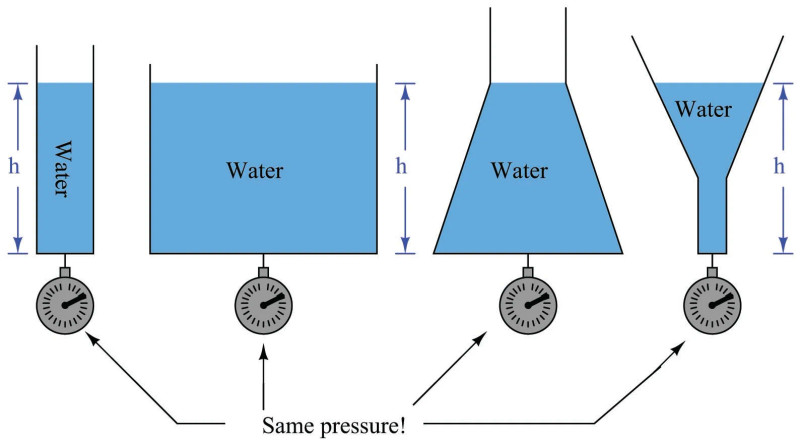
Hydrostatic pressure depends only on vertical depth
Key patterns:
- Pressure increases linearly with depth.
- Double the depth → double the gauge pressure.
- Same depth in different-shaped containers → same pressure.
- Depends on density, not total volume.
Students often think a wider tank means more pressure at the bottom. It doesn’t. Only , , and vertical matter.
Absolute Pressure at Depth
You add atmospheric pressure if they ask for absolute pressure.
Force From Fluid Pressure
Once you know pressure at a surface:
At the same depth, a larger area experiences a larger force. That’s why dam walls are thicker at the bottom. Pressure is larger there, and the area of the lower wall is large, so the total force is huge.
