Topic 5.1 Notes – Rotational Kinematics
1. Rotation About an Axis and Rigid Systems
When something rotates about an axis, every point in the object moves in a circle around the same fixed line.
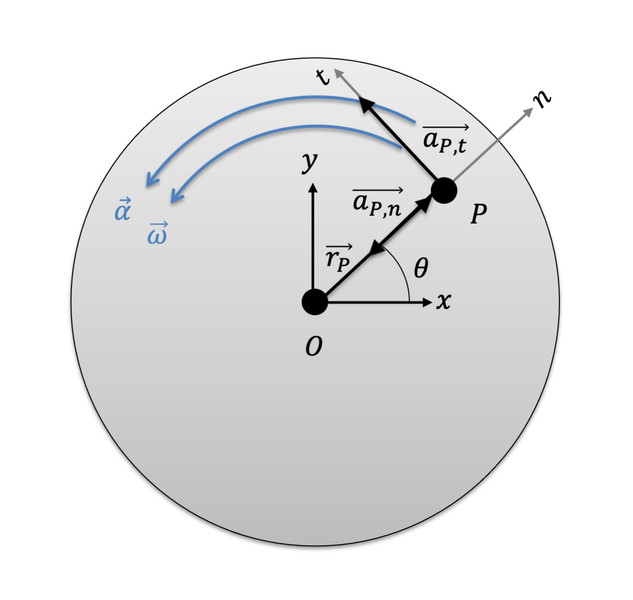
Rigid disk rotating about a fixed axis through O
A rigid system:
- Keeps its shape (distances between points stay constant).
- Has different points moving in different directions at any instant.
- Cannot be treated as a single particle when analyzing rotation.
In the diagram, point P moves in a circular path around O. Its velocity is tangent to the circle, and its acceleration has a component pointing toward the center. Every point on the disk behaves this way, but the farther a point is from the center, the larger its speed.
That last point is big. In linear motion, we often treat an object as a dot. In rotation, points at different radii move differently. The edge of a wheel moves faster than a point near the center.
There are times you can treat a rotating system as one object:
- If you only care about the motion of the center of mass, and the rotation doesn’t affect the situation much.
- Example: When analyzing Earth orbiting the Sun, we ignore Earth’s daily spin.
Direction convention (AP limit)
On the AP exam, direction is limited to:
- Counterclockwise (CCW)
- Clockwise (CW)
You choose one as positive. The other becomes negative. Stay consistent. If you switch signs halfway through a problem, everything falls apart.
2. Angular Displacement, Velocity, and Acceleration
These are the rotational versions of displacement, velocity, and acceleration in 1D motion.
Angular Displacement
Angular displacement is the angle through which something rotates.
- Measured in radians.
- Can be positive or negative.
- Not limited to . If something spins 3 full turns, that’s radians.
A radian is defined by arc length:
If arc length equals radius, that’s 1 radian.
Average Angular Velocity
Angular velocity tells you how fast the angle is changing.
Units: rad/s
If is constant, the object rotates through equal angles in equal time intervals.
Sign matters:
- Positive → rotating in your defined positive direction.
- Negative → rotating the other way.
Average Angular Acceleration
Angular acceleration tells you how fast angular velocity changes.
Units: rad/s²
The sign logic trips people up. Think carefully:
- and same sign → speeding up.
- Opposite signs → slowing down.
If a wheel spins CCW (positive ω) and α is negative, it’s slowing down.
3. Constant Angular Acceleration Equations
If angular acceleration is constant, the equations are structurally identical to linear kinematics.
Just swap:
Quick example:
A disk starts from rest () and has for 4 s.
Same math you’ve done all year.
4. Angular vs Linear Motion Connections
Even though we describe rotation with angles, each point also has linear motion.
For a point distance from the axis:
Important ideas:
- All points share the same .
- Points farther from the axis move faster linearly.
- Radians are dimensionless, so units work out cleanly.
If two points are at different radii:
- Same ω.
- Different linear speeds.
That shows up often in conceptual multiple-choice questions.
5. Graphs of Angular Motion
These graphs behave exactly like 1D motion graphs. If you understand position, velocity, and acceleration vs time, you already understand these.
vs
- Slope =
vs
- Slope =
- Area under curve =
vs
- Area under curve =
In the example below, the acceleration is constant and positive. That makes the vs graph a straight line with positive slope, and the vs graph curves upward because the slope is increasing over time.
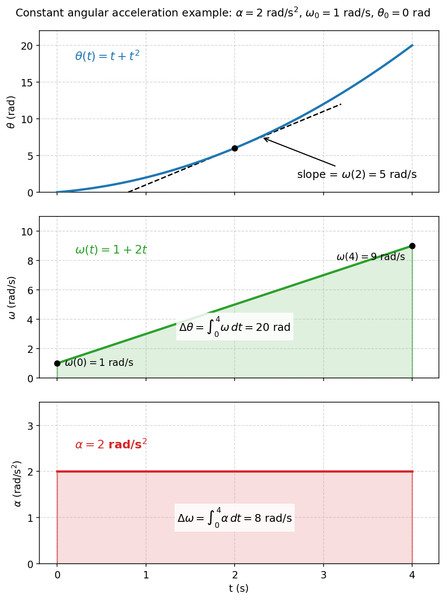
The shaded area under the vs graph represents the change in angle . The shaded area under the vs graph represents the change in angular velocity .
When you see a graph question, think slope gives rate, area gives accumulated change. Same logic as linear motion.
