Topic 5.4 Notes – Rotational Inertia
1. What Rotational Inertia Is
Rotational inertia (I) measures how much an object resists changes in its rotation.
If two objects experience the same net torque:
- The object with larger has smaller angular acceleration.
- This connects directly to .
What Determines Rotational Inertia?
Two factors:
- Total mass
More mass usually means more inertia. - Distribution of mass relative to the axis
Mass farther from the axis increases more strongly because of the dependence.
The units are .
Most important idea:
Rotational inertia depends heavily on how far the mass is from the axis.
Why Distance Matters So Much
The dependence is quadratic. If you double the distance from the axis, the contribution becomes four times larger.
That’s why a hoop and a solid disk with the same mass and radius behave differently.
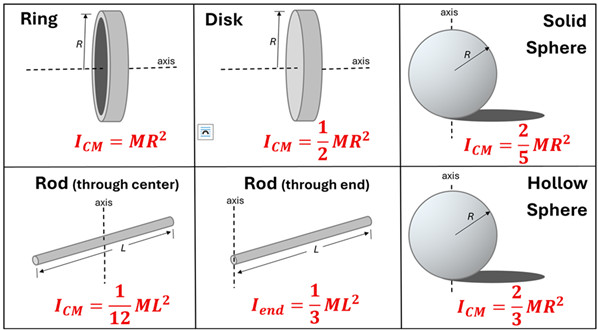
Rotational inertia of common shapes about their center of mass
Focus on the ring and disk at the top. The hoop has more mass at larger radius, so it has greater rotational inertia than the solid disk.
Other qualitative comparisons you should know:
- Pulling mass inward (like a figure skater) → smaller
- If a mass lies directly on the axis → contributes zero
- For a given orientation, rotational inertia is minimum about an axis through the center of mass
Also remember:
Rotational inertia is always defined about a specific axis. Change the axis, change .
2. Calculating Rotational Inertia for Point Mass Systems
In AP Physics 1, you calculate for systems of five or fewer point masses arranged in 2D. For extended objects, the value of will be given.
Single Object About an Axis
The basic formula is:
- = mass
- = perpendicular distance to the axis
That word perpendicular matters. If the axis is vertical, you measure horizontal distance.
If , then .
Multiple Objects
You add the contributions:
A clean way to handle problems:
- Identify the axis clearly.
- For each mass:
- Find perpendicular distance .
- Compute .
- Add them.
Example:
Three point masses lie on a horizontal line. The axis is vertical through the center mass.
- 2 kg at 0.5 m
- 3 kg at 0 m
- 1 kg at 0.5 m
Notice how the 3 kg mass contributes nothing.
On tests, they love moving the axis and asking how changes. Even small shifts can change the answer a lot because of the square.
3. Rotational Inertia and the Center of Mass
For a rigid object in a plane:
- is minimum when the axis passes through the center of mass.
- Any parallel axis away from the CM gives a larger .
The diagram below shows a uniform rod with one axis through its center of mass and another parallel axis shifted to the right by .
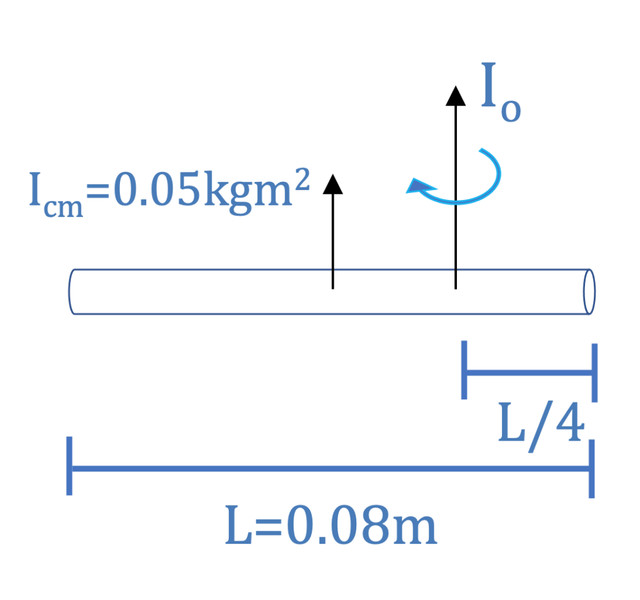
Uniform rod with center-of-mass axis and shifted parallel axis
Physically, when you shift the axis away from the CM, every bit of mass is farther on average from the axis. Since , the increase is noticeable.
That’s why objects spin most “easily” about their center of mass.
4. The Parallel Axis Theorem
When you know inertia about the center of mass and need it about a parallel axis, use:
- = inertia about new axis
- = inertia about CM axis
- = total mass
- = distance between axes
Conceptually:
- is the minimum value.
- is the added rotational inertia from shifting the whole mass.
Because , moving away from the CM always increases .
Use this only when:
- The axes are parallel
- You are given
If you’re just adding point masses, stick with .
5. Big Picture Connections
Rotational inertia shows up in:
- Angular momentum
If no external torque acts and decreases, must increase to keep angular momentum constant. That’s why pulling mass inward speeds up rotation.
This is a favorite conceptual explanation question. You should be able to say:
“When the mass moves closer to the axis, decreases. Since angular momentum is conserved, angular speed increases.”
