Topic 2.5 Notes – Newton’s Second Law
1. When Velocity Changes
A system’s velocity changes only if it accelerates. That means either:
- Its speed changes, or
- Its direction changes, or both.
Acceleration does not just mean “speeding up.” Turning in a circle at constant speed is still accelerating because the direction changes.
So what causes acceleration?
It only happens when the net external force is not zero.
If
- Acceleration
- Velocity is constant (could be zero or nonzero)
- This is Newton’s First Law behavior
Constant velocity includes:
- Sitting still on a table
- Moving in a straight line at steady speed
If
- The system accelerates
- Velocity changes over time
- The acceleration points in the same direction as the net force
That last point is huge. Acceleration always points in the direction of the net force, not necessarily the direction of motion.
2. Balanced vs. Unbalanced Forces
Everything comes down to whether forces cancel.
Balanced Forces
Balanced forces mean the vector sum is zero.
Examples:
- A lamp hanging from the ceiling
- Tension up = weight down
- A hockey puck gliding at constant speed on very smooth ice
The object can be:
- At rest
- Moving at constant velocity
In both cases, acceleration is zero.
Here’s what that looks like conceptually for an object at rest on a surface:
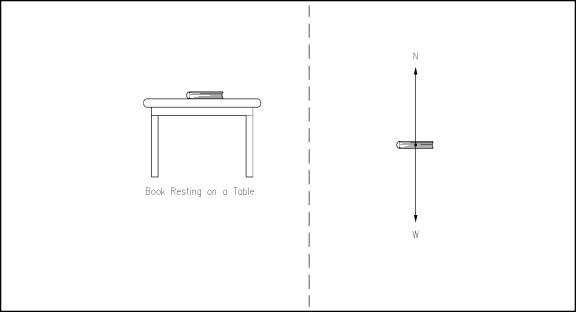
Book at rest with balanced normal force and weight
Unbalanced Forces
Unbalanced forces mean:
- Forces don’t cancel
- There is a nonzero net force
- The object accelerates
If 12 N acts right and 5 N acts left, the net force is 7 N right. The acceleration is also to the right.
On AP questions, students often list all the forces correctly but forget to combine them as vectors. The only force that matters for motion is the net force.
3. Net External Force and the System
The word external matters.
When you define a system, only forces coming from outside that system can change its center-of-mass motion.
External Forces
Examples:
- Gravity from Earth
- Normal force from a surface
- Friction
- Tension from a rope
- A push or pull
These can change the system’s velocity.
Internal Forces
Forces between parts inside the system.
If you choose a system of two interacting objects:
- The forces they exert on each other are internal.
- Internal forces cannot change the velocity of the system’s center of mass.
This shows up on FRQs where you must explain why the center of mass speeds up or doesn’t. The correct reasoning always refers to net external force.
The rule to remember:
The velocity of a system’s center of mass changes only if there is a nonzero net external force on the system.
4. Newton’s Second Law
The mathematical relationship is:
Or equivalently,
Where:
- = acceleration of the center of mass
- = net external force
- = total mass
What this tells you
- If net force doubles → acceleration doubles.
- If mass doubles → acceleration is cut in half.
- Acceleration direction matches net force direction.
Mass measures inertia, which is resistance to acceleration.
Quick example:
A 4 kg cart experiences a 20 N net force.
If the same 20 N acts on an 8 kg cart:
Same force. Larger mass. Smaller acceleration.
5. Applying Newton’s Second Law
When solving problems, everything flows from forces.
- Define the system.
- Draw a free-body diagram with all external forces.
- Choose coordinate axes.
- Add forces as vectors to find .
- Apply along each axis.
In many AP questions, the hardest part is not the algebra. It’s correctly identifying which forces act and which direction they point.
Remember: forces cause acceleration. Acceleration changes velocity. That chain of reasoning is what graders look for in written explanations.
