AP®︎ Physics 1: Topic 2.1 Practice Test
Prepare for your quiz, test, or the AP exam with focused practice questions on Topic 2.1 of AP Physics 1 – Systems and Center of Mass.
Questions List
Topic 2.1
Question 1 Easy
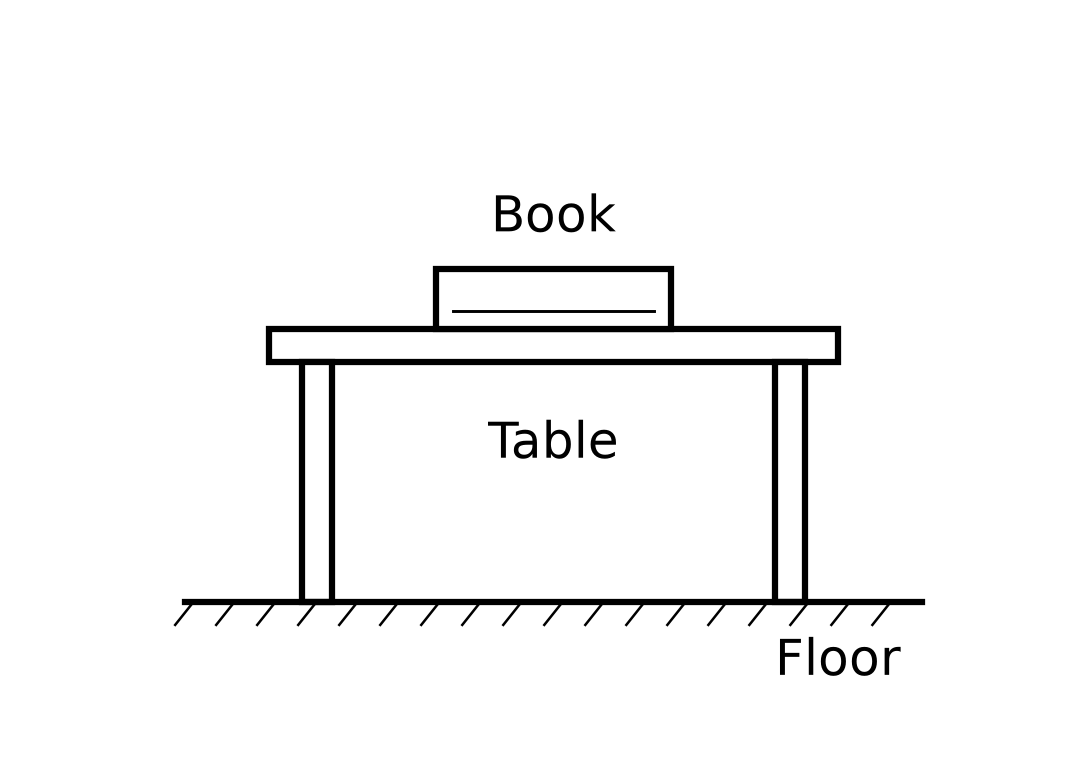
Which of the following lists all the interactions that are external to the system?
What You’re Being Tested On:
Explore the learning objectives taken directly from the College Board’s AP® Physics 1 Curriculum. Ensure you’re prepared for the exact topics covered on the AP® exam, in-class tests, and quizzes, and gain confidence in your mastery of the material.

Topic 2.1: Systems and Center of Mass
Boundary Statements official exam scope notes
- AP Physics 1 only expects students to calculate the center of mass for systems of five or fewer particles arranged in a two-dimensional configuration or for systems that are highly symmetrical.
Learning Objective: 2.1.A
Describe the properties and interactions of a system.
Essential Knowledge: 2.1.A.1
System properties are determined by the interactions between objects within the system.
Essential Knowledge: 2.1.A.2
If the properties or interactions of the constituent objects within a system are not important in modeling the behavior of the macroscopic system, the system can itself be treated as a single object.
Essential Knowledge: 2.1.A.3
Systems may allow interactions between constituent parts of the system and the environment, which may result in the transfer of energy or mass.
Essential Knowledge: 2.1.A.4
Individual objects within a chosen system may behave differently from each other as well as from the system as a whole.
Essential Knowledge: 2.1.A.5
The internal structure of a system affects the analysis of that system.
Essential Knowledge: 2.1.A.6
As variables external to a system are changed, the system’s substructure may change.
Learning Objective: 2.1.B
Describe the location of a system’s center of mass with respect to the system’s constituent parts.
Essential Knowledge: 2.1.B.1
For systems with symmetrical mass distributions, the center of mass is located on lines of symmetry.
Essential Knowledge: 2.1.B.2
The location of a system’s center of mass along a given axis can be calculated using the equation
Essential Knowledge: 2.1.B.3
A system can be modeled as a singular object that is located at the system’s center of mass.
