AP®︎ Physics 1: Topic 5.5 Practice Test
Prepare for your quiz, test, or the AP exam with focused practice questions on Topic 5.5 of AP Physics 1 – Rotational Equilibrium and Newton’s First Law in Rotational Form.
Questions List
Topic 5.5
Question 1 Easy
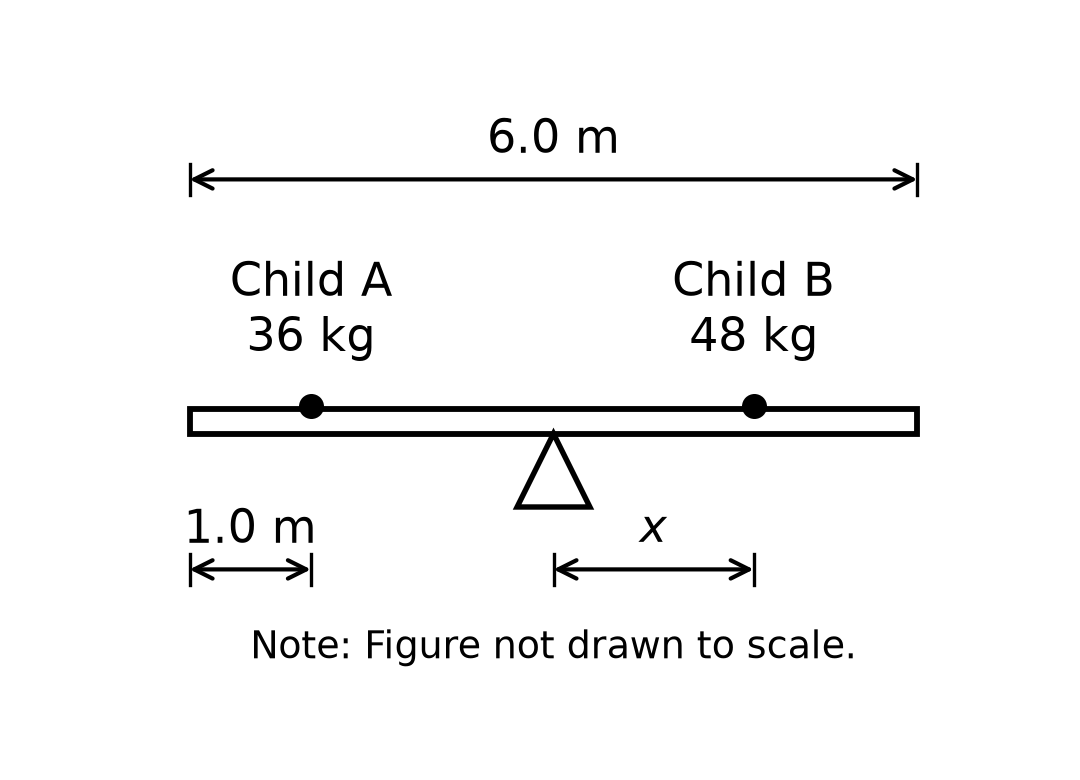
How far from the pivot must Child B sit for the seesaw to balance, most nearly?
What You’re Being Tested On:
Explore the learning objectives taken directly from the College Board’s AP® Physics 1 Curriculum. Ensure you’re prepared for the exact topics covered on the AP® exam, in-class tests, and quizzes, and gain confidence in your mastery of the material.

Topic 5.5: Rotational Equilibrium and Newton’s First Law in Rotational Form
Boundary Statements official exam scope notes
- AP Physics 1 does not expect students to simultaneously analyze rotation in multiple planes.
Learning Objective: 5.5.A
Describe the conditions under which a system’s angular velocity remains constant.
Essential Knowledge: 5.5.A.1
A system may exhibit rotational equilibrium (constant angular velocity) without being in translational equilibrium, and vice versa.
Essential Knowledge: 5.5.A.1.i
Free-body and force diagrams describe the nature of the forces and torques exerted on an object or rigid system.
Essential Knowledge: 5.5.A.1.ii
Rotational equilibrium is a configuration of torques such that the net torque exerted on the system is zero. Relevant equation:
Essential Knowledge: 5.5.A.1.iii
The rotational analog of Newton’s first law is that a system will have a constant angular velocity only if the net torque exerted on the system is zero.
Essential Knowledge: 5.5.A.2
A rotational corollary to Newton’s second law states that if the torques exerted on a rigid system are not balanced, the system’s angular velocity must be changing.
