AP®︎ Physics 1: Topic 4.3 Practice Test
Prepare for your quiz, test, or the AP exam with focused practice questions on Topic 4.3 of AP Physics 1 – Conservation of Linear Momentum.
Questions List
Topic 4.3
Question 1 Easy
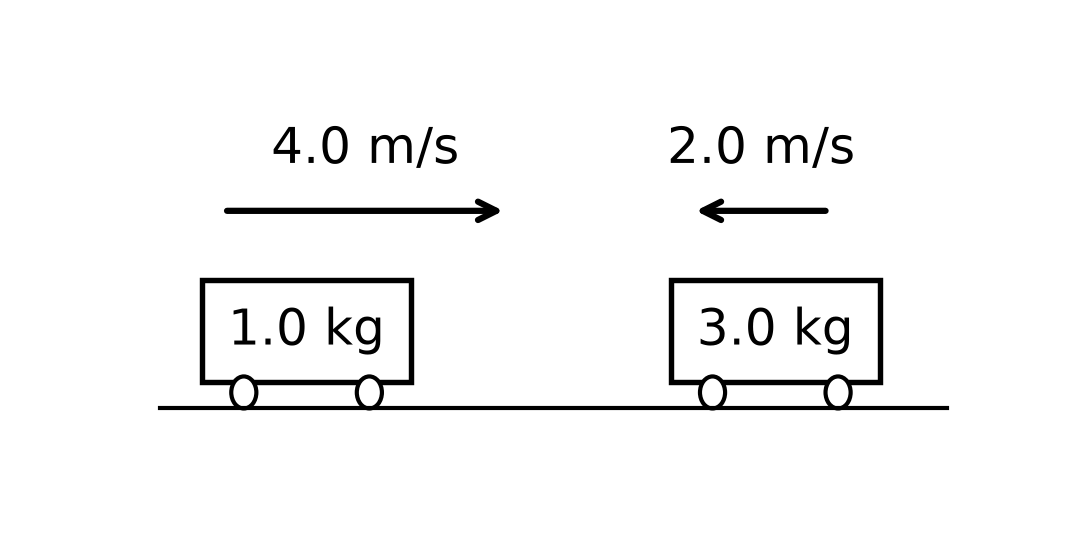
The total momentum of the two-cart system is most nearly
What You’re Being Tested On:
Explore the learning objectives taken directly from the College Board’s AP® Physics 1 Curriculum. Ensure you’re prepared for the exact topics covered on the AP® exam, in-class tests, and quizzes, and gain confidence in your mastery of the material.

Topic 4.3: Conservation of Linear Momentum
Boundary Statements official exam scope notes
- AP Physics 1 includes a quantitative and qualitative treatment of conservation of momentum in one dimension and a semiquantitative treatment of conservation of momentum in two dimensions. Exam questions involving solution of simultaneous equations are not included in AP Physics 1, but the AP Physics 1 Exam may include questions that assess whether students can set up the equations properly and reason about how changing a given mass, speed, or angle would affect other quantities. AP Physics 2 includes a full treatment of conservation of momentum in two dimensions for problems that include one unknown final velocity.
Learning Objective: 4.3.A
Describe the behavior of a system using conservation of linear momentum.
Essential Knowledge: 4.3.A.1
A collection of objects with individual momenta can be described as one system with one center-of-mass velocity.
Essential Knowledge: 4.3.A.1.i
For a collection of objects, the velocity of a system’s center of mass can be calculated using the equation .
Essential Knowledge: 4.3.A.1.ii
The velocity of a system’s center of mass is constant in the absence of a net external force.
Essential Knowledge: 4.3.A.2
The total momentum of a system is the sum of the momenta of the system’s constituent parts.
Essential Knowledge: 4.3.A.3
In the absence of net external forces, any change to the momentum of an object within a system must be balanced by an equivalent and opposite change of momentum elsewhere within the system. Any change to the momentum of a system is due to a transfer of momentum between the system and its surroundings.
Essential Knowledge: 4.3.A.3.i
The impulse exerted by one object on a second object is equal and opposite to the impulse exerted by the second object on the first. This is a direct result of Newton’s third law.
Essential Knowledge: 4.3.A.3.ii
A system may be selected so that the total momentum of that system is constant.
Essential Knowledge: 4.3.A.3.iii
If the total momentum of a system changes, that change will be equivalent to the impulse exerted on the system. Relevant equation:
Essential Knowledge: 4.3.A.4
Correct application of conservation of momentum can be used to determine the velocity of a system immediately before and immediately after collisions or explosions.
Learning Objective: 4.3.B
Describe how the selection of a system determines whether the momentum of that system changes.
Essential Knowledge: 4.3.B.1
Momentum is conserved in all interactions.
Essential Knowledge: 4.3.B.2
If the net external force on the selected system is zero, the total momentum of the system is constant.
Essential Knowledge: 4.3.B.3
If the net external force on the selected system is nonzero, momentum is transferred between the system and the environment.
