AP®︎ Physics 1: Unit 8 Practice Test
Prepare for your quiz, test, or the AP exam with focused practice questions on Unit 8 of AP Physics 1 – Fluids.
Questions List
Unit 8 (All Topics)
Question 1 Topic 8.1Easy
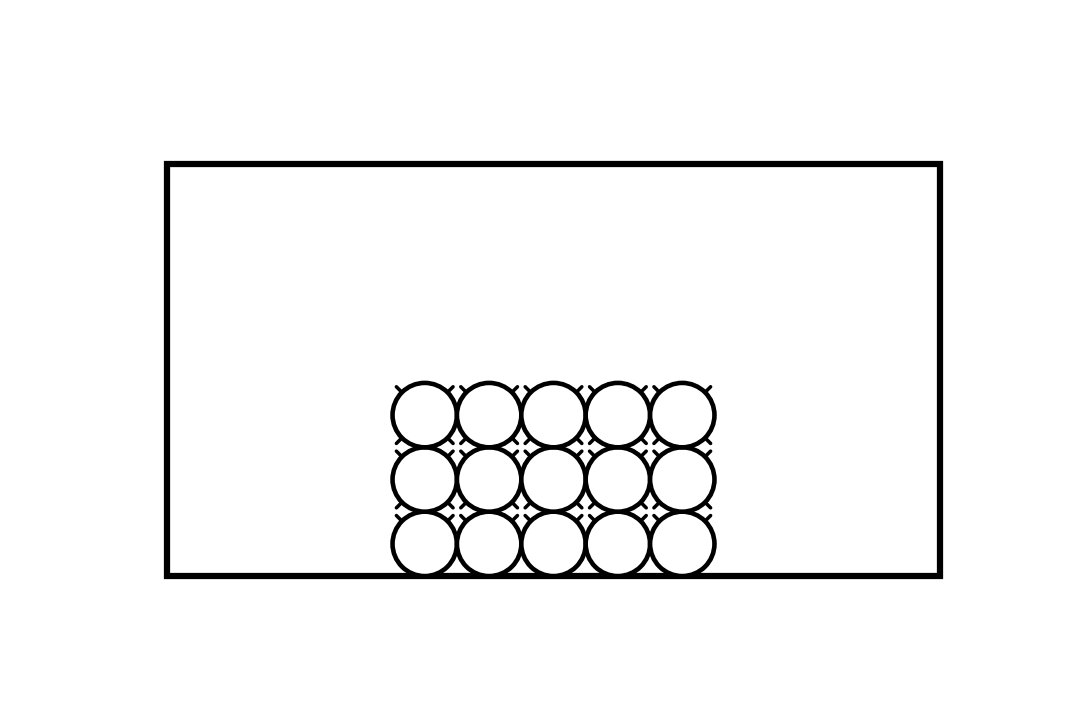
Which state of matter could the diagram represent, and why?
What You’re Being Tested On:
Explore the learning objectives taken directly from the College Board’s AP® Physics 1 Curriculum. Ensure you’re prepared for the exact topics covered on the AP® exam, in-class tests, and quizzes, and gain confidence in your mastery of the material.
Unit 8: Fluids
How pressure, density, and buoyancy govern the behavior of liquids and gases at rest and in motion.

Topic 8.1: Internal Structure and Density
Learning Objective: 8.1.A
Describe the properties of a fluid.
Essential Knowledge: 8.1.A.1
Distinguishing properties of solids, liquids, and gases stem from the varying interactions between atoms and molecules.
Essential Knowledge: 8.1.A.2
A fluid is a substance that has no fixed shape.
Essential Knowledge: 8.1.A.3
Fluids can be characterized by their density. Density is defined as a ratio of mass to volume. Relevant equation:
Essential Knowledge: 8.1.A.4
An ideal fluid is incompressible and has no viscosity.
Topic 8.2: Pressure
Learning Objective: 8.2.A
Describe the pressure exerted on a surface by a given force.
Essential Knowledge: 8.2.A.1
Pressure is defined as the magnitude of the perpendicular force component exerted per unit area over a given surface area, as described by the equation .
Essential Knowledge: 8.2.A.2
Pressure is a scalar quantity.
Essential Knowledge: 8.2.A.3
The volume and density of a given amount of an incompressible fluid is constant regardless of the pressure exerted on that fluid.
Learning Objective: 8.2.B
Describe the pressure exerted by a fluid.
Essential Knowledge: 8.2.B.1
The pressure exerted by a fluid is the result of the entirety of the interactions between the fluid’s constituent particles and the surface with which those particles interact.
Essential Knowledge: 8.2.B.2
The absolute pressure of a fluid at a given point is equal to the sum of a reference pressure , such as the atmospheric pressure , and the gauge pressure . Relevant equation:
Essential Knowledge: 8.2.B.3
The gauge pressure of a vertical column of fluid is described by the equation .
Topic 8.3: Fluids and Newton's Laws
Learning Objective: 8.3.A
Describe the conditions under which a fluid's velocity changes.
Essential Knowledge: 8.3.A.1
Newton's laws can be used to describe the motion of particles within a fluid.
Essential Knowledge: 8.3.A.2
The macroscopic behavior of a fluid is a result of the internal interactions between the fluid's constituent particles and external forces exerted on the fluid.
Learning Objective: 8.3.B
Describe the buoyant force exerted on an object interacting with a fluid.
Essential Knowledge: 8.3.B.1
The buoyant force is a net upward force exerted on an object by a fluid.
Essential Knowledge: 8.3.B.2
The buoyant force exerted on an object by a fluid is a result of the collective forces exerted on the object by the particles making up the fluid.
Essential Knowledge: 8.3.B.3
The magnitude of the buoyant force exerted on an object by a fluid is equivalent to the weight of the fluid displaced by the object. Relevant equation:
Topic 8.4: Fluids and Conservation Laws
Boundary Statements official exam scope notes
- All fluids will be assumed to be ideal, and all pipes are assumed to be completely filled by the fluid, unless otherwise stated.
Learning Objective: 8.4.A
Describe the flow of an incompressible fluid through a cross-sectional area by using mass conservation.
Essential Knowledge: 8.4.A.1
A difference in pressure between two locations causes a fluid to flow.
Essential Knowledge: 8.4.A.1.i
The rate at which matter enters a fluid-filled tube open at both ends must equal the rate at which matter exits the tube.
Essential Knowledge: 8.4.A.1.ii
The rate at which matter flows into a location is proportional to the cross-sectional area of the flow and the speed at which the fluid flows. Derived equation:
Essential Knowledge: 8.4.A.2
The continuity equation for fluid flow describes conservation of mass flow rate in incompressible fluids. Relevant equation:
Learning Objective: 8.4.B
Describe the flow of a fluid as a result of a difference in energy between two locations within the fluid–Earth system.
Essential Knowledge: 8.4.B.1
A difference in gravitational potential energies between two locations in a fluid will result in a difference in kinetic energy and pressure between those two locations that is described by conservation laws.
Essential Knowledge: 8.4.B.2
Bernoulli’s equation describes the conservation of mechanical energy in fluid flow. Relevant equation:
Essential Knowledge: 8.4.B.3
Torricelli’s theorem relates the speed of a fluid exiting an opening to the difference in height between the opening and the top surface of the fluid and can be derived from conservation of energy principles. Derived equation:
