Topic 1.1 Notes – Understanding Social Engineering
What Social Engineering Is
Social engineering targets human behavior. The attacker is trying to manipulate you, not just break software.
A social engineering attack might try to get someone to:
- reveal sensitive personal information such as a birthdate or address
- reveal authentication information such as an OTP (one-time password)
- click a malicious link
- download a malicious file
Elicitation means manipulating someone into giving up information. That request may sound normal, like “verify your identity” or “confirm your account.”
It can happen:
- in person
- by email
- by text
- through social media messages
Message-based social engineering is often called phishing.
Here is a typical phishing email. The warning signs matter more than the brand name. Focus on the generic greeting, the suspicious sender address, and the link destination.
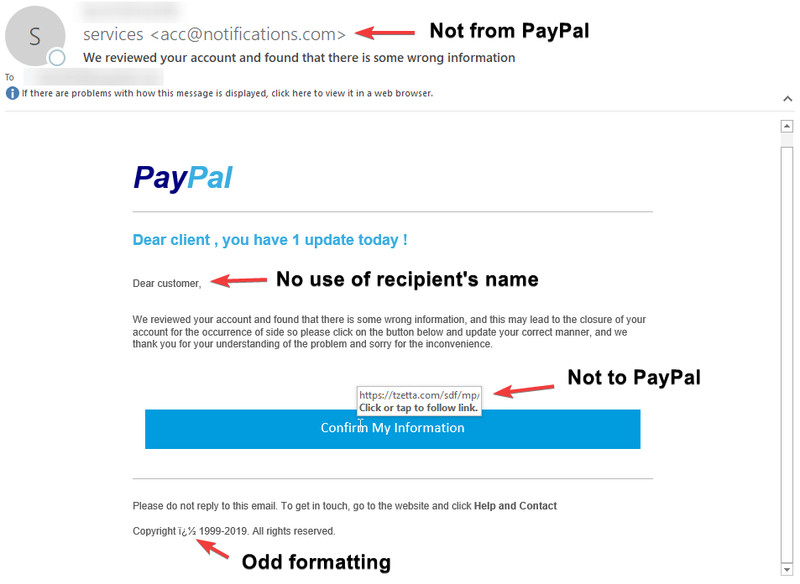
Phishing email with common warning signs
One easy-to-miss point on tests is this. A message can be social engineering even if it has no malware at all. If the attacker gets your password, your OTP, or your personal info, the attack already worked.
The Main Indicators of Social Engineering
When you analyze a message, look for four parts together.
- Pretext = the claimed situation
- Intimidation = the threat
- Urgency = the time pressure
- Requested action = what the attacker wants done
Pretext
The pretext is the story that makes the request sound reasonable.
Common examples:
- “Suspicious activity on your account”
- “Your employer needs verification”
- “There is a payment problem”
Intimidation
Intimidation threatens a negative consequence if the target does not comply.
Common signs:
- account will be disabled
- service will be canceled
- legal or financial trouble
- workplace discipline
This can still be intimidation even if the wording sounds polite. “Please verify to avoid permanent account closure” is still a threat.
Urgency
Urgency pushes the target to act quickly.
Common signs:
- “Act now”
- short deadline
- “Do not delay”
- “The issue will get worse if you wait”
- “Don’t go through normal approval”
A good distinction to memorize is this:
- deadline = urgency
- threatened consequence = intimidation
Requested action
The requested action is the attacker’s goal.
Usually it is to make the victim:
- enter information
- share a code
- click a link
- open or download a file
How Social Engineering Works on People
The structure is pretty consistent:
- The adversary contacts the target.
- They give a believable pretext.
- They add intimidation, urgency, or both.
- They demand a specific action.
- If the target complies, an asset is exposed.
Why does this work? People react fast to fear and apparent emergencies. That pressure can stop someone from checking the sender, contacting the real organization another way, or slowing down enough to think.
The test habit that helps most is to break a scenario into this chain:
psychological tactic → influenced behavior → exposed asset → possible impact
What Victims Can Expose and Why It Matters
| What gets exposed | Example | Why it matters |
|---|---|---|
| Personal information | name, phone, address, workplace, pets’ names, birthdate | can support impersonation and help answer identity challenge questions |
| OTP or login code | six-digit text code | can let an attacker log in as the victim in real time |
| Malicious file | “form,” “update,” “diagnostic” | may install malware |
| Malicious link | fake sign-in page or harmful site | may install malware, steal browser data, or capture credentials |
A big exam trap is the fake login page detail. The page captures credentials only if the victim enters and submits them.
Analyzing a Social Engineering Message
Take this example:
“Your work account has been flagged for a policy violation. It will be disabled in ten minutes unless you verify it. Sign in, enter the code sent to your phone, and download the diagnostic.”
In one short message, the attacker stacks several tactics at once.
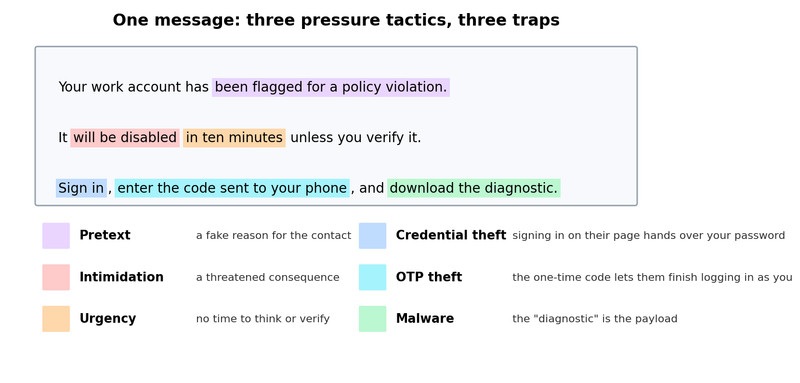
Annotated social-engineering message
Breakdown:
- “flagged for a policy violation” = pretext
- “will be disabled” = intimidation
- “in ten minutes” = urgency
- “sign in” = possible credential theft
- “enter the code” = possible OTP theft
- “download the diagnostic” = possible malware
If this is a work or school account, the damage can spread beyond one person to the whole organization.
Key Takeaways
Social Engineering
Using psychological tactics to manipulate a person into taking an action that benefits an adversary
Elicitation
Manipulating a person into disclosing information, directly or through a disguised request
Phishing
Message-based social engineering, commonly conducted through email, text, or social media
Intimidation
Threatening a target with negative consequences for failing to comply, using fear to encourage action
Urgency
Creating a reason for a target to act quickly, using time pressure to discourage careful evaluation
Pretext
The claimed situation that supposedly explains why the target must take an action
One-Time Password (OTP)
A code intended for one authentication attempt that an adversary can use while valid to log in as the victim
Malicious File
A file presented as useful or legitimate that may install malware when downloaded or opened
Malicious Link
A link whose destination may install malware, steal browser information, or capture credentials submitted to a fraudulent page
Notes
Social Engineering
Using psychological tactics to manipulate a person into taking an action that benefits an adversary
Elicitation
Manipulating a person into disclosing information, directly or through a disguised request
Phishing
Message-based social engineering, commonly conducted through email, text, or social media
Intimidation
Threatening a target with negative consequences for failing to comply, using fear to encourage action
Urgency
Creating a reason for a target to act quickly, using time pressure to discourage careful evaluation
Pretext
The claimed situation that supposedly explains why the target must take an action
One-Time Password (OTP)
A code intended for one authentication attempt that an adversary can use while valid to log in as the victim
Malicious File
A file presented as useful or legitimate that may install malware when downloaded or opened
Malicious Link
A link whose destination may install malware, steal browser information, or capture credentials submitted to a fraudulent page
