Topic 5.4 Notes – Asymmetric Cryptography
What Asymmetric Cryptography Is
A quick refresher helps here. Plaintext is readable data. Ciphertext is encrypted data. Encryption turns plaintext into ciphertext, and decryption turns it back. A key is the binary value the algorithm uses to do that work.
With asymmetric cryptography, each receiver creates a key pair:
- Public key
- Shared openly
- Anyone can use it
- Private key
- Kept secret
- Stored securely by its owner
These keys are mathematically related. In AP Cybersecurity terms, they are inverses of each other. If one key does the first operation, only the matching partner key can reverse it.
That solves the big problem from symmetric encryption. You do not need to secretly share one key ahead of time.
The basic flow is straightforward. A sender uses the receiver's public key to encrypt plaintext, and the receiver uses the matching private key to decrypt it.
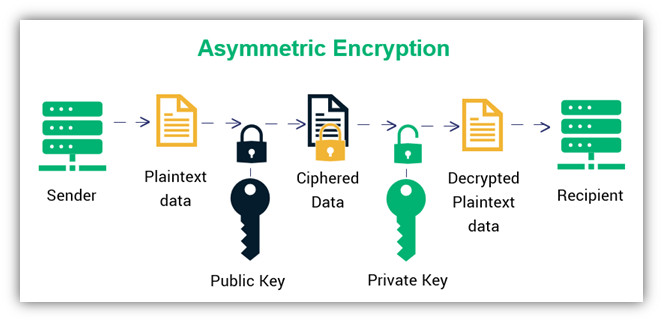
Asymmetric encryption process
The rule to burn into memory is simple. Public key distributes. Private key stays secret.
The Key Pair Rules
Each entity that wants to receive encrypted data needs its own key pair. So if Dev and Marisol both want two-way confidential communication, each needs a separate pair.
Public and private key handling
- Public key
- Can be published or sent out
- Is not treated as secret
- Private key
- Is never shared with senders
- Is never published
- Is the part security depends on
If the private key is compromised
If the private key is exposed, stolen, corrupted, or lost, that pair is no longer trustworthy.
- Generate a new key pair
- Replace the old public key with the new public key
- Retire the old pair completely
A common test trap is thinking new keys fix old damage. They only protect future communication. Data exposed through the old private key stays exposed.
Which Key to Use for Confidentiality
For confidentiality, the direction matters more than anything else.
Correct direction
- Receiver generates a key pair.
- Receiver publishes the public key.
- Sender gets the receiver’s public key.
- Sender encrypts the message.
- Receiver decrypts with the matching private key.
So the test rule is:
- Encrypt with the receiver’s public key
- Decrypt with the receiver’s private key
Two-way communication
- Marisol sends to Dev
→ encrypt with Dev’s public key
→ decrypt with Dev’s private key - Dev sends to Marisol
→ encrypt with Marisol’s public key
→ decrypt with Marisol’s private key
Common mistakes to avoid
- Using the sender’s public key
- Saying “use the public key” without naming whose
- Sharing the private key with the sender
- Encrypting with the private key for confidentiality
That last one connects to digital signatures, which are about proving origin/integrity, not secrecy.
Public key authenticity
A public key must actually belong to the claimed person. If an attacker swaps in their own public key, they can read data meant for someone else. Digital certificates help tie identity to a public key. Detailed PKI stuff is outside this topic’s depth.
Key Length, Keyspace, and Security
For an n-bit key,
Average random guesses needed:
Every extra bit doubles the keyspace, which makes brute-force guessing much harder.
- Longer keys → more security
- Longer keys → more computation and slower processing
Only compare key lengths within the same algorithm:
- AES-256 is stronger than AES-128
- RSA-4096 is stronger than RSA-2048
Do not compare RSA bit length directly to AES or ECC bit length. That shows up in MCQs a lot.
Common Algorithms and Basic CLI Use
Two common asymmetric algorithms are RSA and ECC. You should recognize them and know they are used for encryption, digital signatures, and digital certificates.
Here’s the basic CLI flow with RSA:
openssl genpkey -algorithm RSA -out receiver_private.pem -pkeyopt rsa_keygen_bits:2048
openssl pkey -in receiver_private.pem -pubout -out receiver_public.pem
openssl pkeyutl -encrypt -pubin -inkey receiver_public.pem -in message.txt -out message.enc
openssl pkeyutl -decrypt -inkey receiver_private.pem -in message.enc -out recovered.txt
This matches the same rule the course keeps testing. The receiver’s public key encrypts. The receiver’s private key decrypts.
In real systems, asymmetric crypto is heavier than symmetric crypto, so they’re often used together. For this topic, you mainly need the key-direction rule.
Key Takeaways
Asymmetric Cryptography
Cryptography that uses mathematically related public and private keys, allowing secure communication without a prearranged shared secret
Asymmetric Key Pair
Two equal-length binary keys generated together as mathematical inverses, with either key’s operation reversible only by its partner
Public Key
The published member of a key pair; a sender uses the intended receiver’s public key to encrypt confidential data
Private Key
The secret member of a key pair; its owner securely stores it and uses it to decrypt data encrypted with the matching public key
Private-Key Compromise
Exposure, theft, sharing, corruption, or loss of a private key requiring the old key pair to be retired and replaced
Key Length
The number of bits in a key; within the same algorithm, longer keys generally improve security but require more processing
Binary Keyspace Formula
An n-bit binary key has 2^n possible values, and each additional bit doubles the keyspace
Average Random Key-Guessing Effort
An n-bit key requires 2^n / 2 = 2^(n−1) guesses on average when keys are tried without repetition
Key-Length Comparison
Key lengths can be directly compared only within the same cryptographic algorithm, not across algorithms such as RSA and AES.
RSA
A common asymmetric algorithm based on mathematical relationships involving large numbers, used for encryption, signatures, and certificates
Elliptic Curve Cryptography (ECC)
Asymmetric cryptography based on mathematical relationships involving elliptic curves, supporting key pairs, signatures, and certificates
Digital Signature
An asymmetric application in which the owner uses a private key and others use the matching public key to verify origin and integrity
Digital Certificate
An asymmetric-cryptography application that associates an identity with a public key
Asymmetric Encryption Workflow
The receiver generates a key pair, protects the private key, and publishes the public key; the sender encrypts with the receiver’s public key, and the receiver decrypts with the matching private key
Notes
Asymmetric Cryptography
Cryptography that uses mathematically related public and private keys, allowing secure communication without a prearranged shared secret
Asymmetric Key Pair
Two equal-length binary keys generated together as mathematical inverses, with either key’s operation reversible only by its partner
Public Key
The published member of a key pair; a sender uses the intended receiver’s public key to encrypt confidential data
Private Key
The secret member of a key pair; its owner securely stores it and uses it to decrypt data encrypted with the matching public key
Private-Key Compromise
Exposure, theft, sharing, corruption, or loss of a private key requiring the old key pair to be retired and replaced
Key Length
The number of bits in a key; within the same algorithm, longer keys generally improve security but require more processing
Binary Keyspace Formula
An n-bit binary key has 2^n possible values, and each additional bit doubles the keyspace
Average Random Key-Guessing Effort
An n-bit key requires 2^n / 2 = 2^(n−1) guesses on average when keys are tried without repetition
Key-Length Comparison
Key lengths can be directly compared only within the same cryptographic algorithm, not across algorithms such as RSA and AES.
RSA
A common asymmetric algorithm based on mathematical relationships involving large numbers, used for encryption, signatures, and certificates
Elliptic Curve Cryptography (ECC)
Asymmetric cryptography based on mathematical relationships involving elliptic curves, supporting key pairs, signatures, and certificates
Digital Signature
An asymmetric application in which the owner uses a private key and others use the matching public key to verify origin and integrity
Digital Certificate
An asymmetric-cryptography application that associates an identity with a public key
Asymmetric Encryption Workflow
The receiver generates a key pair, protects the private key, and publishes the public key; the sender encrypts with the receiver’s public key, and the receiver decrypts with the matching private key
