Topic 1.4 Notes – AI-Based Cybersecurity Attacks
What AI-Augmented Cyberattacks Are
In this topic, AI is an attack amplifier. It usually does not invent a brand-new kind of attack. It makes an existing attack more convincing, faster, cheaper, or easier to scale.
A quick way to read any example is this:
- Objective: What does the adversary want?
- AI use: How is AI helping?
- Weakness: What trust gap or vulnerability is being exploited?
- Impact: What harm could happen?
- Mitigation: What defense fits best?
One reminder that shows up all over this topic: trust signals are not proof. A familiar voice, a realistic face, perfect grammar, or a confident chatbot answer can all be fake.
Main Ways Adversaries Use AI
There are six big uses you need to recognize:
- Synthetic impersonation means fake voice, image, or video made from real samples.
- AI-generated phishing means AI writes or improves the scam message.
- Prompt-based extraction means prompts are used to pull sensitive info from an LLM.
- False training information means bad public info is planted so future models may repeat it.
- AI-powered reconnaissance means AI gathers and connects public facts about a target.
- AI-enhanced coding and vulnerability discovery means AI helps write malicious code or find weaknesses.
Synthetic impersonation
AI can clone voices and generate fake images or video from public samples like interviews, livestreams, or social media posts. You’ll hear terms like deepfake and digital avatar.
Common impacts:
- Financial loss from fake urgent payment requests
- Sensitive info disclosure during phone or video scams
- Unauthorized changes to accounts or records
- Reputation damage
- Unauthorized access if a system trusts voice authentication alone
A classic test scenario is a fake executive asking for an urgent wire transfer, like the video-call scam shown here. The attack is still social engineering. AI just makes the impersonation believable.
AI-generated phishing
An LLM can write natural-sounding phishing in any language. That matters because bad grammar used to be a warning sign. Now a phishing email can sound polished and personal.
Keep these separate in your head:
- AI tool writes or improves the message
- Phishing is the social engineering method
- Goal is usually credentials, malware, money, or data
On MCQs, polished writing does not make a message safe.
Prompt-based extraction and false training information
Prompt-based extraction
Adversaries can craft prompts to make an LLM reveal sensitive information. That information may come from:
- User input like prompts, files, transcripts, code, or records
- Training data the model learned from
The main risk is confidentiality loss. Once sensitive data goes into an external AI tool, control over that data may be gone.
False training information
This is about changing what future models may say. The flow below shows how bad information can spread from a public post into model output.
- False information is posted publicly.
- Training data collects it.
- The model learns from it.
- The model repeats it.
- A user trusts the output and makes a bad decision.
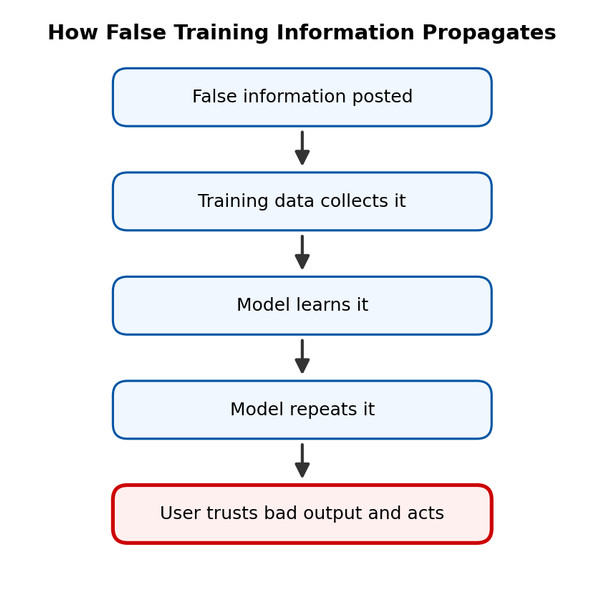
False training information propagation
That is different from extraction.
- Extraction pulls hidden or retained information out
- Training manipulation pushes false information in
AI-powered reconnaissance and coding help
Reconnaissance
Reconnaissance means gathering target information before or during an attack. AI can scan social media, job posts, websites, news, public records, and code repositories, then connect the pieces.
It can build profiles from:
- names and roles
- email patterns
- vendors and technologies
- schedules and projects
- family details
- voice or video samples
The danger is correlation at scale. Separate public facts become one useful target profile.
Coding and vulnerability discovery
AI can help adversaries write malware, modify code for malicious behavior, or search large code bases for weaknesses. It lowers time and skill barriers, even if the output is sometimes wrong.
A common example is AI flagging unsafe user input handling in a web app, which helps an adversary hunt for exploitable vulnerabilities.
How to Protect Against AI-Augmented Attacks
Independent identity checks
A shared secret is a private word or phrase known only to trusted people. If a “relative” or “boss” calls with an emergency request, that secret gives you identity evidence beyond voice or video. It must not be guessable from social media.
MFA matters when voice authentication is targeted. A cloned voice should not satisfy every requirement. The whole point is independent factors, not two versions of the same factor.
Controlling AI input and verifying AI output
Do not put sensitive information into AI tools, including:
- passwords or access tokens
- personal or financial data
- customer records
- private communications
- source code
- internal security details
Important AI output must be checked against reputable, stable, non-AI-based sources like official records, vendor documentation, government publications, or a previously verified communication channel. This matters most when the result affects money, access, privacy, security settings, or sensitive data.
Key Takeaways
Artificial Intelligence (AI)
Tools that perform tasks such as generating language, media, or code; processing information; and finding patterns in large data sets
AI-Augmented Cyberattack
A cyberattack made more convincing, efficient, scalable, or technically capable through the use of AI.
Generative AI
AI that produces new content such as language, images, audio, video, or code
Large Language Model (LLM)
A type of generative AI trained on large collections of text and other data to produce responses to prompts
Prompt
The input or instruction supplied to an AI system
Synthetic Media
AI-generated voice, image, or video that resembles a real person
Digital Avatar
A synthetic representation of a person created from existing samples of the person’s voice or appearance
Deepfake
Realistic synthetic media that makes someone appear to say or do something they did not say or do
Voice Cloning
Using samples of a person’s voice to generate speech that sounds like that person
AI-Generated Phishing
Using generative AI to create polished, localized, or personalized phishing messages at scale
Prompt Injection
A crafted prompt intended to override restrictions or manipulate an AI system’s instructions
Prompt-Based Extraction
Crafting prompts to make an AI system reveal secure or sensitive information from user input or training data
Training-Data Manipulation (Training-Data Poisoning)
Placing false information in potential training sources to influence what a future AI model learns and repeats
Hallucination
An unsupported or fabricated response generated by an AI system, even without deliberate adversarial manipulation
AI-Powered Reconnaissance
Using AI to rapidly collect, connect, and summarize publicly available information about a target
AI-Enhanced Coding Tools
Tools that use AI to generate or modify code, assist malware development, or search large code bases for vulnerabilities
Shared Secret
A private word or phrase known only to trusted parties and used to verify identity in a high-stakes situation
Multifactor Authentication (MFA)
Authentication requiring proof from more than one independent factor category, so imitating one factor alone is insufficient
Keeping Sensitive Data Out of AI-Powered Tools
Do not enter personal, secure, or sensitive information into AI prompts, chats, uploads, or connected files
Independent Verification of AI Output
Check consequential AI claims against reputable, stable, non-AI-based sources before acting on them
Notes
Artificial Intelligence (AI)
Tools that perform tasks such as generating language, media, or code; processing information; and finding patterns in large data sets
AI-Augmented Cyberattack
A cyberattack made more convincing, efficient, scalable, or technically capable through the use of AI.
Generative AI
AI that produces new content such as language, images, audio, video, or code
Large Language Model (LLM)
A type of generative AI trained on large collections of text and other data to produce responses to prompts
Prompt
The input or instruction supplied to an AI system
Synthetic Media
AI-generated voice, image, or video that resembles a real person
Digital Avatar
A synthetic representation of a person created from existing samples of the person’s voice or appearance
Deepfake
Realistic synthetic media that makes someone appear to say or do something they did not say or do
Voice Cloning
Using samples of a person’s voice to generate speech that sounds like that person
AI-Generated Phishing
Using generative AI to create polished, localized, or personalized phishing messages at scale
Prompt Injection
A crafted prompt intended to override restrictions or manipulate an AI system’s instructions
Prompt-Based Extraction
Crafting prompts to make an AI system reveal secure or sensitive information from user input or training data
Training-Data Manipulation (Training-Data Poisoning)
Placing false information in potential training sources to influence what a future AI model learns and repeats
Hallucination
An unsupported or fabricated response generated by an AI system, even without deliberate adversarial manipulation
AI-Powered Reconnaissance
Using AI to rapidly collect, connect, and summarize publicly available information about a target
AI-Enhanced Coding Tools
Tools that use AI to generate or modify code, assist malware development, or search large code bases for vulnerabilities
Shared Secret
A private word or phrase known only to trusted parties and used to verify identity in a high-stakes situation
Multifactor Authentication (MFA)
Authentication requiring proof from more than one independent factor category, so imitating one factor alone is insufficient
Keeping Sensitive Data Out of AI-Powered Tools
Do not enter personal, secure, or sensitive information into AI prompts, chats, uploads, or connected files
Independent Verification of AI Output
Check consequential AI claims against reputable, stable, non-AI-based sources before acting on them
