Topic 2.4 Notes – Detecting Physical Attacks
What Detecting Physical Attacks Is
Physical attack detection means spotting unauthorized or suspicious activity in real spaces like entrances, hallways, server rooms, and storage areas. The goal is not just to know that something happened. You want usable evidence.
A quick reminder. Preventive controls try to stop access, like locks or vestibules. Detective controls reveal activity, like cameras or motion sensors. Some controls do both. A badge reader can block entry and create a log.
The main thing to remember is this: one alert rarely proves an attack. Defenders usually verify and correlate evidence.
This helps uncover attacks such as:
- Tailgating when someone slips in behind an authorized person
- Piggybacking when an authorized person is talked or tricked into letting someone in
- Cloned or stolen badge use when the system accepts a credential, but the person using it is unauthorized
- Shoulder surfing, device access, theft, and physical destruction
Physical Detective Controls
These controls help defenders notice suspicious activity and piece together what happened afterward. A common setup uses cameras and motion sensors together.
- Cameras give visual monitoring and a visual record.
- Best case is live monitoring + recording.
- Live feeds help immediate response.
- Recordings help later with timelines, route tracking, and seeing what the person did.
- Facial recognition can add alerts for unauthorized people, but it still needs verification.
- Their weakness is field of view. If the camera sees only the door, it cannot show what happened deeper inside.
- Security guards notice suspicious behavior and can respond right away.
- Stationary guards fit entrances, lobbies, restricted doors, and high-value assets.
- Patrolling guards fit perimeters, parking lots, and exterior spaces.
- Guards are strong because they can interpret context, question someone, and act.
- Motion sensors detect movement and raise alerts.
- Best in low-traffic sensitive spaces like server rooms or records rooms.
- A motion alert tells you movement happened. It does not tell you who moved or what they did.
- That is why motion sensors work best with cameras.
- Employees are often the first people to notice someone out of place.
- They might catch fake maintenance claims, badge excuses, shoulder surfing, or suspicious wandering.
- They are an extra layer, not the whole system.
- Badge and door-sensor records show who appeared to access a door and when.
- Door sensors can also show how long a door stayed open.
- Long-open times can suggest piggybacking or tailgating.
- Common test trap: a valid badge record does not prove the real cardholder used it.
Where Controls Should Go
Placement matters because a bad control location gives weak evidence.
- Cameras
- Strong locations are ingress and egress points.
- Think about coverage, angle, lighting, obstructions, likely attacker path, and tampering risk.
- A few well-placed cameras beat many cameras with blind spots.
- Motion sensors
- Put them where movement is unexpected, not just where the room is important.
- Busy lobbies create too many false alarms, and people stop trusting the alerts.
- Best setup is when the sensor’s area matches a camera’s view.
- Locks and controlled entry
- Sensitive spaces need locks on all entry points.
- One unsecured side door weakens the whole design.
- Access control vestibules help stop piggybacking and tailgating and funnel people past cameras, guards, and badge readers.
- Guards
- Stationary guards belong at traffic funnels like gates, lobbies, and secure-area entrances.
- Patrolling guards belong around perimeters and exterior areas.
How Physical Attacks Are Identified
Detection usually follows a chain, moving from the first alert to the asset that may have been affected:
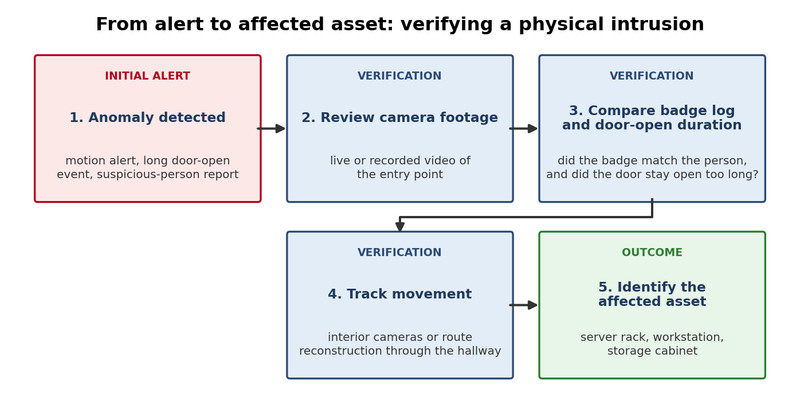
Physical attack investigation flow
- An indicator appears, such as a motion alert, long door-open event, suspicious person report, or unusual camera activity.
- Defenders check camera footage.
- They compare badge logs and door data.
- They track where the person went.
- They identify what assets may have been affected.
The strongest pairings are:
- Motion sensor + camera = alert + visual confirmation
- Badge log + door-open time + camera = strong evidence for piggybacking or tailgating
Keep these distinctions clear:
- Alert ≠ confirmed breach
- Valid badge use ≠ legitimate person
- Entry evidence ≠ evidence of actions inside
- Live monitoring helps response, and recordings help investigation
Classic Detection Scenario to Remember
One employee badges into a restricted area. The door stays open much longer than normal. The entrance camera shows a second person entering on that same authorization. Later, a motion sensor triggers in the server room, and interior footage tracks that person there.
That layered evidence tells the story:
- Badge log shows credential accepted
- Door sensor shows unusual open duration
- Entrance camera confirms two people entered
- Interior camera shows route and actions
- Motion sensor flags activity in a low-traffic sensitive area
Key Takeaways
Physical Detective Control
A control that reveals unauthorized or suspicious physical activity occurring now or after the event
Security Camera
A control that visually monitors a designated space and can preserve footage of people, movements, and actions
Live Camera Monitoring vs. Recorded Camera Footage
Live monitoring supports immediate detection and response; recorded footage supports later investigation and reconstruction
Facial Recognition Software
Software that analyzes faces in camera footage and can alert defenders when an unauthorized individual enters a controlled area
Camera Placement
Position cameras for useful coverage and angles over likely actions and ingress or egress points while limiting blind spots, obstructions, and tampering
Security Guard
A person who monitors physical activity, interprets suspicious behavior, and can question individuals or begin an immediate response
Stationary Guard
A guard who remains at one location to provide continuous protection, especially at entrances, traffic funnels, or high-value assets
Patrolling Guard
A guard who moves through an area, providing broad, unpredictable coverage suited to perimeters and exterior spaces
Motion Sensor
A control that detects movement in a monitored area and raises an alert without identifying the person or action
Motion-Sensor Placement
Place sensors in sensitive, low-traffic areas where movement is unexpected, ideally within camera coverage; avoid busy areas that generate false alarms
Employee Observation and Reporting
Employees notice unauthorized people or suspicious behavior in their workspace and alert security for investigation
Electronic Badge Record
A log of the credential, door, and time of an access attempt or entry; acceptance proves the credential was valid, not who carried it
Door-Sensor Record
A record of how long a door remained open; an unusually long interval can indicate possible piggybacking or tailgating
Access Control Vestibule
A controlled entry space that admits people individually to help prevent piggybacking and tailgating into sensitive areas
Alert vs. Confirmed Breach
An alert indicates unusual activity requiring investigation; a confirmed breach is supported by verification such as footage, observation, or correlated records
Lock Placement
Lock and control every entry to areas containing sensitive information or systems so adversaries cannot bypass monitored entry points
Notes
Physical Detective Control
A control that reveals unauthorized or suspicious physical activity occurring now or after the event
Security Camera
A control that visually monitors a designated space and can preserve footage of people, movements, and actions
Live Camera Monitoring vs. Recorded Camera Footage
Live monitoring supports immediate detection and response; recorded footage supports later investigation and reconstruction
Facial Recognition Software
Software that analyzes faces in camera footage and can alert defenders when an unauthorized individual enters a controlled area
Camera Placement
Position cameras for useful coverage and angles over likely actions and ingress or egress points while limiting blind spots, obstructions, and tampering
Security Guard
A person who monitors physical activity, interprets suspicious behavior, and can question individuals or begin an immediate response
Stationary Guard
A guard who remains at one location to provide continuous protection, especially at entrances, traffic funnels, or high-value assets
Patrolling Guard
A guard who moves through an area, providing broad, unpredictable coverage suited to perimeters and exterior spaces
Motion Sensor
A control that detects movement in a monitored area and raises an alert without identifying the person or action
Motion-Sensor Placement
Place sensors in sensitive, low-traffic areas where movement is unexpected, ideally within camera coverage; avoid busy areas that generate false alarms
Employee Observation and Reporting
Employees notice unauthorized people or suspicious behavior in their workspace and alert security for investigation
Electronic Badge Record
A log of the credential, door, and time of an access attempt or entry; acceptance proves the credential was valid, not who carried it
Door-Sensor Record
A record of how long a door remained open; an unusually long interval can indicate possible piggybacking or tailgating
Access Control Vestibule
A controlled entry space that admits people individually to help prevent piggybacking and tailgating into sensitive areas
Alert vs. Confirmed Breach
An alert indicates unusual activity requiring investigation; a confirmed breach is supported by verification such as footage, observation, or correlated records
Lock Placement
Lock and control every entry to areas containing sensitive information or systems so adversaries cannot bypass monitored entry points
