Topic 4.10 Notes – Implementing ArrayList Algorithms
What ArrayList Algorithms Are
An ArrayList algorithm processes elements using traversal, usually with:
for (int i = 0; i < list.size(); i++)
Key reminders:
- Valid indices go from
0tosize() - 1 get(i)andset(i, value)access elementsadd(index, value)andremove(index)shift elements
Most algorithms are:
- Single pass (O(n)) → process each element once
- Nested loops (O(n²)) → compare elements to each other
If you recognize the pattern, you know how the loop should look before writing code.
Standard ArrayList Algorithm Patterns
Here’s the full set you’re expected to write and trace.
Minimum and Maximum
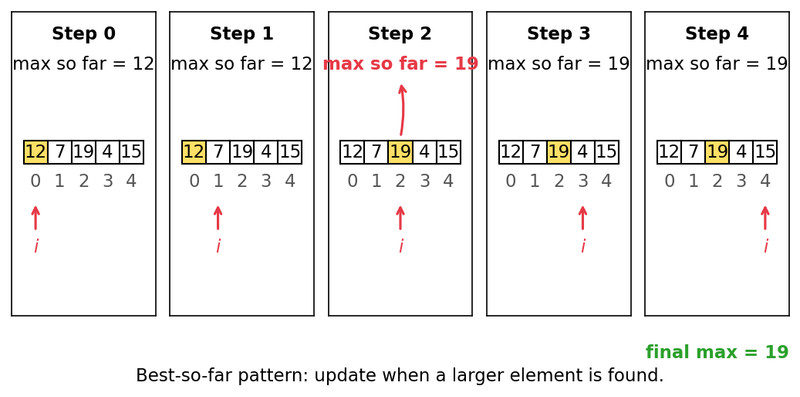
This is the “best so far” pattern. You keep track of the largest value you’ve seen as you move left to right through the list.
Structure:
- Assume the list is non-empty (or check first).
- Set
max(ormin) tolist.get(0). - Loop from index
1. - Update when you find something better.
Common mistake:
Initializing max = 0. That fails if all numbers are negative.
Sum, Average, and Counting
This uses an accumulator variable.
int sum = 0;
for (int i = 0; i < list.size(); i++) {
    sum += list.get(i);
}
Variations:
- Average →
(double) sum / list.size() - Count with condition → increment inside
if - At least one → return
trueimmediately when found - All elements → return
falseimmediately when one fails
Placement of return is where students lose points.
If you return too early in an “all” problem, you break the logic.
Consecutive Pairs
You compare i and i + 1. Each step forms a pair of neighbors.
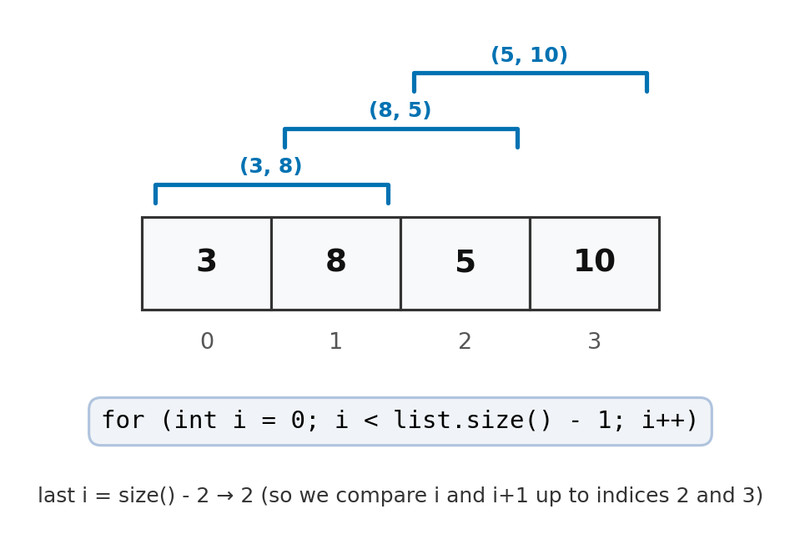
Loop condition:
for (int i = 0; i < list.size() - 1; i++)
If you go to size(), you’ll crash with out-of-bounds.
Detecting Duplicates
This requires nested loops.
for (int i = 0; i < list.size(); i++) {
    for (int j = i + 1; j < list.size(); j++) {
        if (list.get(i).equals(list.get(j))) {
            return true;
        }
    }
}
Why j = i + 1?
- Avoid comparing element to itself
- Avoid checking the same pair twice
Time complexity is O(n²). If you see two loops comparing elements, expect quadratic behavior.
Shifting and Rotating
Right shift steps:
- Save last element
- Move elements right (backward loop)
- Put saved value at index 0
Backward loop is critical:
for (int i = list.size() - 1; i > 0; i--) {
    list.set(i, list.get(i - 1));
}
Forward loop would overwrite values.
Reversing
This uses the two-pointer swap pattern. You swap the first with the last, then move inward.
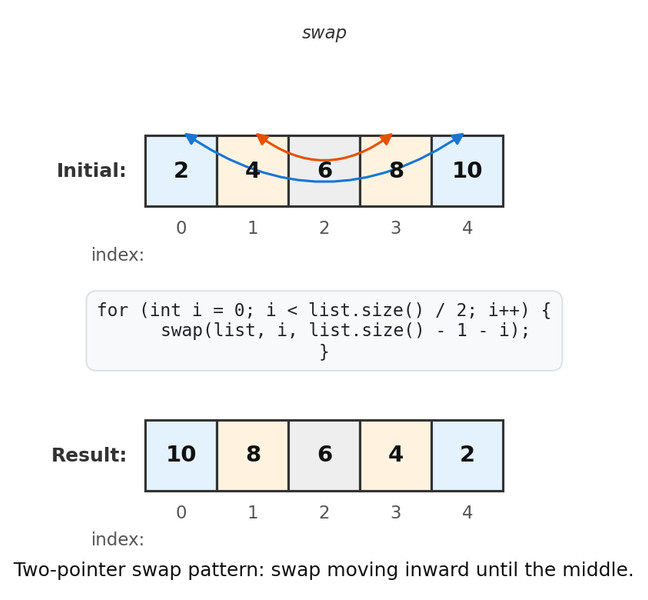
Loop until i < size() / 2, swapping:
isize() - 1 - i
Insert and Delete
add(index, value)→ shifts rightremove(index)→ shifts left
If removing during traversal:
- Traverse backward, or
- Decrement
iafter removal
Otherwise, you skip elements. This shows up constantly in FRQ grading.
Traversing Multiple Lists Simultaneously
Some algorithms compare two lists element-by-element.
for (int i = 0; i < list1.size(); i++) {
    if (!list1.get(i).equals(list2.get(i))) {
        return false;
    }
}
Be careful:
- Use the correct list’s
size() - If sizes might differ, check first
Parallel traversal questions are common in code-tracing MCQs.
Edge Cases You Must Mentally Test
Before you’re done, think about:
- Empty list
- One element
- No matches
- Removing while looping
- Peak/min at index 0 or last index
A classic crash:
int max = list.get(0); // fails if empty
Even when the question says “assume non-empty,” you should notice the risk.
