Topic 3.16 Notes – Simulations
What Simulations Are
A simulation is an abstraction of something more complex.
That means:
- It represents a real-world object or phenomenon (like traffic flow, population growth, or weather patterns).
- It is built for a specific purpose (answering a question, testing a scenario, predicting trends).
- It intentionally removes or simplifies details that are not relevant to that purpose.
Think about abstraction from earlier in Unit 3. You hide unnecessary details so you can focus on what matters. A simulation does exactly that, but for a real-world system.
Very important:
A simulation is not the real thing. It is a model based on:
- Assumptions
- Chosen variables
- Programmer decisions
On quizzes, you’ll often be asked to explain why something counts as a simulation. The key phrases to include are representation, real-world phenomenon, and simplification for a purpose.
How Simulations Represent Changing Phenomena
Simulations work by modeling state and updating it over time.
A state is the current condition of the system. It’s stored in variables.
Examples of state variables:
- Speed and position of a car
- Number of infected people
- Temperature of a room
- Amount of money in an account
The simulation:
- Sets initial values (starting state).
- Applies rules or formulas to update variables.
- Repeats this process over many steps.
Here’s the basic structure most simulations follow. Notice the repeated decision points and loops that send the system back to earlier steps after updating values.
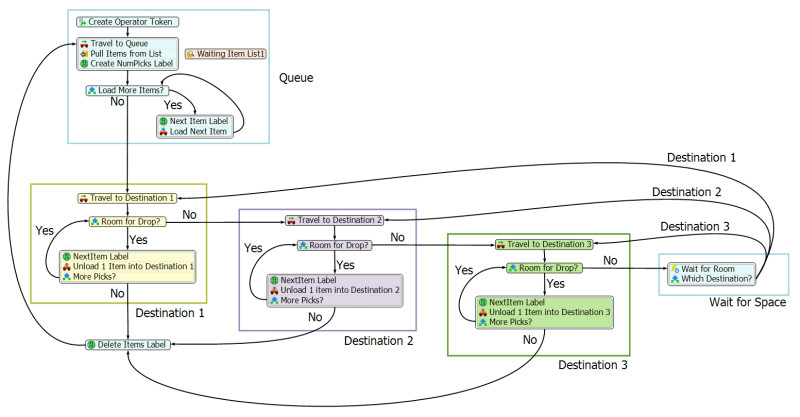
Flowchart of a looping simulation process
Each loop represents a small “moment in time.” As values change, the system evolves.
This connects directly to programming concepts you already know:
- Variables store state.
- Algorithms update state.
- Iteration (loops) repeats the process.
Different starting values or inputs can lead to different outcomes. That’s how simulations let us explore “what if” questions.
Why Simulations Are Useful
Simulations let us investigate phenomena without real-world constraints.
They’re especially useful when real experiments are:
- Too large (galaxy formation)
- Too small (molecular interactions)
- Too fast (explosions)
- Too slow (climate change)
- Too dangerous (disease outbreaks)
- Too expensive (large-scale engineering tests)
Instead of waiting decades or risking safety, we model it.
Simulations help with:
- Formulating hypotheses (If we change X, does Y increase?)
- Refining hypotheses after multiple trials
- Observing long-term patterns quickly
- Running many scenarios efficiently
Notice the word inference. We use simulation results to draw conclusions about trends. We are not proving exactly what will happen in real life. That distinction shows up in multiple-choice questions.
Tradeoffs and Bias in Simulations
Because simulations simplify reality, choices must be made.
When developing a simulation, programmers:
- Decide which variables to include
- Decide which details to remove
- Simplify how relationships work
That simplification can cause problems.
For example:
- Leaving out a key variable may distort results.
- Assuming a relationship is linear when it isn’t can mislead conclusions.
- Using incomplete or biased data affects outcomes.
This leads to bias in simulations.
Bias can come from:
- What was included
- What was excluded
- The assumptions built into the rules
On tests, you may see a scenario describing a simulation. A common question is: How could the design choices affect the results? Your answer should connect the omitted or simplified detail to a possible change in outcome.
Randomness in Simulations
Real-world systems include variability. Computers use random number generators (RNGs) to simulate that variability.
An RNG produces values that approximate randomness.
They’re used for:
- Simulating dice rolls
- Modeling probability of infection
- Creating unpredictable movement
- Representing natural variation
Running a simulation many times with random variation helps:
- Estimate probabilities
- See overall trends
- Reduce the impact of unusual single outcomes
Randomness makes simulations more realistic, but it still operates within the rules programmed into the model.
Simulation vs Real World
Here’s how they compare:
| Simulation | Real-World Context |
|---|---|
| Controlled environment | Many uncontrolled variables |
| Repeatable trials | Often not repeatable |
| Based on assumptions | Full complexity of reality |
| Safe and cost-effective | May be dangerous or expensive |
| Used to draw inferences | Produces actual outcomes |
A simulation helps us understand and predict. The real world provides the actual results.
