Topic 5.4 Notes – Crowdsourcing
1. What Crowdsourcing Is
Crowdsourcing means obtaining input or information from a large number of people via the Internet.
Break that apart:
- Crowd = distributed individuals, often strangers
- Sourcing = getting data, work, ideas, or funds from them
- Internet platforms = the computing systems that connect everyone
Before widespread internet access, collaboration usually meant small, local teams. Now:
- A researcher can post a dataset online.
- A company can ask millions of users for feedback.
- A creator can request small donations from thousands of people.
All of that depends on:
- Widespread access to information and public data
- Personal computing devices (phones, laptops, tablets)
- Platforms that store, organize, and distribute contributions
The big idea here is that human capabilities are enhanced by collaboration through computing. Many small contributions combine into something powerful.
2. Types of Crowdsourcing
Crowdsourcing shows up in different forms. Citizen science is one of the most important for this course, but it’s not the only one.
a. Citizen Science
Citizen science is scientific research conducted in whole or in part by distributed individuals, many of whom are not professional scientists.
Participants:
- Use their own devices (phones, apps, GPS tools)
- Collect or submit relevant data
- Contribute to real research projects
For example:
- Logging local weather measurements
- Classifying images of wildlife
- Reporting plant growth or pollution levels
Scientists then:
- Aggregate the data
- Analyze patterns
- Publish results
Here’s the basic flow from defining a research question to sharing results:
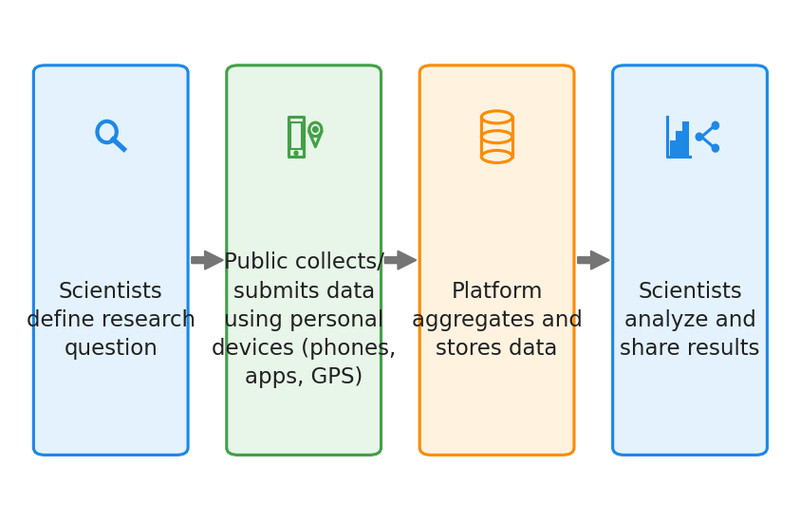
Citizen science data flow
Why this matters:
- Data can be collected across huge geographic areas.
- More data increases the reliability of findings.
- People who are not scientists still meaningfully contribute.
On exams, you might see a scenario where thousands of volunteers submit environmental data. If you can explain how computing enables large-scale data collection and aggregation, you’re answering the real question.
b. Feedback and Content Contribution
Organizations often crowdsource opinions or content.
Examples:
- Product ratings and written reviews
- Online surveys
- Community-edited articles
- User-uploaded videos or tutorials
This produces:
- Large, diverse datasets about user experience
- Rapid updates without hiring a full-time team
- Ongoing improvement based on public input
Computing platforms store, sort, and display this information automatically. Without automation, handling millions of reviews would be impossible.
c. Labor and Services
Some platforms crowdsource the workforce itself.
- Ridesharing and delivery apps
- Short-term rentals
- Freelance job marketplaces
The platform:
- Matches customers to workers
- Handles payments
- Manages ratings and logistics
The “crowd” supplies labor. The computing system coordinates everything at scale.
d. Problem Solving and Innovation Contests
Organizations sometimes post open challenges to the public.
- Coding competitions
- Engineering design challenges
- Public idea submissions
Participants submit solutions. The best ones may receive rewards or contracts.
This model increases the chance of creative solutions because it pulls from diverse backgrounds and skill sets.
e. Crowdfunding
Crowdfunding is crowdsourcing money.
- Many individuals contribute small amounts.
- Platforms connect creators or causes with supporters.
- Projects range from new products to social causes.
In crowdfunding, many small payments are funneled through a platform to one project or creator:
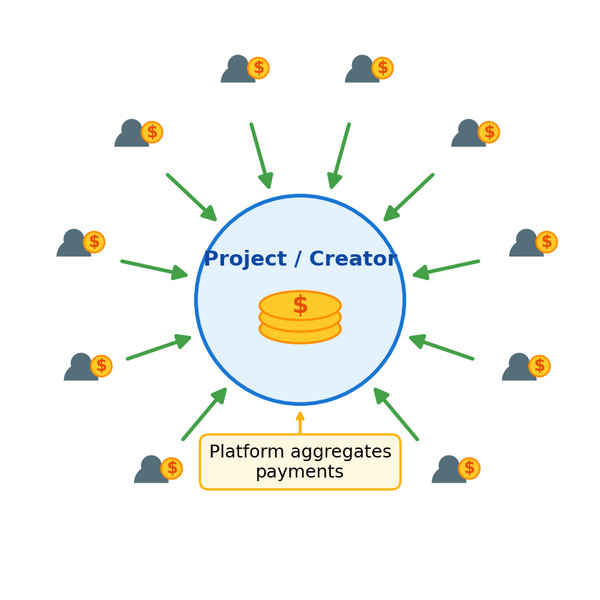
Crowdfunding model
This creates a new funding model:
- Bypasses traditional banks or investors
- Relies on public interest and online visibility
- Connects businesses or social causes directly to supporters
3. How Large-Scale Participation Works
Let’s zoom out and look at the general process.
- A problem, need, or idea is defined.
- It is shared widely through an online platform.
- Individuals contribute data, work, ideas, or money.
- The platform aggregates and organizes contributions.
- Results are analyzed, implemented, or distributed.
This only works because information is widely accessible. Public data, research findings, and open calls for participation can be shared instantly and globally.
That’s the scale piece. Computing removes geographic barriers and dramatically lowers coordination costs.
4. Benefits and Tradeoffs
Crowdsourcing has clear benefits:
- Large-scale data collection
- Faster problem solving
- More diverse perspectives
- Lower costs for organizations
- Greater public engagement in science and innovation
But computing innovations can also have unintended consequences.
Possible tradeoffs:
- Data quality may vary when contributors are non-experts.
- Workers may be underpaid or lack job protections.
- Personal data shared through platforms can raise privacy concerns.
- Popular projects may receive funding while equally important ones are ignored.
When you’re asked to evaluate an innovation, don’t just explain what it does. Connect it to broader impacts, including who benefits and who might be disadvantaged.
