Topic 5.2 Notes – Digital Divide
1. What the Digital Divide Is
The digital divide is the difference in access to:
- Computing devices (laptops, tablets, smartphones)
- Reliable, high-speed Internet
- Digital literacy (the skills needed to use technology effectively)
Access is about more than owning a phone. Someone might technically have Internet access but:
- Only through limited mobile data
- On a shared device
- With unreliable service
- Without the skills to use online tools for school or work
That still counts as part of the divide.
The divide exists at two levels:
- Within a country (intra-national)
Example: urban vs. rural areas in the same nation. - Between countries (international)
Wealthier countries often have higher Internet penetration rates than developing nations.
The map below shows Internet users per 100 people around the world. Darker shades represent higher Internet use, and lighter shades represent lower access. Notice how access varies between regions, which illustrates the international digital divide.
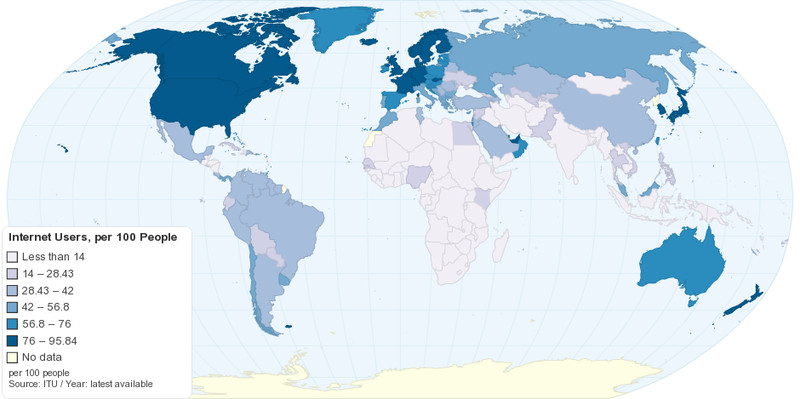
Global Internet users per 100 people
When you see a question about unequal access to devices or connectivity based on income, location, or demographics, you are in digital divide territory.
2. Factors That Contribute to the Digital Divide
Almost every cause fits into one of three categories.
a. Socioeconomic Factors
Income affects access in several ways:
- Ability to purchase devices
- Ability to pay monthly Internet bills
- Ability to repair or upgrade outdated technology
- Ability to afford multiple devices in a household
In lower-income households:
- Multiple family members may share one device.
- Broadband may be too expensive.
- Service may be inconsistent or canceled due to cost.
Even if infrastructure exists, it may not be affordable.
b. Geographic Factors
Location affects infrastructure.
- Urban areas usually have strong broadband networks.
- Rural or remote areas may lack high-speed Internet entirely.
- Some regions rely on slower satellite connections.
- Entire countries may lack widespread broadband systems.
This means someone may want Internet access and even be able to pay for it, but the infrastructure simply isn’t there.
c. Demographic Factors
Access also varies across social groups:
- Age (older adults may have lower adoption rates)
- Education level (more education often correlates with more digital use)
- Gender disparities in some regions
- Race or ethnicity, often connected to systemic inequalities
These patterns don’t exist in isolation. Someone can be affected by multiple factors at once, which deepens the divide.
3. Who the Digital Divide Affects
It impacts both groups and individuals.
Groups
- Low-income communities
- Rural populations
- Certain demographic groups
- Entire nations with limited infrastructure
The divide often mirrors existing inequalities and can reinforce them.
Individuals
Even within the same school or family, access can differ.
One student might have:
- Personal laptop
- Fiber Internet
- Quiet workspace
Another might:
- Share a phone
- Use public Wi-Fi
- Have unstable connectivity
On tests, you may be asked to explain how a situation affects either a group or a specific person. Make sure you’re clear about which level you’re discussing.
4. Why the Digital Divide Matters
This topic connects directly to unintended consequences of computing innovations. The Internet was designed to increase connection and access. It can also deepen inequality when access isn’t equal.
a. Education
- Online assignments require devices and Wi-Fi.
- Virtual classes depend on stable connections.
- Research, college applications, and digital resources are online.
- Lack of digital literacy limits academic success.
When schools rely heavily on digital platforms, students without access fall behind.
b. Employment and Economic Impact
- Jobs are posted and applied for online.
- Many careers require digital tools.
- Remote work depends on stable Internet.
- Skill gaps limit career advancement.
Over time, this can reinforce income inequality.
c. Influence and Voice
Digital platforms shape public conversation.
People without reliable access:
- Participate less in online discussions.
- Have less influence in digital communities.
- May be excluded from civic engagement that happens online.
Access affects who gets heard.
5. How the Digital Divide Can Be Reduced
Different actors play different roles.
Individuals
- Participate in digital literacy programs.
- Advocate for local broadband expansion.
Organizations (schools, nonprofits, companies)
- Provide laptops or Wi-Fi hotspots.
- Offer public access (libraries).
- Create digital literacy programs.
- Design tools that work on low-bandwidth connections.
Governments
- Fund broadband infrastructure expansion.
- Subsidize Internet costs for low-income households.
- Support public access institutions.
- Create policies promoting equitable access.
When answering how to reduce the divide, clearly explain how the action increases access or improves equity. Don’t just name a solution. Connect it to one of these actors.
