Topic 5.5 Notes – Legal and Ethical Concerns
1. Intellectual Property and Copyright
Intellectual property (IP) is anything created by the mind. In computing, that includes code, digital art, videos, music, apps, and written content. If you create something on a computer, you (or your employer, if it’s work-for-hire) own it.
Copyright
Copyright is the legal protection given to creators of original works.
It gives two main types of rights:
- Economic rights
- Control over copying, distributing, selling, or displaying the work
- Ability to earn money from it
- Moral rights
- Right to be credited as the creator
- Right to prevent harmful changes to the work
You can think of copyright as covering both the financial side and the personal credit side of a work:
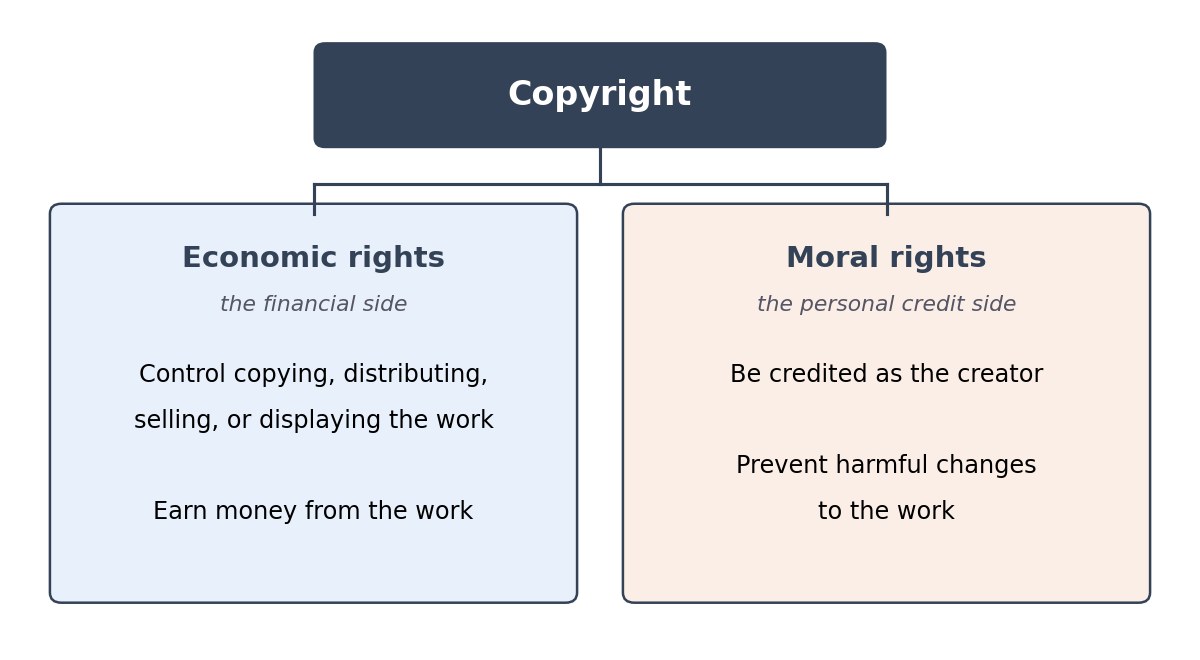
Economic rights and moral rights under copyright
Why Computing Makes This Harder
Digital content is:
- Easy to copy (perfect duplicates in seconds)
- Easy to distribute (global sharing instantly)
- Easy to modify (edit, remix, repost)
That ease creates tension:
- Creators want control and compensation.
- Users want fast, free access.
On exams, they often describe a new app or platform and expect you to explain how easy distribution creates concerns about ownership, value, or control of digital works.
Safeguarding Intellectual Property
Measures to protect IP include:
- Copyright laws
- Licensing agreements
- Terms of service
- Digital rights management (DRM)
You don’t need legal detail. You just need to recognize that society creates rules to protect creators while balancing access.
2. Plagiarism and Proper Use of Others’ Work
Plagiarism is using someone else’s work and presenting it as your own.
It includes:
- Copying text without citation
- Using images or music without credit
- Submitting someone else’s code as your own
- Even using ideas without attribution
Two key distinctions:
- Copyright violation → legal issue
- Plagiarism → ethical issue (and sometimes legal too)
Even if something is free online, you must cite it if you didn’t create it.
In your Create Performance Task, this matters. If you use code from a library or tutorial, you must acknowledge it. Failing to cite can invalidate your submission.
3. Legal Ways to Use Digital Content
There are structured ways to share work legally.
Creative Commons
A public copyright license where creators allow others to use their work under specific conditions.
Depending on the license, you may:
- Share the work
- Modify it
- Use it commercially
- Be required to give attribution
You must follow the license terms.
Open Source
Used mostly for software.
- Source code is publicly available
- Others can modify and redistribute it
- Encourages collaboration and innovation
Examples include many programming languages and frameworks.
Open Access
Used mostly for research.
- Academic work available online for free
- Few or no access restrictions
- Still check usage rules
These models expand access to information while still interacting with IP rights.
4. Broader Legal and Ethical Concerns
Computing often has unintended consequences.
Harmful or Illegal Uses
- Illegal downloading or streaming violates copyright
- Platforms can be used for harassment
- Malware spreads through pirated software
Using computing to harm individuals or groups raises both legal and ethical concerns.
Data Collection and Privacy
Many devices continuously monitor users:
- Fitness trackers
- Location services
- Social media platforms
Concerns include:
- Who owns the data
- How it’s used
- Whether users gave informed consent
Biased Algorithms
Algorithms trained on biased data can:
- Discriminate in hiring or lending
- Reinforce social inequalities
- Appear objective while embedding bias
This shows how unintended consequences arise from computing innovations.
Social and Political Impact
Computing influences:
- Spread of misinformation
- Political messaging
- Algorithm-driven echo chambers
This raises questions about:
- Free speech
- Platform responsibility
- Political polarization
The Digital Divide
Not everyone has equal access to:
- Devices
- Internet
- Digital literacy
This creates ethical concerns because unequal access widens economic and educational gaps.
5. The Core Pattern
When you’re asked to analyze a scenario:
- Identify the computing innovation.
- State its intended purpose.
- Explain unintended consequences.
- Connect to legal or ethical concerns such as IP, privacy, bias, harm, or access inequality.
Most AP questions follow that structure, even if they don’t spell it out.
