Topic 1.4 Notes – Democratization
What Democratization Is
Democratization means a country is transitioning from an authoritarian regime toward a democratic one. That is regime change, not just swapping one president, prime minister, or ruling party for another.
A lot of students miss this point. One election does not finish democratization. A new constitution does not finish it either. Even a civilian transfer of power might only begin the process. The deeper issue is whether the rules of politics are changing.
Democratization is a process, not an event. It can advance, stall, reverse through backsliding, and eventually consolidate.
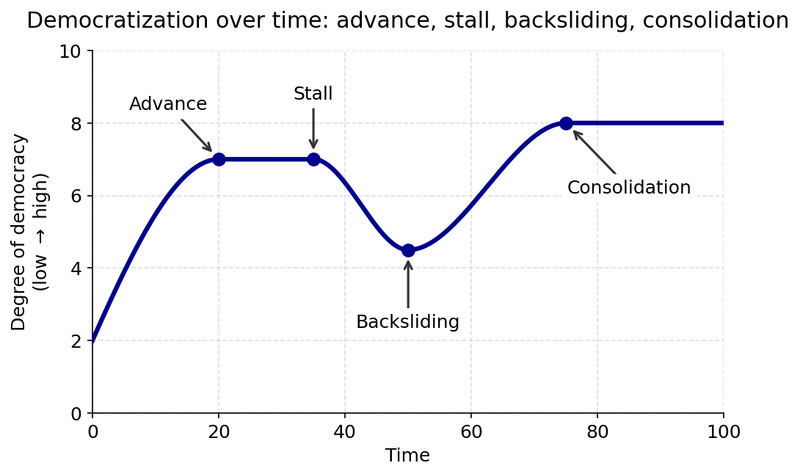
Democratization over time
- advance when elections get fairer and rights expand
- stall in a hybrid regime that mixes democratic and authoritarian traits
- reverse through backsliding, like weaker courts or more media control
It also differs from liberalization. Liberalization means rulers relax control a bit, maybe allowing more speech or limited opposition. That can happen without giving citizens real power to remove leaders.
It also differs from democracy itself. A country can be democratizing without being fully democratic yet.
Quick country paths:
- Mexico moved from PRI dominance to competitive multiparty democracy.
- Nigeria shifted from military rule to civilian rule in 1999.
- Russia had limited democratization, then backslid under Putin.
- Iran has elections and some openings, but no full democratic transition.
- UK democratized gradually and then consolidated democracy.
- China is not democratizing. It has reform and consultation without real access to power.
The Main Goals of Democratization
These goals fit together. Fair elections need civil liberties. Participation needs suffrage. Accountability needs transparency and rule of law.
- Competitive, fair, and transparent elections mean opposition groups can organize, campaign, use media, and actually win.
- A peaceful transfer of power is one of the strongest signs this is real.
- Mexico 2000 matters because Vicente Fox defeated the long-dominant PRI.
- Nigeria 2015 matters because Buhari defeated incumbent Jonathan, and Jonathan conceded.
- Participation includes voting, joining parties, civil society, protests, petitions, and public debate.
- Universal adult suffrage means adults are not excluded by sex, race, ethnicity, religion, property, or status.
- UK milestones: Representation of the People Acts of 1918 and 1928, then voting age lowered to 18 in 1969.
- Iran shows why suffrage alone is not enough. Many can vote, but candidate choice is filtered.
- Transparency lets people see abuses and corruption.
- Civil rights and civil liberties protect criticism, organizing, and opposition.
- Equal treatment means no systematic exclusion by gender, ethnicity, religion, region, or political views.
- Rule of law means laws are known and applied neutrally to leaders and citizens.
Electoral Rules That Can Advance or Block Democratization
Electoral rules shape who gets represented and whether competition is genuine.
| Rule | Can help democratization when it... | Can block democratization when it... |
|---|---|---|
| Quotas | opens access for excluded groups | exists on paper but is weakly enforced |
| Proportional representation | helps smaller parties and minorities win seats | can be limited by other restrictive rules |
| Vote thresholds | low thresholds allow more parties in | high thresholds can shut out opposition |
| District boundaries | are drawn fairly for equal representation | are manipulated through malapportionment or gerrymandering |
- Mexico’s gender quota and parity reforms increased women’s representation.
- Mexico’s PR seats helped opposition parties gain seats during PRI decline.
- Russia repeatedly changed registration and threshold rules to favor United Russia.
What Makes Democratization Succeed, Stall, or Reverse
Corruption blocks democratization because public office gets used for private or political gain. That includes patronage, vote buying, misuse of state resources, selective law enforcement, and falsified election administration.
An independent judiciary matters because courts can review elections, punish corruption, protect liberties, and enforce limits on government. China is the counterexample. Courts are subordinate to the CCP, so anticorruption is not an independent democratic check.
Backsliding often happens through:
- media control
- weakened courts
- harassment of opposition
- manipulated election rules
Examples:
- Russia shows managed elections and executive centralization.
- Iran shows candidate vetting by the Guardian Council and repression after the 2009 Green Movement.
Democratic consolidation means democracy becomes durable. Election rules, separation of powers, and civil liberties are mature and widely accepted. Losers expect future chances to compete, and winners do not crush the opposition. The UK is the clearest course example.
Consensus helps make democracy sustainable, especially in divided societies. In Nigeria, federalism, broad-support requirements, and informal power-sharing help manage ethnic and regional divisions.
Key Takeaways
Democratization
The process by which an authoritarian regime moves toward a democratic regime by changing the rules governing access to and exercise of political power
Political Liberalization
An authoritarian government’s relaxation of restrictions without necessarily allowing genuine competition for power or accountability to citizens
Electoral Competition
A condition in which multiple candidates or parties can genuinely contest office and incumbents can realistically lose
Electoral Fairness
Impartial application of election rules rather than their design or enforcement to preserve the ruling group
Electoral Transparency
Public, observable election rules and procedures, including credible vote counting and publication of results
Universal Adult Suffrage
The right of adult citizens generally to vote without exclusion based on sex, race, ethnicity, religion, property, or social status
Governmental Transparency
The openness of government decisions, procedures, information, and use of public resources to public scrutiny
Rule of Law
The principle that publicly known laws govern officials and citizens alike through established procedures rather than arbitrary personal decisions
Electoral Quotas (Gender and Cultural Quotas)
Rules requiring a specified level of candidacy or representation for women or cultural groups that have faced persistent exclusion
Proportional Representation
An electoral system that allocates legislative seats in relation to each party’s share of the vote
Vote Threshold
The minimum share of votes a party must receive to qualify for legislative seats in a proportional system
Electoral District Boundaries
The lines determining which voters are grouped together to elect representatives, affecting representation and political competition
Malapportionment
The creation of electoral districts with substantially unequal populations, causing some votes to carry more weight than others
Gerrymandering
Drawing electoral district boundaries to advantage a political party or group
Political Corruption
The abuse of public office or public resources for private or political gain
Judicial Independence (Independent Judiciary)
The ability of courts to decide cases according to law without control by the executive, ruling party, military, or other powerful actors
Stalled Democratization
A halt in movement toward democracy before democratic institutions and practices have become secure
Democratic Backsliding (Democratic Reversal)
The weakening of democratic rules and protections as a regime moves in an authoritarian direction, often through incremental policy changes
Democratic Consolidation
The process by which democratic election rules, separation of powers, and civil-liberty protections mature enough that authoritarian reversal is unlikely without an external shock
Consensus Among Competing Cultural and Political Groups
Agreement among major groups on fundamental democratic rules, protected rights, legal procedures, and pursuing development through accepted institutions
Citizen Participation
Citizens’ ability to influence public policy through voting, political organizations, petitions, public debate, demonstrations, and contact with officials
Equal Treatment of Citizens
The principle that laws and public institutions should not systematically privilege or exclude citizens based on identity, status, or political affiliation
Notes
Democratization
The process by which an authoritarian regime moves toward a democratic regime by changing the rules governing access to and exercise of political power
Political Liberalization
An authoritarian government’s relaxation of restrictions without necessarily allowing genuine competition for power or accountability to citizens
Electoral Competition
A condition in which multiple candidates or parties can genuinely contest office and incumbents can realistically lose
Electoral Fairness
Impartial application of election rules rather than their design or enforcement to preserve the ruling group
Electoral Transparency
Public, observable election rules and procedures, including credible vote counting and publication of results
Universal Adult Suffrage
The right of adult citizens generally to vote without exclusion based on sex, race, ethnicity, religion, property, or social status
Governmental Transparency
The openness of government decisions, procedures, information, and use of public resources to public scrutiny
Rule of Law
The principle that publicly known laws govern officials and citizens alike through established procedures rather than arbitrary personal decisions
Electoral Quotas (Gender and Cultural Quotas)
Rules requiring a specified level of candidacy or representation for women or cultural groups that have faced persistent exclusion
Proportional Representation
An electoral system that allocates legislative seats in relation to each party’s share of the vote
Vote Threshold
The minimum share of votes a party must receive to qualify for legislative seats in a proportional system
Electoral District Boundaries
The lines determining which voters are grouped together to elect representatives, affecting representation and political competition
Malapportionment
The creation of electoral districts with substantially unequal populations, causing some votes to carry more weight than others
Gerrymandering
Drawing electoral district boundaries to advantage a political party or group
Political Corruption
The abuse of public office or public resources for private or political gain
Judicial Independence (Independent Judiciary)
The ability of courts to decide cases according to law without control by the executive, ruling party, military, or other powerful actors
Stalled Democratization
A halt in movement toward democracy before democratic institutions and practices have become secure
Democratic Backsliding (Democratic Reversal)
The weakening of democratic rules and protections as a regime moves in an authoritarian direction, often through incremental policy changes
Democratic Consolidation
The process by which democratic election rules, separation of powers, and civil-liberty protections mature enough that authoritarian reversal is unlikely without an external shock
Consensus Among Competing Cultural and Political Groups
Agreement among major groups on fundamental democratic rules, protected rights, legal procedures, and pursuing development through accepted institutions
Citizen Participation
Citizens’ ability to influence public policy through voting, political organizations, petitions, public debate, demonstrations, and contact with officials
Equal Treatment of Citizens
The principle that laws and public institutions should not systematically privilege or exclude citizens based on identity, status, or political affiliation
