Topic 1.8 Notes – Political Legitimacy
What Political Legitimacy Is
Legitimacy means people believe the government is rightfully using power. That matters because accepted rule is easier to enforce than rule based only on fear.
- Power is the ability to make people comply.
- Authority is the recognized right to use that power. Legitimacy is what turns power into authority.
- Legality means acting according to law. Legal action can help legitimacy, but people can see a law as unfair or rigged.
- Sovereignty is the state’s independent authority over its territory and population. Legitimacy strengthens sovereignty because people are more likely to obey laws, pay taxes, and accept state decisions.
Legitimacy can attach to different things:
- The state itself
- The regime and its rules
- The current government or leaders
- A specific policy
That’s why an unpopular president or prime minister does not automatically mean the whole regime lacks legitimacy.
Main Sources of Legitimacy
Most regimes mix sources. A source only works if people connect it to rightful rule.
Popular elections
Elections create legitimacy when people see them as a real way to choose and replace leaders.
- Strongest when elections are competitive, free, fair, transparent, and inclusive
- Authoritarian regimes also hold elections to claim a mandate, even when competition is limited
Constitutional provisions
People may accept rule because it follows recognized constitutional rules about offices, succession, and limits on power.
- This applies in the UK too, even without one single written constitution
Nationalism
Governments gain legitimacy by linking themselves to national unity, independence, strength, or resistance to foreign influence.
Tradition
Longstanding institutions can seem rightful because they are familiar and tied to identity.
- Standard example: British monarchy
Governmental effectiveness
This is performance legitimacy. People may accept rulers who keep order, deliver services, and handle crises well.
Economic growth
Rising living standards can make people accept a regime, especially if they credit the government for the improvement.
- Standard example: China after 1978 reforms
Ideology
A regime can claim legitimacy through a set of political beliefs.
- China uses Marxism-Leninism
- Iran uses the ideology of the Islamic Republic
Religious heritage and organizations
Religious tradition or clerical authority can support rightful rule.
- Standard example: Iran, Shia Islam, and velayat-e faqih
Iran’s regime structure helps connect those sources of legitimacy to actual institutions. Students should notice that elected offices exist, but unelected religious bodies, especially the Supreme Leader and Guardian Council, shape who can run and how power is exercised.
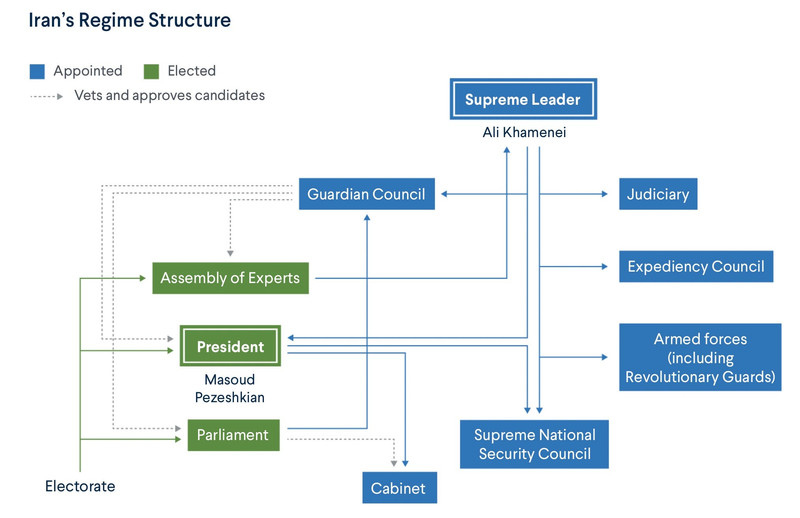
Iran’s regime structure
Dominant political party’s endorsement
In some systems, party approval itself gives authority.
- CCP in China
- PRI in historical Mexico
- United Russia in Russia
Democratic vs Authoritarian Legitimacy
No source belongs only to one regime type.
- Democracies usually lean more on meaningful elections, broad participation, constitutionalism, and peaceful transfer of power.
- Authoritarian regimes often lean more on nationalism, ideology, religion, performance, growth, and ruling-party endorsement.
The key question is always the same. Why do people accept these rulers as entitled to govern? A democracy can lose legitimacy, and an authoritarian regime can have genuine public acceptance.
Course Country Patterns
| Country | Main legitimacy sources |
|---|---|
| China | CCP endorsement, socialist/revolutionary ideology, nationalism, effectiveness, economic growth after 1978 |
| Iran | Shia Islam, clerical institutions, 1979 Revolution, Islamic Republic ideology, constitution, limited elections |
| Mexico | 1917 Constitution, Mexican Revolution legacy, PRI as party of the revolution, stronger electoral legitimacy after 2000 |
| Nigeria | 1999 Constitution, civilian elections after military rule, federalism, 2015 first party-to-party presidential transfer |
| Russia | 1993 Constitution, presidential elections, nationalism, restored order after the 1990s, United Russia |
| United Kingdom | Competitive elections, parliamentary government, constitutional rules and conventions, effectiveness, monarchy and tradition |
How to Identify Legitimacy in Evidence
You’re looking for accepted right to rule, not just obedience.
- Describe the pattern first. Say what the data shows.
- Connect it to a plausible source of legitimacy.
- Avoid jumping to proof. One indicator alone is rarely enough.
Useful indicators:
- Survey data on trust, system support, or right to govern
- Compliance with laws and taxes
- Participation through normal institutions
- Protest or unrest
- Speeches and constitutional claims
- How much coercion is needed
Key Takeaways
Political Legitimacy
Constituents’ belief that a government has the right to rule and use power as it does; it confers authority and can increase practical power
Power
The ability to make others behave in a particular way or to enforce binding decisions, including through coercion
Authority
The recognized right to exercise power; legitimacy turns power into authority in the eyes of those who accept it
Sovereignty
The state’s independent legal authority over its population and territory, reinforced when legitimacy encourages acceptance of state commands
Popular Elections
A source of legitimacy in which citizens authorize leaders through voting and an accepted procedure for choosing and replacing officeholders
Constitutional Provisions / Constitutional Legitimacy
Legitimacy based on accepted constitutional rules that establish institutions, distribute powers, and authorize the selection and actions of officials
Nationalism
A source of legitimacy that links acceptance of a regime to the nation’s identity, unity, independence, security, or international strength
Tradition / Traditional Legitimacy
Legitimacy based on an institution or ruler being accepted as the continuation of long-established customs, identity, and political practice
Governmental Effectiveness / Performance Legitimacy
Legitimacy earned by competently providing security, order, services, infrastructure, crisis response, or other important public results
Economic Growth
A source of legitimacy when constituents credit the government with material improvements such as rising incomes, employment, infrastructure, or reduced poverty
Ideology
A coherent set of political ideas and values that legitimizes a regime when constituents accept its institutions as the proper expression of those principles
Religious Heritage and Organizations
A source of legitimacy that presents political authority as consistent with sacred law, religious teaching, or recognized religious institutions
Dominant Political Party’s Endorsement
A source of legitimacy in which acceptance of a leading party’s right to select leaders makes its endorsed officeholders appear entitled to govern
Notes
Political Legitimacy
Constituents’ belief that a government has the right to rule and use power as it does; it confers authority and can increase practical power
Power
The ability to make others behave in a particular way or to enforce binding decisions, including through coercion
Authority
The recognized right to exercise power; legitimacy turns power into authority in the eyes of those who accept it
Sovereignty
The state’s independent legal authority over its population and territory, reinforced when legitimacy encourages acceptance of state commands
Popular Elections
A source of legitimacy in which citizens authorize leaders through voting and an accepted procedure for choosing and replacing officeholders
Constitutional Provisions / Constitutional Legitimacy
Legitimacy based on accepted constitutional rules that establish institutions, distribute powers, and authorize the selection and actions of officials
Nationalism
A source of legitimacy that links acceptance of a regime to the nation’s identity, unity, independence, security, or international strength
Tradition / Traditional Legitimacy
Legitimacy based on an institution or ruler being accepted as the continuation of long-established customs, identity, and political practice
Governmental Effectiveness / Performance Legitimacy
Legitimacy earned by competently providing security, order, services, infrastructure, crisis response, or other important public results
Economic Growth
A source of legitimacy when constituents credit the government with material improvements such as rising incomes, employment, infrastructure, or reduced poverty
Ideology
A coherent set of political ideas and values that legitimizes a regime when constituents accept its institutions as the proper expression of those principles
Religious Heritage and Organizations
A source of legitimacy that presents political authority as consistent with sacred law, religious teaching, or recognized religious institutions
Dominant Political Party’s Endorsement
A source of legitimacy in which acceptance of a leading party’s right to select leaders makes its endorsed officeholders appear entitled to govern
