Topic 5.2 Notes – Political Responses to Global Market Forces
Political Responses to Global Market Forces
All six AP Comp Gov countries have mixed economies. That means the real question is never “market or no market.” It’s how much control the state keeps, where it allows private firms in, and whether foreign investors get access.
Governments use several tools to manage that balance:
- Privatization means shifting an industry or company from state control toward private ownership or private competition.
- Nationalization means bringing a private industry under state control.
- Re-nationalization means the state takes back control after earlier privatization.
- State-owned enterprises are government-owned companies that still operate commercially.
- Foreign direct investment means outside firms put money into actual production, not just stocks.
- Joint ventures let the state and foreign firms share ownership, risk, and profits.
- Special economic zones are limited areas with looser rules to attract trade and investment.
A common trap is treating these as all-or-nothing. A country can open an industry to competition without fully selling the state company. Also, legal ownership is only part of the story. Real power comes from who controls investment, production, and revenue.
The Continuum of Private and State Control
You should picture the six countries on a spectrum, with the United Kingdom closest to private control and China closest to state control.
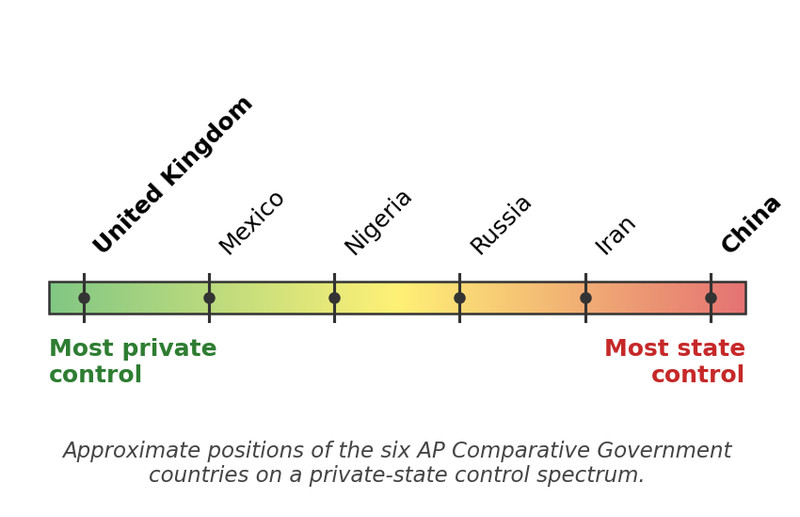
Private-state control spectrum
- United Kingdom sits at the most private-control end.
- Private firms make most commercial decisions in natural resources.
- The government still taxes, licenses, and regulates.
- Standard examples are Margaret Thatcher, privatization of British Gas, sale of BP shares, and North Sea oil and gas.
- China sits at the least private-control end.
- It opened parts of the economy selectively, but the party-state kept control of strategic sectors and natural resources.
- Middle cases
- Mexico keeps state ownership but allowed more private participation and competition.
- Nigeria keeps a state oil company and works with foreign firms through joint ventures.
- Russia moved from privatization in the 1990s back toward stronger state control.
- Iran keeps extensive state control and limits foreign participation through restricted arrangements.
Private control can bring competition, efficiency, capital, and technology. State control can protect sovereignty, revenue, development goals, and political control. Many countries try for a hybrid.
The Key Country Examples
China
China’s answer to market pressure was selective opening under Deng Xiaoping’s reform and opening policies.
- In 1980, the first coastal SEZs were Shenzhen, Zhuhai, Shantou, and Xiamen.
- These zones offered tax incentives, export manufacturing, foreign investment, and looser commercial rules.
- The CCP never gave up national political control.
The map highlights those first SEZs on the southeast coast and also shows how opening later spread to other coastal cities and regions.
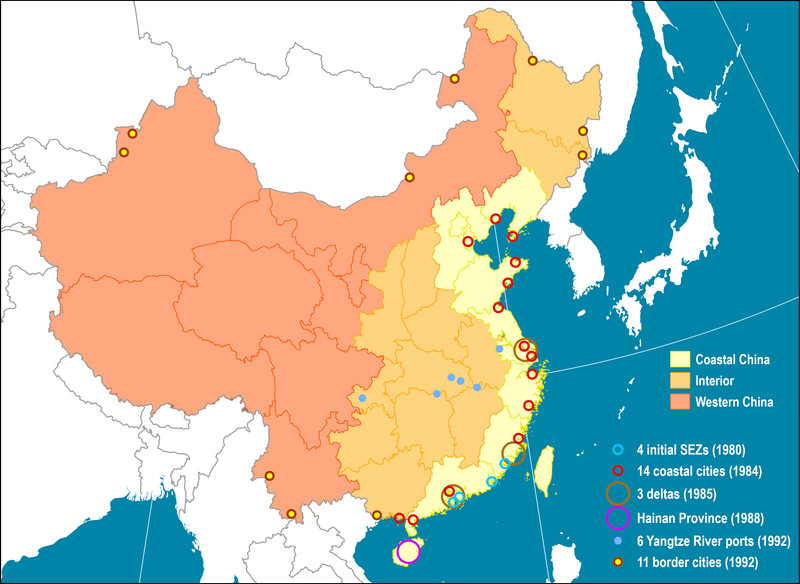
China’s special economic zones and coastal opening
This is the classic example of economic liberalization without political liberalization.
Mexico
Mexico’s oil sector is tied to nationalism.
- In 1938, Lázaro Cárdenas expropriated foreign oil interests and created Pemex.
- The 2013 energy reform opened the oil industry to private and foreign participation and increased competition.
- Pemex stayed state-owned, and subsurface oil remained national property.
- AMLO later pushed back toward a stronger state role and stronger Pemex.
Nigeria
Nigeria uses a hybrid oil model.
- NNPC is the state oil enterprise.
- It works in joint ventures with Shell, Chevron, ExxonMobil, Total, and Eni.
- The state keeps a stake and claims revenue, while firms provide capital, technology, and expertise.
Russia
Russia shows reversal.
- After 1991, privatization helped create oligarchs.
- Under Putin, strategic oil and gas sectors were re-nationalized and foreign investment was limited.
- Key state-controlled firms are Rosneft and Gazprom.
- The standard example is Yukos, Mikhail Khodorkovsky, and asset transfer to Rosneft.
Why Governments Choose These Policies
Governments make these choices for four connected reasons:
- Improve domestic economic conditions
- attract investment, raise production, gain technology, create jobs, improve efficiency, reduce the burden of weak SOEs
- Respond to domestic demands
- nationalism, labor concerns, sovereignty, attachment to oil, business pressure for competition
- This is especially visible in democratic politics in Mexico and the UK.
- Preserve or increase political power
- control revenue, reward allies, weaken rivals, block independent economic elites
- This is clearest in Russia and also matters in China.
- Extend regional and international influence
- resource control can become foreign policy power
- Russia is the clearest example, and China used economic opening to build national strength.
The exam loves this idea: economic liberalization does not automatically create political liberalization, and democracy does not require full privatization.
Fast Comparisons to Lock In
- UK vs China: most private control vs least private control.
- Mexico vs Russia: Mexico opened a state-dominated oil sector; Russia restored state control over a privatized one.
- Mexico vs Nigeria: both keep state involvement in oil, but Mexico emphasizes opening and competition, while Nigeria emphasizes joint ventures.
- China vs Russia: both keep strong state control, but China opens selected zones and Russia reasserts control over strategic assets.
- Iran: remember extensive state control, oil sovereignty, and limits on foreign influence.
Key Takeaways
Market Forces
Pressures created by supply, demand, competition, prices, and capital flows, including those operating across national borders
Privatization
Transfer of a government enterprise or asset to private ownership or management, or opening a state-dominated industry to private competition
Nationalization
Transfer of privately owned enterprises or assets into government ownership or control
Re-Nationalization
Restoration of state control over assets or industries that were previously privatized
State-Owned Enterprise (SOE)
A commercial organization owned or controlled by the government but able to operate in markets and contract with private firms
Foreign Direct Investment (FDI)
A lasting foreign investment in another country's productive activity that includes a continuing stake in management or production
Joint Venture
An enterprise or project in which multiple parties share investment, ownership, risks, management, or returns
Special Economic Zone (SEZ)
A designated area with investment-friendly rules such as lower taxes, fewer trade barriers, and greater access for foreign capital
Petróleos Mexicanos (Pemex)
Mexico's state-owned petroleum company, retained under public ownership even as the oil industry opened to private participation
Mexico's 2013 Energy Reform
Reform that opened Mexico's petroleum industry to private and foreign competition while Pemex and underground resources remained state-owned
Nigerian National Petroleum Corporation (NNPC)
Nigeria's state petroleum enterprise, which works with multinational oil companies through joint ventures to finance and conduct production
Putin's Energy Re-Nationalization
Russia's restoration of state control over strategic oil and gas assets, alongside restrictions on foreign ownership and investment
United Kingdom–China Natural-Resource Control Contrast
The United Kingdom permits the most private control of natural resources among course countries, while China permits the least
China’s Coastal Special Economic Zones
Coastal zones where China introduced investment-friendly market rules and welcomed foreign capital while retaining broader party-state control
Notes
Market Forces
Pressures created by supply, demand, competition, prices, and capital flows, including those operating across national borders
Privatization
Transfer of a government enterprise or asset to private ownership or management, or opening a state-dominated industry to private competition
Nationalization
Transfer of privately owned enterprises or assets into government ownership or control
Re-Nationalization
Restoration of state control over assets or industries that were previously privatized
State-Owned Enterprise (SOE)
A commercial organization owned or controlled by the government but able to operate in markets and contract with private firms
Foreign Direct Investment (FDI)
A lasting foreign investment in another country's productive activity that includes a continuing stake in management or production
Joint Venture
An enterprise or project in which multiple parties share investment, ownership, risks, management, or returns
Special Economic Zone (SEZ)
A designated area with investment-friendly rules such as lower taxes, fewer trade barriers, and greater access for foreign capital
Petróleos Mexicanos (Pemex)
Mexico's state-owned petroleum company, retained under public ownership even as the oil industry opened to private participation
Mexico's 2013 Energy Reform
Reform that opened Mexico's petroleum industry to private and foreign competition while Pemex and underground resources remained state-owned
Nigerian National Petroleum Corporation (NNPC)
Nigeria's state petroleum enterprise, which works with multinational oil companies through joint ventures to finance and conduct production
Putin's Energy Re-Nationalization
Russia's restoration of state control over strategic oil and gas assets, alongside restrictions on foreign ownership and investment
United Kingdom–China Natural-Resource Control Contrast
The United Kingdom permits the most private control of natural resources among course countries, while China permits the least
China’s Coastal Special Economic Zones
Coastal zones where China introduced investment-friendly market rules and welcomed foreign capital while retaining broader party-state control
