Topic 2.5 Notes – Removal of Executives
What Removal of Executives Is
Removal means forcing an executive leader out early. That matters because it is one kind of horizontal accountability, where one institution checks another to limit abuse of power.
It does not mean:
- losing an election
- hitting a term limit
- ordinary succession at the end of a term
- death or incapacity
- voluntary resignation
A resignation can happen because removal is coming, but that still is not the same procedure.
The first thing to pin down in any question is four pieces:
- Who is being removed
- Who can remove them
- Why they can be removed
- How hard removal is
Different systems build this differently:
- Presidential systems give executives fixed terms, so removal is usually for serious wrongdoing.
- Parliamentary systems keep the executive in office only as long as the legislature supports them.
- Semi-presidential and authoritarian systems often split removal power across several institutions.
Main Types of Removal Procedures
Impeachment
In presidential and some semi-presidential systems, impeachment handles misconduct, grave crime, constitutional violations, or incapacity. One body usually accuses and another makes the final decision. Supermajorities are common, and courts may be involved.
The key idea is that impeachment is not for ordinary policy disagreement. A legislature cannot remove a president just because it dislikes the president’s agenda.
Votes of no confidence
In parliamentary systems, a vote of no confidence means the government has lost legislative support. That is political, not criminal.
- Usually decided by a simple majority
- Can cause resignation
- Can produce a replacement government
- Can trigger a new election
Hybrid or indirect removal
Some systems share removal power. The legislature may start the process, but another institution finishes it. Iran is the clearest example. Russia partly fits this too.
Party-controlled formal removal
In China, the constitution gives the legislature removal power, but real leadership change happens inside the Chinese Communist Party. The formal rule exists, but the party controls it.
Country Procedures and Examples
This comparison chart pulls the six cases together, so you can quickly see who starts removal and who actually finishes it in each system.
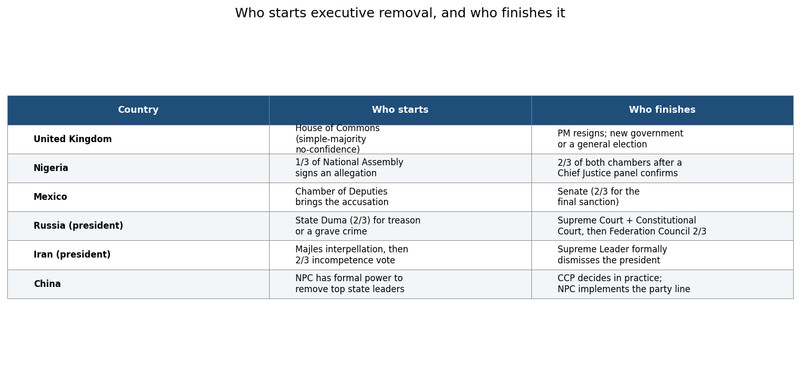
Executive removal procedures in six countries
United Kingdom
The UK is the clearest parliamentary case. The prime minister stays in office only with House of Commons confidence.
- Simple-majority no-confidence vote
- In 1979, James Callaghan lost 311 to 310
- That led to a general election won by Margaret Thatcher
PMs can also be pushed out by their own party, but that is party leadership change, not legislative removal.
Nigeria
Nigeria uses presidential impeachment for gross misconduct.
- One-third of the National Assembly signs an allegation.
- Two-thirds in both chambers approve investigation.
- The chief justice appoints a seven-member panel.
- If the panel confirms the charge, two-thirds in both chambers can remove the president.
No president has been removed this way in the Fourth Republic.
Mexico
Mexico’s president cannot be removed by no confidence. Removal uses a formal legal-political responsibility process.
- Chamber of Deputies brings or approves accusation
- Senate decides
- Final sanctions require a two-thirds Senate vote
No Mexican president has been removed. Under PRI dominant-party rule, Congress had weak practical independence.
Russia
Russia shows mixed rules.
- President
State Duma initiates for high treason or grave crime. It then needs two-thirds Duma, approval from the Supreme Court and Constitutional Court, then two-thirds Federation Council. The 1999 Boris Yeltsin impeachment attempt failed. - Prime minister and government
The Duma can pass no confidence, but the president may reject it. A repeat vote can force dismissal of the government or dissolution of the Duma.
Iran
Iran splits removal across elected and unelected institutions.
- President
The Majles can interpellate the president. A two-thirds vote can declare political incompetence. The Supreme Leader then formally dismisses the president. Abolhassan Banisadr was removed this way in 1981 by Majles action followed by Ayatollah Khomeini’s dismissal. - Supreme Leader
The Assembly of Experts can remove the Supreme Leader, but it never has.
China
The National People’s Congress can formally remove the president, vice president, premier, and State Council leaders. In practice, the CCP controls the NPC, so actual leadership change is mostly internal party decision-making.
How Removal Procedures Reflect Power
These rules tell you where power sits.
- UK shows fused executive-legislative power. Easy removal means strong legislative accountability.
- Mexico and Nigeria protect fixed presidential tenure through difficult impeachment rules.
- Russia gives the legislature some tools, but the president dominates.
- Iran divides authority between elected bodies and religious institutions.
- China has formal legislative power without independent legislative control.
What Makes Removal Effective or Weak
A removal rule works only if institutions are independent enough to use it.
| Country | Main procedure | Grounds/logic | Who acts |
|---|---|---|---|
| UK | No confidence | Loss of support | Commons |
| Nigeria | Impeachment | Gross misconduct | National Assembly + panel |
| Mexico | Formal legal removal | Wrongdoing | Deputies + Senate |
| Russia | Impeachment + weak no confidence | Grave crime / loss of support | Duma, courts, Federation Council, president |
| Iran | Majles initiates, Supreme Leader finalizes | Political incompetence | Majles + Supreme Leader |
| China | NPC formal removal | Formal legislative authority | NPC, but CCP controls |
High thresholds, multiple chambers, and court review can stop partisan abuse. They can also make removal almost impossible. That is why the exam loves this distinction: having a removal rule does not prove real accountability.
Key Takeaways
Horizontal Accountability
One government institution checks another to deter or respond to abuse of power, including through executive removal
Impeachment
A formal accusation of serious wrongdoing that begins a possible removal process; impeachment itself does not necessarily remove the official
Vote of No Confidence
A legislative declaration that a parliamentary government has lost majority support, normally requiring resignation, formation of a new government, or an election
United Kingdom: Vote of No Confidence
A simple majority of House of Commons members voting withdraws confidence, after which the government is expected to resign or seek dissolution and a general election
Nigeria: Presidential Impeachment
At least one-third of all National Assembly members alleges gross misconduct, two-thirds of all members of each chamber approves an investigation, an independent panel investigates, and two-thirds of all members of each chamber removes the president if the allegation is proved
Mexico: Presidential Removal
The Chamber of Deputies brings or approves an accusation of legally recognized wrongdoing, and the Senate decides the case, with political sanctions requiring two-thirds of senators present
Russia: Presidential Impeachment
At least one-third of State Duma deputies initiates charges, two-thirds of all deputies approves them, the Supreme and Constitutional Courts review them, and two-thirds of all Federation Council members must remove the president within three months
Russia: Vote of No Confidence
A majority of all State Duma deputies may declare no confidence in the government, but the president may reject it; if repeated within three months, the president ordinarily must dismiss the government or dissolve the Duma
Iran: Presidential Removal
One-third of the Majles may interpellate the president and two-thirds voting may declare him incompetent, but the Supreme Leader formally dismisses him after that finding or a Supreme Court finding of constitutional violations
Iran: Removal of Cabinet Ministers
The Majles may interpellate a cabinet minister and withdraw confidence, directly causing the minister’s dismissal
Iran: Removal of the Supreme Leader
The Assembly of Experts may remove the Supreme Leader for inability to perform his duties or for lacking or losing the constitutionally required qualifications
China: National People’s Congress Removal Power
The National People’s Congress may remove the president, vice president, premier, and other State Council leaders, but Communist Party control prevents it from acting as an independent check
Executive Removal
The involuntary departure of an executive from office through another institution’s action before the ordinary end of the executive’s tenure
Notes
Horizontal Accountability
One government institution checks another to deter or respond to abuse of power, including through executive removal
Impeachment
A formal accusation of serious wrongdoing that begins a possible removal process; impeachment itself does not necessarily remove the official
Vote of No Confidence
A legislative declaration that a parliamentary government has lost majority support, normally requiring resignation, formation of a new government, or an election
United Kingdom: Vote of No Confidence
A simple majority of House of Commons members voting withdraws confidence, after which the government is expected to resign or seek dissolution and a general election
Nigeria: Presidential Impeachment
At least one-third of all National Assembly members alleges gross misconduct, two-thirds of all members of each chamber approves an investigation, an independent panel investigates, and two-thirds of all members of each chamber removes the president if the allegation is proved
Mexico: Presidential Removal
The Chamber of Deputies brings or approves an accusation of legally recognized wrongdoing, and the Senate decides the case, with political sanctions requiring two-thirds of senators present
Russia: Presidential Impeachment
At least one-third of State Duma deputies initiates charges, two-thirds of all deputies approves them, the Supreme and Constitutional Courts review them, and two-thirds of all Federation Council members must remove the president within three months
Russia: Vote of No Confidence
A majority of all State Duma deputies may declare no confidence in the government, but the president may reject it; if repeated within three months, the president ordinarily must dismiss the government or dissolve the Duma
Iran: Presidential Removal
One-third of the Majles may interpellate the president and two-thirds voting may declare him incompetent, but the Supreme Leader formally dismisses him after that finding or a Supreme Court finding of constitutional violations
Iran: Removal of Cabinet Ministers
The Majles may interpellate a cabinet minister and withdraw confidence, directly causing the minister’s dismissal
Iran: Removal of the Supreme Leader
The Assembly of Experts may remove the Supreme Leader for inability to perform his duties or for lacking or losing the constitutionally required qualifications
China: National People’s Congress Removal Power
The National People’s Congress may remove the president, vice president, premier, and other State Council leaders, but Communist Party control prevents it from acting as an independent check
Executive Removal
The involuntary departure of an executive from office through another institution’s action before the ordinary end of the executive’s tenure
