Topic 5.8 Notes – Causes and Effects of Demographic Change
What Demographic Change Is
Demographic change covers changes in population size, location, age structure, migration, and social composition. That includes:
- Population growth or decline when births, deaths, immigration, and emigration change the total size
- Internal migration when people move within a country
- External migration when people cross borders
- Rural-to-urban migration and urbanization
- Aging populations with a larger share of elderly people
- Changes in ethnic, religious, or social group distribution
A few terms get tested a lot:
- Immigration means entering a country
- Emigration means leaving a country
- Net migration is the balance between the two
- Positive net migration means more people enter than leave
- Negative net migration means more leave than enter
- Brain drain means highly skilled or well-educated people emigrate
Urbanization is easy to mix up with migration. They connect, but they are not the same thing. Urbanization can happen because people move to cities, because cities grow naturally, or because places get reclassified as urban.
The core chain in this topic is:
- Government policy or political/economic conditions change incentives
- People move or change reproductive behavior
- A demographic shift happens
- Government services and resources face pressure
- Legitimacy can rise or fall depending on the response
Political Causes of Demographic Change
Different causes fit into four big groups: economic opportunity, development and trade policy, repression/corruption/discrimination, and birth policy.
China
China’s late-1970s reforms shifted the economy from agriculture toward industry. Special economic zones starting in 1980 and heavy FDI on the east and south coast created jobs there, so people moved:
- from rural to urban areas
- from the west/interior to the east/coast
- later, abroad for work and education as incomes rose
The migration map below shows that pattern clearly, with many interior provinces losing people and coastal provinces gaining them.
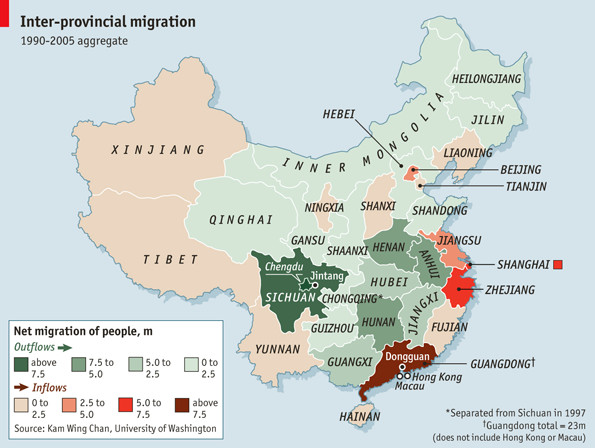
Interprovincial migration in China, 1990-2005
The hukou system matters here. It ties benefits to registered residence, so rural migrants in cities often had weaker access to schools, housing, and health care.
Mexico
Mexico’s liberalization changed where opportunity was located. NAFTA in 1994, maquiladora zones, and FDI concentrated jobs in northern border regions. At the same time, reduced agricultural supports hurt some rural producers.
That pushed migration:
- from rural to urban areas
- from south to north
- from Mexico to the United States
The result was a wider regional gap between the richer north and poorer south.
Iran and Nigeria
Both countries show brain drain. Highly educated people may leave because of corruption, repression, instability, limited opportunity, or restrictive state practices.
Fertility and minority policies
- China’s one-child policy was antinatalist. China then shifted to a two-child policy in 2016 and a three-child policy in 2021.
- Russia’s maternity capital is a pronatalist policy meant to encourage births.
- In Iran, discrimination against Bahá’ís affects migration and the country’s social composition.
Political and Social Effects of Demographic Change
Once people move or birth patterns shift, governments have to deal with the consequences.
- Resource pressure grows in housing, transportation, sanitation, schools, hospitals, and infrastructure. Local governments often feel this first.
- Inequality can deepen. Receiving regions gain labor, investment, and taxpayers. Sending regions lose workers and consumers.
- Skill concentration happens when richer places attract doctors, engineers, academics, and administrators.
- Higher density can contribute to crime or fear of crime. Be careful here. The course does not say migrants automatically cause crime.
- Legitimacy and conflict can worsen through anti-immigration backlash and new parties opposing immigration or supranational control.
United Kingdom Immigration, Aging, and Legitimacy
The UK had positive net migration, helped by EU free movement before Brexit plus non-EU migration. Immigration expanded the labor force, increased tax revenue, and filled staffing shortages. It also added pressure to housing and services and fed cultural and economic backlash.
UKIP became the key anti-immigration example. Immigration and sovereignty became tied to opposition to the EU, helping drive the Brexit referendum in 2016 and formal exit in 2020. The legitimacy issue was that many citizens felt the national government lacked control because of supranational rules.
The UK also has an aging population and a smaller working-age share. That raises costs for the universal NHS and increases pressure over taxes, staffing, spending, and benefits. One useful complication is that working-age immigrants can also help fund and staff the NHS.
How States Respond and How to Read the Data
States respond with:
- Migration controls and residency rules
- Development policy that shifts where jobs are
- Pronatalist or antinatalist birth policy
- Anti-discrimination or discriminatory minority policy
Each response involves trade-offs among capacity, equality, growth, and legitimacy.
Data also has limits:
- National averages hide regional differences
- Net migration hides who is moving
- Undocumented or distrustful groups may be undercounted
- Definitions of urban, migrant, resident, and working age vary
- Correlation does not prove causation
The best exam explanation usually follows this order:
- Identify the demographic pattern
- Name the policy or political cause
- Explain the mechanism
- Give the political consequence
Key Takeaways
Demographic Change
A shift over time in a population’s size, location, age structure, migration patterns, or social composition
Migration
Movement from one place of residence to another
Internal Migration
Movement within a country, such as from rural areas to cities or from the interior to the coast
External or International Migration
Movement across state borders
Immigration
Entry into a country for settlement
Emigration
Departure from a country for settlement elsewhere
Net Migration
Immigration minus emigration; it is positive when more people enter than leave and negative when more leave than enter
Urbanization
An increase in the proportion of a population living in urban areas
Age Structure
The distribution of a population among age groups
Aging Population
A population with a growing proportion of older people, commonly resulting from low fertility and longer life expectancy
Population Pyramid
A graph of a population’s age and sex structure; a broad base indicates a younger population, while a narrow base and wider upper groups indicate aging and lower fertility
Push Factors vs. Pull Factors
Push factors drive people away from an area, while pull factors attract them toward another area
Special Economic Zone (SEZ)
A designated area offering favorable rules and conditions for foreign investment and export production, used in China to concentrate coastal industry and jobs
Hukou (Household Registration) System
China’s system linking access to many public services to a person’s registered place of residence, often limiting rural migrants’ access to urban benefits
North American Free Trade Agreement (NAFTA)
The 1994 trade agreement among Mexico, the United States, and Canada that helped concentrate Mexican investment and industrial employment in northern and urban areas
Maquiladora
An export-oriented Mexican factory that imports components, assembles or processes goods, and exports the finished products
Brain Drain
The emigration of highly skilled or well-educated people, depriving the home country of scarce expertise while benefiting receiving countries
United Kingdom Independence Party (UKIP)
A British party that mobilized opposition to immigration and the authority of the European Union
Brexit
The United Kingdom’s withdrawal from the European Union following the 2016 referendum, partly driven by conflict over immigration, free movement, and national control of borders
National Health Service (NHS)
The United Kingdom’s publicly funded universal health-care system, whose costs rise as an aging population requires more care
Antinatalist Policy
A government policy intended to reduce births
Pronatalist Policy
A government policy intended to encourage births, such as payments, tax benefits, child-care subsidies, or parental leave
China’s One-Child Policy
An antinatalist policy used from about 1979 through 2015 that slowed population growth but contributed to aging, a smaller future workforce, and a sex imbalance
Population Growth vs. Population Decline
Growth occurs when births and immigration exceed deaths and emigration; decline occurs when deaths and emigration exceed births and immigration
Notes
Demographic Change
A shift over time in a population’s size, location, age structure, migration patterns, or social composition
Migration
Movement from one place of residence to another
Internal Migration
Movement within a country, such as from rural areas to cities or from the interior to the coast
External or International Migration
Movement across state borders
Immigration
Entry into a country for settlement
Emigration
Departure from a country for settlement elsewhere
Net Migration
Immigration minus emigration; it is positive when more people enter than leave and negative when more leave than enter
Urbanization
An increase in the proportion of a population living in urban areas
Age Structure
The distribution of a population among age groups
Aging Population
A population with a growing proportion of older people, commonly resulting from low fertility and longer life expectancy
Population Pyramid
A graph of a population’s age and sex structure; a broad base indicates a younger population, while a narrow base and wider upper groups indicate aging and lower fertility
Push Factors vs. Pull Factors
Push factors drive people away from an area, while pull factors attract them toward another area
Special Economic Zone (SEZ)
A designated area offering favorable rules and conditions for foreign investment and export production, used in China to concentrate coastal industry and jobs
Hukou (Household Registration) System
China’s system linking access to many public services to a person’s registered place of residence, often limiting rural migrants’ access to urban benefits
North American Free Trade Agreement (NAFTA)
The 1994 trade agreement among Mexico, the United States, and Canada that helped concentrate Mexican investment and industrial employment in northern and urban areas
Maquiladora
An export-oriented Mexican factory that imports components, assembles or processes goods, and exports the finished products
Brain Drain
The emigration of highly skilled or well-educated people, depriving the home country of scarce expertise while benefiting receiving countries
United Kingdom Independence Party (UKIP)
A British party that mobilized opposition to immigration and the authority of the European Union
Brexit
The United Kingdom’s withdrawal from the European Union following the 2016 referendum, partly driven by conflict over immigration, free movement, and national control of borders
National Health Service (NHS)
The United Kingdom’s publicly funded universal health-care system, whose costs rise as an aging population requires more care
Antinatalist Policy
A government policy intended to reduce births
Pronatalist Policy
A government policy intended to encourage births, such as payments, tax benefits, child-care subsidies, or parental leave
China’s One-Child Policy
An antinatalist policy used from about 1979 through 2015 that slowed population growth but contributed to aging, a smaller future workforce, and a sex imbalance
Population Growth vs. Population Decline
Growth occurs when births and immigration exceed deaths and emigration; decline occurs when deaths and emigration exceed births and immigration
