Topic 2.3 Notes – Executive Systems
What Executive Systems Are
Every course country has an executive. This is the part of government that makes policy happen.
The core pieces show up in all six countries:
- Chief executive means the top political leader in the executive. That might be a president, prime minister, premier, or Supreme Leader.
- Cabinet means the senior ministers who advise the top leader and run major policy areas like defense, finance, or health.
- Civil service or bureaucracy means the permanent agencies and officials who actually carry out laws, collect taxes, enforce rules, and deliver services.
Executives do three jobs:
- Policy formulation means setting the agenda, proposing laws, writing budgets, and giving directives.
- Policy implementation means turning those decisions into real programs through ministries and agencies.
- Policy enforcement means making people comply through administrative agencies, courts, police, or military power.
A major distinction is head of state versus head of government.
- Head of state represents the country and often has symbolic, diplomatic, constitutional, or military roles.
- Head of government runs daily government, the cabinet, and the civil service.
These roles are combined in Mexico and Nigeria. They are divided in China, Iran, Russia, and the United Kingdom.
The exam loves the difference between formal power and actual power.
- Formal power comes from constitutions, laws, or conventions.
- Actual power means who can really dominate politics in practice.
A king, president, or prime minister can have an impressive title and still be weaker than someone else.
Executive Structures in the Six Course Countries
| Country | Head of state | Head of government | Key executive facts |
|---|---|---|---|
| Mexico | President | President | Commander in chief, leads bureaucracy, proposes budget/policy, signs or vetoes laws, appoints cabinet, one six-year term called sexenio |
| Nigeria | President | President | Chief executive, commander in chief, heads civil service, appoints ministers to Federal Executive Council with Senate confirmation, signs/vetoes laws |
| Russia | President | Prime minister | President leads foreign policy, appoints top ministers, can dissolve Duma in some cases; PM oversees civil service and domestic administration |
| United Kingdom | Monarch | Prime minister | Monarch is ceremonial; PM directs cabinet and civil service, sets foreign policy agenda, acts as de facto commander in chief |
| China | President | Premier | Real power comes when the president is also CCP General Secretary and chair of the Central Military Commission; president nominates premier; premier runs State Council |
| Iran | Supreme Leader | President | Supreme Leader sets agenda, commands military, appoints head of judiciary, Expediency Council, and half of Guardian Council; president oversees civil service and budget but is subordinate |
Who Actually Has Power
This is where comparison gets interesting. Countries can divide executive offices but give very different amounts of real power to each one.
- United Kingdom: the monarch is head of state on paper, but the prime minister and cabinet govern.
- China: the title president matters less than control of the CCP and military. Xi Jinping is the standard example because he holds all three top posts.
- Iran: the elected president handles administration, but the Supreme Leader controls the biggest ideological, military, and strategic decisions. The 2015 nuclear agreement was negotiated by the president’s side, but within limits set by the Supreme Leader.
- Russia: it looks like a dual executive, but the president dominates. Vladimir Putin is the standard example of the gap between structure on paper and concentrated power in practice.
- Mexico and Nigeria: power is concentrated in one elected president, though legislatures and constitutions still matter.
Executive Succession and Why It Matters
How leaders are replaced tells you a lot about the regime.
- Mexico and Nigeria replace presidents through national elections. A new legislature does not automatically remove the executive.
- United Kingdom usually gets a new PM after parliamentary elections, but a PM can also change without a general election if the governing party changes leaders. Boris Johnson → Liz Truss → Rishi Sunak in 2022 is the standard example.
- Russia elects the president nationally and appoints the PM separately. A presidential change matters more.
- Iran elects the president, but the Supreme Leader is chosen by the Assembly of Experts within the theocratic system. A new Supreme Leader would matter far more than a new president.
- China chooses top leadership through closed-door CCP bargaining, then state institutions ratify it. The party chart below helps show why leadership change in China is really about control inside the CCP, especially at the top of the Central Committee and Politburo system.
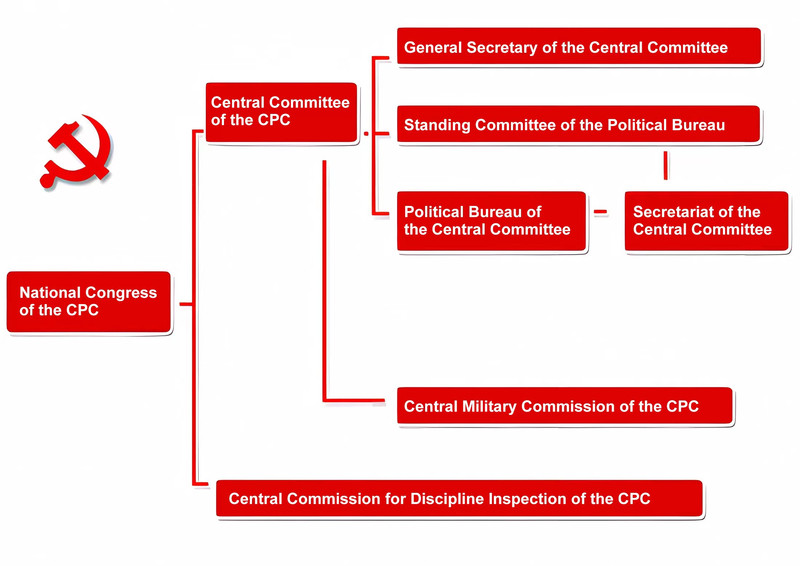
Chinese Communist Party leadership structure
Key Takeaways
Head Of State vs. Head Of Government
The head of state represents the country and performs constitutional, diplomatic, military, or ceremonial functions; the head of government directs daily governing, the cabinet, and the civil service
Chief Executive
The senior official who directs the executive functions of government, such as a president, prime minister, premier, or Supreme Leader
Executive Cabinet (Cabinet)
Senior ministers or department heads who advise the chief executive and direct major policy areas and government agencies
Civil Service (Bureaucracy)
The officials and agencies that administer laws and programs, regulate activity, provide public services, and enforce administrative rules
Policy Formulation
Developing governmental goals and proposals by setting agendas, preparing budgets or legislation, issuing directives, and negotiating with officials
Policy Implementation
Converting a law or executive decision into an operating program through regulations, resources, personnel, and organized public services
Policy Enforcement
Using administrative, legal, police, or military authority to secure compliance with laws and regulations
Formal Power vs. Actual Power
Formal power is authority granted by law or constitutional convention; actual power is the influence an officeholder exercises in political practice
Presidential System
An executive system in which a separately elected president serves for a fixed term and ordinarily combines the roles of head of state and head of government
Parliamentary System
An executive system in which a prime minister leads a government dependent on the confidence of the legislature
Semi-Presidential System
An executive system with both an elected president and a prime minister, dividing the offices of head of state and head of government
Dual Executive
An executive structure that divides senior executive roles between two offices, although their actual power may be highly unequal
Chinese Communist Party (CCP) / Communist Party Of China (CPC)
China's ruling party, whose leadership stands above and penetrates the state institutions that formally exercise executive authority
President Of China
China’s head of state, who nominates the premier and ordinarily also serves as CCP general secretary and Central Military Commission chair, making the officeholder the senior political leader and commander in chief
CCP General Secretary
The leader of the Chinese Communist Party and the party office that provides the president's authority over China's ruling political organization
Chair Of The Central Military Commission
The office that controls China's armed forces and makes its holder the country's commander in chief
Premier Of China
China's head of government, nominated by the president, who directs the State Council and oversees the civil service and daily administration beneath top party leadership
State Council Of China
China's cabinet and highest state administrative body, directed by the premier through its ministries and commissions
Chinese Executive Succession
Top leaders are chosen through closed-door Communist Party bargaining and deliberation, after which state institutions formally ratify the party's choices
Supreme Leader Of Iran
Iran’s unelected head of state and dominant authority, who sets the political agenda, commands the military, and appoints top ministers, the head of the judiciary, the Expediency Council, and half of the Guardian Council
President Of Iran
A popularly elected executive who may serve two consecutive four-year terms, oversees the civil service, appoints ministers subject to Majles confirmation, and conducts foreign policy within limits set by the Supreme Leader
Assembly Of Experts
Iran's elected but candidate-vetted body that formally selects a new Supreme Leader when the office becomes vacant
President Of Mexico
Mexico’s popularly elected head of state and government, commander in chief, and leader of the federal bureaucracy who leads foreign policy and may sign, promulgate, or veto legislation passed by Congress
Sexenio
Mexico's single six-year presidential term; the incumbent may not seek reelection
President Of Nigeria
Nigeria’s popularly elected head of state and government, commander in chief, and head of the federal civil service who conducts foreign policy and may sign or veto legislation passed by the National Assembly
Federal Executive Council
Nigeria's cabinet of presidentially appointed, Senate-confirmed ministers who direct federal departments and help formulate and implement policy
President Of Russia
Russia’s elected head of state and dominant executive, who commands the military, nominates the prime minister, appoints senior officials and ministers, directs security and foreign policy, issues decrees, and may dissolve the State Duma under specified circumstances
Prime Minister Of Russia
Russia's head of government, nominated by the president, who chairs the government, oversees the civil service, and administers economic and domestic programs under presidential dominance
Monarch Of The United Kingdom
The largely ceremonial head of state who formally appoints the prime minister, grants royal assent, and performs constitutional acts on ministerial advice
Prime Minister Of The United Kingdom
The head of government and chief executive who directs the cabinet, sets policy, supervises the civil service, acts as de facto commander in chief, and can initiate an early election
United Kingdom Cabinet
Senior ministers, nearly all members of Parliament, who direct departments under the prime minister and connect executive leadership to the Commons majority
Confidence Of The House Of Commons
The parliamentary support required for a prime minister and government to take office and remain in power
United Kingdom Prime-Ministerial Succession
A governing party may replace its leader without a general election, after which the monarch appoints the new leader prime minister if that person retains Commons confidence
Notes
Head Of State vs. Head Of Government
The head of state represents the country and performs constitutional, diplomatic, military, or ceremonial functions; the head of government directs daily governing, the cabinet, and the civil service
Chief Executive
The senior official who directs the executive functions of government, such as a president, prime minister, premier, or Supreme Leader
Executive Cabinet (Cabinet)
Senior ministers or department heads who advise the chief executive and direct major policy areas and government agencies
Civil Service (Bureaucracy)
The officials and agencies that administer laws and programs, regulate activity, provide public services, and enforce administrative rules
Policy Formulation
Developing governmental goals and proposals by setting agendas, preparing budgets or legislation, issuing directives, and negotiating with officials
Policy Implementation
Converting a law or executive decision into an operating program through regulations, resources, personnel, and organized public services
Policy Enforcement
Using administrative, legal, police, or military authority to secure compliance with laws and regulations
Formal Power vs. Actual Power
Formal power is authority granted by law or constitutional convention; actual power is the influence an officeholder exercises in political practice
Presidential System
An executive system in which a separately elected president serves for a fixed term and ordinarily combines the roles of head of state and head of government
Parliamentary System
An executive system in which a prime minister leads a government dependent on the confidence of the legislature
Semi-Presidential System
An executive system with both an elected president and a prime minister, dividing the offices of head of state and head of government
Dual Executive
An executive structure that divides senior executive roles between two offices, although their actual power may be highly unequal
Chinese Communist Party (CCP) / Communist Party Of China (CPC)
China's ruling party, whose leadership stands above and penetrates the state institutions that formally exercise executive authority
President Of China
China’s head of state, who nominates the premier and ordinarily also serves as CCP general secretary and Central Military Commission chair, making the officeholder the senior political leader and commander in chief
CCP General Secretary
The leader of the Chinese Communist Party and the party office that provides the president's authority over China's ruling political organization
Chair Of The Central Military Commission
The office that controls China's armed forces and makes its holder the country's commander in chief
Premier Of China
China's head of government, nominated by the president, who directs the State Council and oversees the civil service and daily administration beneath top party leadership
State Council Of China
China's cabinet and highest state administrative body, directed by the premier through its ministries and commissions
Chinese Executive Succession
Top leaders are chosen through closed-door Communist Party bargaining and deliberation, after which state institutions formally ratify the party's choices
Supreme Leader Of Iran
Iran’s unelected head of state and dominant authority, who sets the political agenda, commands the military, and appoints top ministers, the head of the judiciary, the Expediency Council, and half of the Guardian Council
President Of Iran
A popularly elected executive who may serve two consecutive four-year terms, oversees the civil service, appoints ministers subject to Majles confirmation, and conducts foreign policy within limits set by the Supreme Leader
Assembly Of Experts
Iran's elected but candidate-vetted body that formally selects a new Supreme Leader when the office becomes vacant
President Of Mexico
Mexico’s popularly elected head of state and government, commander in chief, and leader of the federal bureaucracy who leads foreign policy and may sign, promulgate, or veto legislation passed by Congress
Sexenio
Mexico's single six-year presidential term; the incumbent may not seek reelection
President Of Nigeria
Nigeria’s popularly elected head of state and government, commander in chief, and head of the federal civil service who conducts foreign policy and may sign or veto legislation passed by the National Assembly
Federal Executive Council
Nigeria's cabinet of presidentially appointed, Senate-confirmed ministers who direct federal departments and help formulate and implement policy
President Of Russia
Russia’s elected head of state and dominant executive, who commands the military, nominates the prime minister, appoints senior officials and ministers, directs security and foreign policy, issues decrees, and may dissolve the State Duma under specified circumstances
Prime Minister Of Russia
Russia's head of government, nominated by the president, who chairs the government, oversees the civil service, and administers economic and domestic programs under presidential dominance
Monarch Of The United Kingdom
The largely ceremonial head of state who formally appoints the prime minister, grants royal assent, and performs constitutional acts on ministerial advice
Prime Minister Of The United Kingdom
The head of government and chief executive who directs the cabinet, sets policy, supervises the civil service, acts as de facto commander in chief, and can initiate an early election
United Kingdom Cabinet
Senior ministers, nearly all members of Parliament, who direct departments under the prime minister and connect executive leadership to the Commons majority
Confidence Of The House Of Commons
The parliamentary support required for a prime minister and government to take office and remain in power
United Kingdom Prime-Ministerial Succession
A governing party may replace its leader without a general election, after which the monarch appoints the new leader prime minister if that person retains Commons confidence
