Topic 2.7 Notes – Independent Legislatures
What Legislative Independence Is
A legislature is independent when it can control its own work instead of just approving decisions made somewhere else. That means asking whether it can decide who gets in, what gets debated, how debate happens, what laws pass, and whether it can check other institutions.
This is the core distinction you need to keep straight:
- Formal power means powers written on paper.
- Practical autonomy means what the legislature can actually do in real politics.
Independence is a continuum. A legislature can be somewhat independent in debate but weak in agenda control, or elected but still tightly controlled.
Different dimensions to scan for in any case:
- Membership autonomy: who can run, who gets excluded
- Agenda autonomy: who decides what gets discussed or voted on
- Deliberative autonomy: whether members can debate and criticize freely
- Decision-making autonomy: whether its votes truly decide policy
- Oversight autonomy: whether it can investigate or limit other officials
- Practical autonomy: whether formal powers are used in practice
Being elected does not automatically make a legislature independent. Iran’s Majles is elected, but candidate vetting limits who can even appear on the ballot. Checks also do not automatically destroy independence. The UK Parliament faces party discipline and fused powers, but it still matters a lot in policymaking.
A strong exam answer usually does three things in order:
- Name the legislature’s formal power
- Name the outside institution or process limiting it
- Explain the effect on real independence
How China’s NPC Is Constrained
China’s National People’s Congress, or NPC, is formally the highest organ of state power. It passes laws, amends the constitution, elects the president, and approves the premier. On paper, that sounds very strong.
In practice, the NPC is usually a rubber-stamp legislature. It gives legal form to decisions made by the Chinese Communist Party. This party-state flowchart helps you see why the NPC’s formal powers do not translate into real independence.
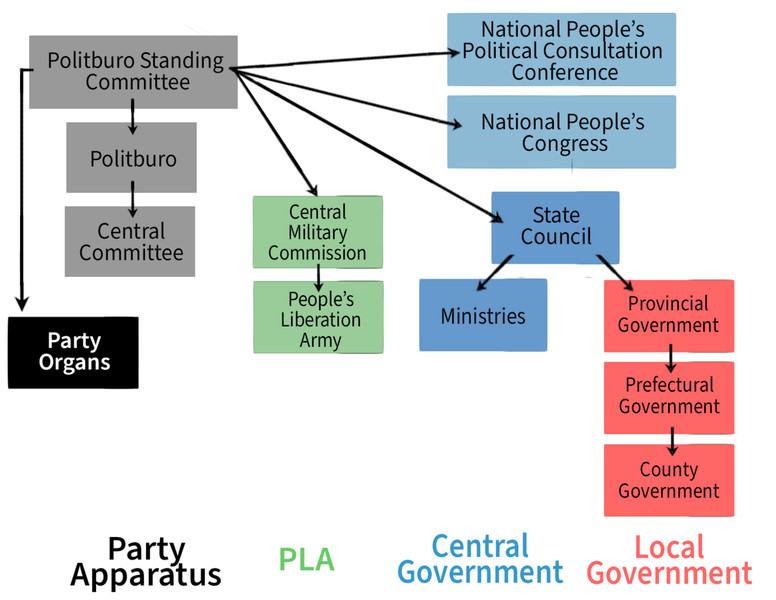
China’s party-state structure
Politburo Standing Committee
The Politburo Standing Committee is the real center of power in China. It is the top CCP leadership body and directs major policy and personnel decisions.
- This constrains the NPC from outside the legislature
- In the diagram, the key point is that the party leadership sits above the state institutions, including the NPC
- Major agenda-setting power lies with party leadership, not the full NPC
- Standard example: the 2018 constitutional amendment removing presidential term limits had party backing before the NPC approved it
So the NPC has constitutional status, but weak practical independence.
NPC Standing Committee
The NPC Standing Committee is different. It is a legislative body, not the top party leadership.
- It works most of the year while the full NPC is not in session
- It sets the legislative agenda
- It supervises elections of NPC members
- It interprets the constitution and laws
This constrains the full NPC from within the legislative structure because so much continuing power is concentrated in a smaller permanent body.
Keep these separate:
- Politburo Standing Committee = CCP leadership body
- NPC Standing Committee = legislative body
How Iran’s Majles Is Constrained
Iran’s Majles is an elected unicameral legislature. It passes laws, approves the budget, confirms cabinet nominees, and can host real factional debate. Its main limits come from theocratic institutions tied to the Supreme Leader, not mainly from the president.
The flowchart below helps you see the basic pattern. Elected institutions exist, but unelected bodies can still filter candidates and block legislation.
Guardian Council
The Guardian Council has 12 members.
- 6 Islamic jurists are appointed directly by the Supreme Leader
- 6 legal specialists are tied indirectly to him through the judiciary nomination process
It constrains the Majles in two major ways:
- Candidate vetting shapes who can run for the Majles and other offices
- Legislative review checks whether Majles laws match Islam and the constitution
This means:
- Ex ante constraint = before the election, it shapes membership
- Ex post constraint = after a law passes, it can reject the law
Standard example: before the 2004 Majles election, many reformist candidates were disqualified.
Expediency Council
The Expediency Council is selected by the Supreme Leader. It advises him and resolves disputes between the Majles and the Guardian Council.
Here’s how the dispute process works:
- The Majles passes a law
- The Guardian Council reviews it
- If rejected, it goes back to the Majles
- The Majles can revise it or insist
- If conflict continues, the Expediency Council resolves it
“Expediency” means the broader interests of the Islamic Republic. So the final decision can rest with an unelected body, which limits the Majles’s final authority.
Why Legislative Independence Matters
An independent legislature can strengthen legitimacy and stability because it can:
- Respond to public demand, so people feel represented
- Debate policy openly, making decisions look less arbitrary
- Facilitate compromise between factions, reducing conflict
- Extend civil liberties, protecting rights through law
- Restrict executive power, which increases accountability
China shows a different pattern. The NPC can still give the regime legitimacy by formalizing CCP policy, but that is not the same as independent accountability.
Iran shows partial independence. The Majles has debate and some representation, but the Guardian Council and Expediency Council limit full responsiveness.
Comparative reminders:
- UK: fused powers and strong party discipline, but the Commons can still scrutinize and remove a government
- Russia: the State Duma has formal powers, but pro-presidential dominance weakens practical autonomy
- Mexico and Nigeria: stronger formal separation and oversight potential, though party pressure, patronage, and executive influence still matter
The final distinction is the one the exam loves. Independence is about whether the legislature can genuinely shape policy, not whether it simply exists, meets, or votes.
Key Takeaways
Legislative Independence / Independent Legislature
The extent to which a legislature can control its membership, agenda, deliberations, decisions, and oversight without another institution routinely controlling or overriding it
Politburo Standing Committee
The Chinese Communist Party’s top collective leadership body and the actual center of power whose decisions guide the Chinese state and NPC.
Standing Committee of the National People’s Congress / NPC Standing Committee
The NPC’s permanent organ, which legislates while the full NPC is out of session, sets its agenda, supervises member elections, and interprets the constitution and laws
Rubber-Stamp Legislature
A legislature that chiefly gives formal approval and legal effect to decisions already made by the ruling leadership
Guardian Council
Iran’s 12-member supervisory body that vets electoral candidates and reviews Majles legislation for compatibility with Islam and the constitution
Expediency Council
A body selected by and advising Iran’s Supreme Leader that resolves persistent disputes between the Majles and the Guardian Council
Legitimacy
The public belief that a government has the right to rule
Political Stability
A political system’s ability to persist, maintain order, and manage conflict without collapse or uncontrolled violence
Notes
Legislative Independence / Independent Legislature
The extent to which a legislature can control its membership, agenda, deliberations, decisions, and oversight without another institution routinely controlling or overriding it
Politburo Standing Committee
The Chinese Communist Party’s top collective leadership body and the actual center of power whose decisions guide the Chinese state and NPC.
Standing Committee of the National People’s Congress / NPC Standing Committee
The NPC’s permanent organ, which legislates while the full NPC is out of session, sets its agenda, supervises member elections, and interprets the constitution and laws
Rubber-Stamp Legislature
A legislature that chiefly gives formal approval and legal effect to decisions already made by the ruling leadership
Guardian Council
Iran’s 12-member supervisory body that vets electoral candidates and reviews Majles legislation for compatibility with Islam and the constitution
Expediency Council
A body selected by and advising Iran’s Supreme Leader that resolves persistent disputes between the Majles and the Guardian Council
Legitimacy
The public belief that a government has the right to rule
Political Stability
A political system’s ability to persist, maintain order, and manage conflict without collapse or uncontrolled violence
