Topic 4.1 Notes – Electoral Systems and Rules
A country can hold elections and still tightly control outcomes. That’s why you always look at the full system together, including districts, formulas, ballot access, thresholds, and whether voters directly choose legislators.
What Electoral Systems and Rules Are
An electoral system is the set of rules that decides how votes become legislative seats. Those rules are political. They help some parties and groups more than others, and they often reflect what ruling elites want.
The main parts fit together like this:
- District magnitude means how many seats a district elects.
- Single-member districts elect one person.
- Multimember districts elect more than one.
- Electoral formula means how winners are chosen.
- Plurality / first-past-the-post = most votes wins.
- Proportional representation = seats match party vote share more closely.
- Mixed systems combine both.
- Ballot structure asks whether voters choose an individual candidate or a party list.
- Direct vs indirect election asks whether voters pick legislators themselves or choose lower bodies that choose higher ones.
- Ballot access and candidate vetting decide who can even appear on the ballot.
- Thresholds require a minimum vote share to win PR seats.
- Second rounds happen when one round does not settle all seats.
- Quotas and reserved seats increase representation for certain groups.
One of the biggest exam traps is treating elections as proof of democracy. You need competitiveness, real ballot access, and limits on elite control.
Main Electoral System Types
A quick way to sort electoral systems is by district structure. Some systems elect one representative per district, and others elect several.
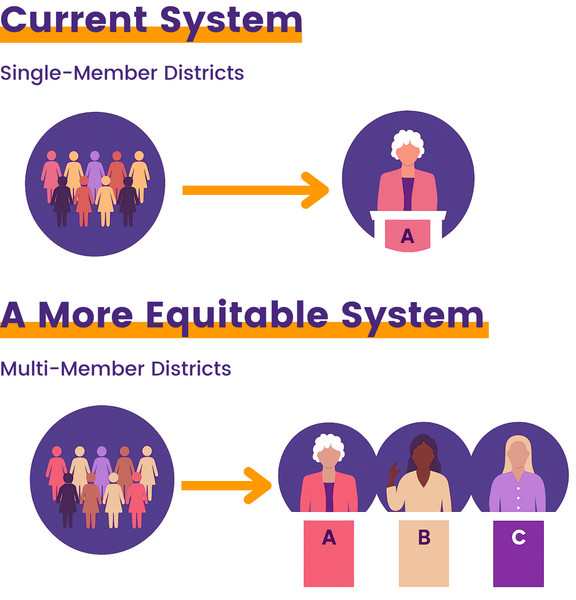
Single-member and multi-member districts
Single-member plurality and first-past-the-post
In the top part of the graphic, one district elects one representative. The candidate with the most votes wins. They do not need a majority.
This tends to help:
- larger parties
- parties with geographically concentrated support
Course examples:
- United Kingdom House of Commons: 650 MPs, directly elected in single-member constituencies by first-past-the-post
- Nigeria also uses direct election in single-member districts for both chambers
Proportional representation
The bottom part shows the basic idea behind PR. PR uses multimember districts and gives parties seats roughly based on vote share. This usually encourages multiparty systems because smaller parties can still win seats. It often uses party lists. A threshold can block very small parties.
Mixed systems
Mixed systems combine district seats and PR seats. Don’t label the whole legislature only one way. Mexico and Russia are the key examples.
How the Course Countries Elect Their Legislatures
It helps to locate the six course countries before comparing their election rules.
| Country | Legislative election rules |
|---|---|
| China | NPC chosen indirectly through lower-level people’s congresses; citizens vote locally, but CCP control limits real competition |
| Iran | Majles has 290 seats; direct elections in single-member and multimember districts; second round sometimes used; Guardian Council vets candidates; factions matter more than strong formal parties; 5 reserved seats for Jews, Zoroastrians, Assyrian and Chaldean Christians, Armenian Christians north, Armenian Christians south |
| Mexico | Congress of the Union is bicameral; Chamber of Deputies has 300 plurality district seats + 200 PR list seats; Senate has 96 seats in three-seat constituencies + 32 PR seats; gender quotas/parity rules increased women’s representation |
| Nigeria | National Assembly is bicameral and directly elected; House has 360 single-member seats by population; Senate has 109 seats, 3 per state plus 1 for Abuja/FCT; PDP and APC have alternated control |
| Russia | State Duma has 450 seats; 225 single-member district seats + 225 PR list seats; 5% threshold; changed to all-PR in 2007 and 2011, back to mixed in 2016 |
| United Kingdom | House of Commons directly elected in single-member constituencies by first-past-the-post; no second round, no majority required |
Rules That Expand or Limit Representation
Some rules widen choice. Others narrow it before voters even cast ballots.
- Direct election: Iran, Mexico, Nigeria, Russia, UK
- Indirect election: China’s NPC
Indirect election still uses elections. It is different from simple appointment. - Candidate vetting and ballot access
- Iran: Guardian Council screens candidates
- China: CCP control limits open competition
- Thresholds, quotas, reserved seats
- Russia: 5% threshold restricts small parties in PR
- Mexico: gender quotas/parity shape nominations
- Iran: reserved seats guarantee minority representation
Why Electoral Rules Matter
Electoral rules shape who gets represented and how democratic elections actually are.
- PR in multimember districts promotes more parties and broader representation.
- Single-member plurality usually concentrates seats in fewer parties.
- Mixed systems combine local district representation with party proportionality.
- Rule changes can open politics up or help elites stay in control.
Key Takeaways
Electoral System
The institutions and rules that determine who may compete and vote, how representatives are selected, and how votes are converted into public offices or legislative seats
Electoral District / Constituency
A geographic area whose voters select one or more representatives; constituency is the common British term
District Magnitude
The number of representatives elected from an electoral district
Single-Member District
An electoral district that elects one representative
Multimember District
An electoral district that elects two or more representatives and is required for proportional representation
Electoral Formula
The rule used to convert votes into winners or legislative seats, such as plurality or proportional representation
Ballot Structure
The rules determining whether voters select individual candidates, political parties, or party lists
Ballot Access
The requirements a candidate or party must satisfy to appear on the ballot and compete in an election
Proportional Representation (PR)
A system allocating seats in approximate proportion to parties’ vote shares through multimember districts, thereby promoting multiparty representation
Party-List Proportional Representation
Voters support a party or its candidate list, parties receive seats according to vote share, and candidates fill those seats from the lists
Electoral Threshold
The minimum vote share a party must receive to participate in the proportional allocation of seats
Mixed Electoral System
An electoral system combining multiple formulas, typically single-member district elections for some seats and party-list proportional representation for others
Direct Election
An election in which voters directly determine the officeholders, either by choosing candidates or by voting for a party list whose candidates receive seats
Indirect Election
An election in which voters choose a lower-level body whose members then select officials at a higher level
Second-Round Voting
An additional ballot held when the first round does not satisfy the legal requirements needed to fill an office or all available seats
Competitive Selection
Electoral selection in which meaningful alternatives can access the ballot and voters can determine which candidates receive office
Candidate Quota
A rule requiring parties to nominate a specified proportion of candidates from a designated group without guaranteeing that group seats
Reserved Seat
A legislative seat set aside for a designated group, directly guaranteeing that group representation
China’s National People’s Congress Electoral System
Citizens elect county and township congresses, successively higher congresses elect those above them, and provincial-level bodies select up to 3,000 NPC deputies
Iran’s Majles Electoral System
The 290 members are directly elected from single-member and multimember districts, sometimes through second rounds, after Guardian Council vetting; five seats are reserved for non-Muslim minorities
Mexico’s Chamber of Deputies Electoral System
Of 500 deputies, 300 are elected by plurality from single-member districts and 200 by party-list PR from five 40-seat regional constituencies
Mexico’s Senate Electoral System
Each of 32 federal entities elects two senators from the first-place slate and one from the second-place slate, while 32 additional senators are elected by nationwide party-list PR.
Nigeria’s House of Representatives Electoral System
Its 360 members are directly elected by plurality from single-member districts, with each state’s number of districts based on population
Nigeria’s Senate Electoral System
Each of the 36 states directly elects three senators from single-member districts, and the Federal Capital Territory elects one, for 109 senators total
Russia’s State Duma Electoral System
Of 450 deputies, 225 are elected from single-member districts and 225 by nationwide party-list PR with a 5% threshold; the mixed system was restored in 2016 after two all-PR elections
United Kingdom’s House of Commons Electoral System
Each of 650 MPs is directly elected from a single-member constituency by first-past-the-post, with no majority requirement or second round
Plurality Voting
An electoral formula in which the candidate receiving more votes than any other candidate wins, without needing an absolute majority
First-Past-the-Post
Plurality voting in a single-member district: the candidate with the most votes wins the district’s seat
Guardian Council Candidate Vetting
Before Iran’s Majles elections, the Guardian Council screens prospective candidates and may exclude them from the ballot, restricting electoral competition
Notes
Electoral System
The institutions and rules that determine who may compete and vote, how representatives are selected, and how votes are converted into public offices or legislative seats
Electoral District / Constituency
A geographic area whose voters select one or more representatives; constituency is the common British term
District Magnitude
The number of representatives elected from an electoral district
Single-Member District
An electoral district that elects one representative
Multimember District
An electoral district that elects two or more representatives and is required for proportional representation
Electoral Formula
The rule used to convert votes into winners or legislative seats, such as plurality or proportional representation
Ballot Structure
The rules determining whether voters select individual candidates, political parties, or party lists
Ballot Access
The requirements a candidate or party must satisfy to appear on the ballot and compete in an election
Proportional Representation (PR)
A system allocating seats in approximate proportion to parties’ vote shares through multimember districts, thereby promoting multiparty representation
Party-List Proportional Representation
Voters support a party or its candidate list, parties receive seats according to vote share, and candidates fill those seats from the lists
Electoral Threshold
The minimum vote share a party must receive to participate in the proportional allocation of seats
Mixed Electoral System
An electoral system combining multiple formulas, typically single-member district elections for some seats and party-list proportional representation for others
Direct Election
An election in which voters directly determine the officeholders, either by choosing candidates or by voting for a party list whose candidates receive seats
Indirect Election
An election in which voters choose a lower-level body whose members then select officials at a higher level
Second-Round Voting
An additional ballot held when the first round does not satisfy the legal requirements needed to fill an office or all available seats
Competitive Selection
Electoral selection in which meaningful alternatives can access the ballot and voters can determine which candidates receive office
Candidate Quota
A rule requiring parties to nominate a specified proportion of candidates from a designated group without guaranteeing that group seats
Reserved Seat
A legislative seat set aside for a designated group, directly guaranteeing that group representation
China’s National People’s Congress Electoral System
Citizens elect county and township congresses, successively higher congresses elect those above them, and provincial-level bodies select up to 3,000 NPC deputies
Iran’s Majles Electoral System
The 290 members are directly elected from single-member and multimember districts, sometimes through second rounds, after Guardian Council vetting; five seats are reserved for non-Muslim minorities
Mexico’s Chamber of Deputies Electoral System
Of 500 deputies, 300 are elected by plurality from single-member districts and 200 by party-list PR from five 40-seat regional constituencies
Mexico’s Senate Electoral System
Each of 32 federal entities elects two senators from the first-place slate and one from the second-place slate, while 32 additional senators are elected by nationwide party-list PR.
Nigeria’s House of Representatives Electoral System
Its 360 members are directly elected by plurality from single-member districts, with each state’s number of districts based on population
Nigeria’s Senate Electoral System
Each of the 36 states directly elects three senators from single-member districts, and the Federal Capital Territory elects one, for 109 senators total
Russia’s State Duma Electoral System
Of 450 deputies, 225 are elected from single-member districts and 225 by nationwide party-list PR with a 5% threshold; the mixed system was restored in 2016 after two all-PR elections
United Kingdom’s House of Commons Electoral System
Each of 650 MPs is directly elected from a single-member constituency by first-past-the-post, with no majority requirement or second round
Plurality Voting
An electoral formula in which the candidate receiving more votes than any other candidate wins, without needing an absolute majority
First-Past-the-Post
Plurality voting in a single-member district: the candidate with the most votes wins the district’s seat
Guardian Council Candidate Vetting
Before Iran’s Majles elections, the Guardian Council screens prospective candidates and may exclude them from the ballot, restricting electoral competition
