Topic 3.1 Notes – Civil Society
Civil society, defined
Civil society means voluntary groups outside direct state control. The key test is autonomy. A group counts when it can control its own leadership, message, membership, and activities.
That means a group does not have to be openly political to belong to civil society. A church group, neighborhood association, charity, or professional society can count if it is independent.
The course’s main civil society groups are:
- Local religious organizations like congregations or faith networks
- Neighborhood and community organizations that solve local problems or mobilize residents
- News media when they operate independently enough to investigate and publish freely
- Business and professional associations that represent shared interests outside the state
- Labor organizations like unions
- NGOs or nongovernmental organizations
NGOs
NGOs are independent of government and often work on:
- human rights
- humanitarian relief
- public health
- environment
- development
- accountability
A group can still count as civil society even if it registers with the government, gets some public funding, or works with officials. What matters is whether the state controls it.
Not civil society:
- the state and its agencies
- legislatures and courts
- government-created mass organizations
- political parties trying to win control of government
- businesses acting only to make profit
Strong vs Weak Civil Society
A strong civil society has more than lots of organizations on paper. It has real freedom to act.
- Variety of groups and viewpoints
- Broad participation by citizens
- Protection for association, expression, religion, assembly, and press
- Independence from the state
- Access to funding, information, and communication
- Ability to criticize officials and survive leadership changes
Regime type shapes all of this. Democracies usually allow more autonomous groups. Authoritarian regimes often allow service charities but restrict watchdogs, labor independence, rights groups, and organizers. In the democracy framework below, focus on how civil society sits within participation and connects to basic rights like association, assembly, expression, and press freedom.
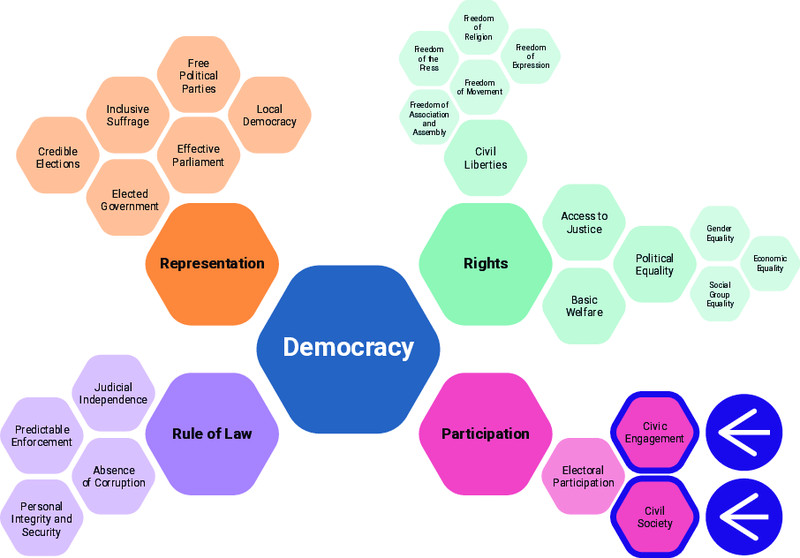
Democracy framework highlighting civil society and rights
Common restrictions include:
- registration or official sponsorship requirements
- denial of registration
- surveillance of meetings or finances
- limits on foreign funding
- foreign agent labels
- censorship or license revocation
- harassment, arrests, prosecutions
- state-created substitute groups
- use of national security, public order, or religious law
One nuance teachers love to test: regulation alone is not repression. The real question is whether rules are neutral or selectively used to control opponents.
What Civil Society Does
Civil society helps citizens act collectively instead of one by one, which gives them much more political weight.
Its four core functions are:
- Monitoring and lobbying government through reports, campaigns, testimony, and pressure
- Exposing governmental malfeasance such as corruption, abuse of power, unlawful violence, or misuse of funds
- Representing interests by expressing what members or communities want
- Providing organizational experience in leadership, fundraising, coalition building, and communication
Independent media matter a lot here because they spread information beyond one group.
A robust civil society can push democratization by building independent power centers, spreading information, checking rulers, defending liberties, monitoring elections, and exposing corruption. It does not guarantee democracy. Some groups get co-opted, divided, repressed, or even support authoritarian goals.
Civil Society in the Course Countries
| Country | Civil society pattern | Key examples |
|---|---|---|
| United Kingdom | Robust and protected in a liberal democracy | Liberty, trade unions, charities, independent press; BBC is influential but less clear-cut because of public status |
| Mexico | Grew more autonomous as PRI dominance weakened | 1985 Mexico City earthquake citizen groups, election-monitoring and human rights NGOs, Ayotzinapa 43, democratization ending in Vicente Fox’s 2000 win |
| Nigeria | Active but uneven | MOSOP and Ken Saro-Wiwa represented Ogoni interests, exposed abuses, faced repression under Sani Abacha; later helped transition to civilian rule in 1999 |
| Russia | Narrowed under Putin | 2012 foreign-agent law, 2015 undesirable-organizations law, Memorial dissolved in 2021 |
| China | Selective tolerance under CCP rule | 2017 Foreign NGO Law, Falun Gong crackdown after 1999 gathering, official mass organizations lack full autonomy |
| Iran | Exists under heavy theocratic constraints | expansion under Khatami, closure of Center for Defenders of Human Rights, Shirin Ebadi, repression after 2009 Green Movement, limits on journalists and activists, bonyads are not fully autonomous |
Civil Society and Civil Liberties
Restrictions on civil society show the gap between formal rights and actual practice. The most relevant liberties are association, expression, press, assembly, and religion.
- China’s Article 35 formally protects freedoms, but the CCP restricts them in practice.
- Iran’s constitution includes rights, but qualifies them through Islam and the Islamic Republic.
- Russia, Mexico, Nigeria, and the UK also formally protect these liberties, though practice varies.
Key Takeaways
Civil Society
The sphere of voluntary, meaningfully autonomous organizations outside direct state control through which people pursue shared interests, values, identities, or goals
Nongovernmental Organization (NGO)
A government-independent organization that works on issues such as human rights, relief, health, development, the environment, or government accountability
Robust Civil Society
A diverse, participatory, legally protected, and autonomous network of organizations able to obtain resources, criticize officials, and influence government or the public
Governmental Malfeasance
Misconduct by public officials, including corruption, abuse of power, unlawful violence, or misuse of public funds
Civil Society as an Agent of Democratization
Autonomous organizations promote democratization by spreading information, building citizen skills and coalitions, defending liberties, and increasing government accountability and competition
Movement for the Survival of the Ogoni People (MOSOP)
A Nigerian civil society organization that represented Ogoni interests, publicized Niger Delta environmental damage, and demanded accountability from government and oil companies
Russian Foreign-Agent Law (2012)
A law imposing registration, reporting burdens, and a stigmatizing foreign-agent label on organizations receiving foreign support and engaging in broadly defined political activity
Russian Undesirable-Organizations Law (2015)
A law allowing Russian authorities to ban foreign or international organizations deemed threats to the state
Memorial
A Russian organization that documented Soviet repression and defended human rights; courts dissolved major parts of it in 2021 under foreign-agent requirements
China’s Foreign NGO Law (2017)
A law placing foreign NGOs under public-security supervision and requiring registration and official sponsorship or a Chinese partner for their activities
Falun Gong
A spiritual organization with a large autonomous following that China banned and severely repressed after its members mobilized near Beijing’s leadership compound in 1999
Center for Defenders of Human Rights
An Iranian organization associated with Shirin Ebadi that documented abuses and represented political prisoners until authorities closed its office in 2008
Bonyads
Iranian religious and charitable foundations whose ties to the clerical establishment and state privileges make them questionable examples of autonomous civil society
Monitoring and Lobbying Government
Observing government actions and advocating policy preferences through reports, meetings, campaigns, testimony, or publicity
Exposing Governmental Malfeasance
Investigating and publicizing corruption, abuse of power, unlawful violence, or misuse of public funds by officials
Representing Interests
Identifying members’ shared interests and communicating them to government or the broader public
Providing Organizational Experience
Teaching citizens leadership, fundraising, negotiation, communication, and collective-action skills that can support political participation
Notes
Civil Society
The sphere of voluntary, meaningfully autonomous organizations outside direct state control through which people pursue shared interests, values, identities, or goals
Nongovernmental Organization (NGO)
A government-independent organization that works on issues such as human rights, relief, health, development, the environment, or government accountability
Robust Civil Society
A diverse, participatory, legally protected, and autonomous network of organizations able to obtain resources, criticize officials, and influence government or the public
Governmental Malfeasance
Misconduct by public officials, including corruption, abuse of power, unlawful violence, or misuse of public funds
Civil Society as an Agent of Democratization
Autonomous organizations promote democratization by spreading information, building citizen skills and coalitions, defending liberties, and increasing government accountability and competition
Movement for the Survival of the Ogoni People (MOSOP)
A Nigerian civil society organization that represented Ogoni interests, publicized Niger Delta environmental damage, and demanded accountability from government and oil companies
Russian Foreign-Agent Law (2012)
A law imposing registration, reporting burdens, and a stigmatizing foreign-agent label on organizations receiving foreign support and engaging in broadly defined political activity
Russian Undesirable-Organizations Law (2015)
A law allowing Russian authorities to ban foreign or international organizations deemed threats to the state
Memorial
A Russian organization that documented Soviet repression and defended human rights; courts dissolved major parts of it in 2021 under foreign-agent requirements
China’s Foreign NGO Law (2017)
A law placing foreign NGOs under public-security supervision and requiring registration and official sponsorship or a Chinese partner for their activities
Falun Gong
A spiritual organization with a large autonomous following that China banned and severely repressed after its members mobilized near Beijing’s leadership compound in 1999
Center for Defenders of Human Rights
An Iranian organization associated with Shirin Ebadi that documented abuses and represented political prisoners until authorities closed its office in 2008
Bonyads
Iranian religious and charitable foundations whose ties to the clerical establishment and state privileges make them questionable examples of autonomous civil society
Monitoring and Lobbying Government
Observing government actions and advocating policy preferences through reports, meetings, campaigns, testimony, or publicity
Exposing Governmental Malfeasance
Investigating and publicizing corruption, abuse of power, unlawful violence, or misuse of public funds by officials
Representing Interests
Identifying members’ shared interests and communicating them to government or the broader public
Providing Organizational Experience
Teaching citizens leadership, fundraising, negotiation, communication, and collective-action skills that can support political participation
