Topic 1.7 Notes – Federal and Unitary Systems
What Federal and Unitary Systems Are
This is about the territorial distribution of power, not whether a country is democratic or authoritarian.
- In a federal system, the constitution divides power between the national government and regional governments. Regional governments have authority the center cannot just erase.
- In a unitary system, ultimate constitutional authority stays with the national government. Regions can have power, but the center gave it and can change it.
Course-country split
| Federal | Unitary |
|---|---|
| Mexico | China |
| Nigeria | Iran |
| Russia | United Kingdom |
The exam often pushes one key distinction. Formal structure and actual practice are not the same thing.
- Russia is federal on paper, but heavily centralized in reality.
- United Kingdom is unitary on paper, but devolved in practice.
- China is unitary, but local governments sometimes get room to experiment.
Regional autonomy is still not sovereignty. States or provinces usually cannot leave on their own, and the national government usually keeps defense, foreign affairs, and currency.
Federal vs Unitary Features and Why States Choose Them
Federal systems usually have two constitutionally recognized levels of government.
- National government usually handles defense, foreign affairs, currency, and national economic policy.
- Regional governments often handle education, health care, policing, transportation, and social services.
Unitary systems keep final authority at the center.
- Provinces or regions may administer policy.
- The center can change their boundaries, powers, or institutions.
States choose federalism to:
- accommodate ethnic, linguistic, religious, or regional diversity
- reduce conflict by sharing power
- bring policy closer to local communities
- allow policy variation
- govern large or diverse territory
- spread offices and resources across regions
States choose unitarism to:
- create uniform laws and policies
- coordinate policy faster
- simplify administration
- strengthen national unity
- keep tighter control over security and economic planning
The tradeoff is straightforward. Federalism gives flexibility and representation, but can strengthen regional identity and create uneven services. Unitarism gives coordination and uniformity, but may be less responsive locally.
Centralization, Decentralization, and Devolution
These terms explain what power looks like in practice.
- Centralization means effective power is concentrated nationally.
- Decentralization means responsibilities move away from the center.
- Devolution means real decision-making power goes to regional institutions.
In a unitary state, devolved power still depends on the national government. In a federal state, regional power rests on the constitution.
A weaker version is administrative delegation. Local officials carry out national policy, but they do not make independent policy.
A great AP test for any country has two parts:
- What is the legal source of regional authority?
- How much power do regions actually exercise?
Shifts happen because of:
- ethnic and regional cleavages
- separatist movements
- security threats
- democratization
- economic reform
- supranational organizations and other countries
The Federal Course Countries
Mexico
The 1917 Constitution created a federal system with 31 states plus Mexico City. States have their own constitutions, governors, legislatures, and courts. In practice, PRI dominance from 1929 to 2000 made the system more centralized. Democratization gave governors more independence, but states still depend heavily on federal transfers, so fiscal power stays centralized.
Nigeria
The 1999 Constitution created a federation of 36 states plus the Federal Capital Territory. Federalism helps manage major cleavages, especially Hausa-Fulani, Yoruba, and Igbo, plus the Muslim north and Christian south. State creation expanded from 3 regions to 36 states to weaken old regional blocs. After 1999, 12 northern states expanded Sharia criminal law, showing real regional autonomy. Oil revenue still keeps the center powerful.
Russia
The 1993 Constitution defines Russia as federal. In the 1990s under Boris Yeltsin, regions had more autonomy and some got special bilateral agreements. Chechnya and the First Chechen War (1994-1996) plus Second Chechen War (beginning 1999) showed there was no accepted right to secede. Under Vladimir Putin, Russia recentralized through seven federal districts in 2000 (a North Caucasus district was split off in 2010, so current maps show eight), the end of direct gubernatorial elections after the 2004 Beslan school siege, and tightly controlled restored elections in 2012.
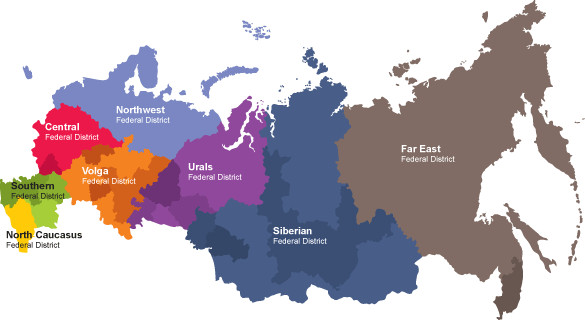
Russia’s federal districts
The Unitary Course Countries
China
China is a unitary state under CCP control. Provinces administer policy but do not have constitutionally protected sovereignty. The five autonomous regions are Guangxi, Inner Mongolia, Ningxia, Tibet, and Xinjiang. Deng Xiaoping-era reforms allowed local economic experimentation, but the 1994 tax-sharing reform pulled revenue power back to the center. Hong Kong and Macao are special administrative regions, but China is still unitary.
Iran
Iran is a unitary Islamic republic. Provinces are administrative units inside a centralized system tied to the Supreme Leader and national religious-political institutions. Local councils exist, but there is no federal-style regional sovereignty. Centralization helps the regime maintain unity across Azeri, Kurd, Arab, and Baluchi populations.
United Kingdom
The UK is a unitary state based on parliamentary sovereignty, but it has devolution, not federalism. Key laws and agreements were all in 1998: the Scotland Act, Government of Wales Act, and the Good Friday Agreement, which helped create the Northern Ireland Assembly. Devolved governments handle education, health, and transportation, while Westminster keeps defense and foreign affairs. Devolution is asymmetrical, and England has no separate parliament. Brexit and EU exit in 2020 shifted authority again and showed how supranational organizations affect power distribution.
Key Takeaways
Federal System / Federal State / Federalism
A system constitutionally dividing authority between national and regional governments, often to provide local autonomy and accommodate regional diversity; Mexico, Nigeria, and Russia are federal
Unitary System / Unitary State / Unitarism
A system in which the national government holds ultimate constitutional authority and may alter or withdraw subnational powers; China, Iran, and the United Kingdom are unitary
Centralization
The concentration of effective decision-making authority at the national level, regardless of a state’s formal federal or unitary classification
Decentralization
The movement of administrative, fiscal, or political responsibilities away from the national government
Devolution
The transfer of decision-making authority from the national government to regional institutions; in a unitary state, the center retains ultimate legal authority
Administrative Delegation
An arrangement in which local officials implement national policy under national direction, with discretion but no independent right to set policy
Mexico’s Federal System
A federation of 32 entities whose states have constitutional powers, but historical PRI control and dependence on federal transfers have strengthened the center
Nigeria’s Federal System
A 36-state federation designed to manage ethnic, religious, and regional cleavages, with regional policy variation but strong central control through oil revenue
Russia’s Federal System
A constitutional federation that became highly centralized under Vladimir Putin, leaving regional governments with much less practical autonomy than the formal structure suggests
China’s Unitary System
A unitary party-state in which local governments may exercise substantial administrative and economic discretion, but the national government can revise or withdraw it
Iran’s Unitary System
A centralized unitary system in which provinces and elected local councils administer services but lack constitutionally protected independent powers
United Kingdom’s Unitary System
A unitary state with extensive asymmetrical devolution to Scotland, Wales, and Northern Ireland, while Parliament at Westminster retains ultimate legal authority
Parliamentary Sovereignty
The principle that the United Kingdom’s Parliament holds ultimate legal authority, including the power to change the statutory basis of devolution
Notes
Federal System / Federal State / Federalism
A system constitutionally dividing authority between national and regional governments, often to provide local autonomy and accommodate regional diversity; Mexico, Nigeria, and Russia are federal
Unitary System / Unitary State / Unitarism
A system in which the national government holds ultimate constitutional authority and may alter or withdraw subnational powers; China, Iran, and the United Kingdom are unitary
Centralization
The concentration of effective decision-making authority at the national level, regardless of a state’s formal federal or unitary classification
Decentralization
The movement of administrative, fiscal, or political responsibilities away from the national government
Devolution
The transfer of decision-making authority from the national government to regional institutions; in a unitary state, the center retains ultimate legal authority
Administrative Delegation
An arrangement in which local officials implement national policy under national direction, with discretion but no independent right to set policy
Mexico’s Federal System
A federation of 32 entities whose states have constitutional powers, but historical PRI control and dependence on federal transfers have strengthened the center
Nigeria’s Federal System
A 36-state federation designed to manage ethnic, religious, and regional cleavages, with regional policy variation but strong central control through oil revenue
Russia’s Federal System
A constitutional federation that became highly centralized under Vladimir Putin, leaving regional governments with much less practical autonomy than the formal structure suggests
China’s Unitary System
A unitary party-state in which local governments may exercise substantial administrative and economic discretion, but the national government can revise or withdraw it
Iran’s Unitary System
A centralized unitary system in which provinces and elected local councils administer services but lack constitutionally protected independent powers
United Kingdom’s Unitary System
A unitary state with extensive asymmetrical devolution to Scotland, Wales, and Northern Ireland, while Parliament at Westminster retains ultimate legal authority
Parliamentary Sovereignty
The principle that the United Kingdom’s Parliament holds ultimate legal authority, including the power to change the statutory basis of devolution
