Topic 2.8 Notes – Judicial Systems
What Judiciaries Do
A judiciary is the set of courts and judicial officials that interpret and apply law. Courts settle disputes, decide whether laws were broken, and sometimes judge whether government actions are legal.
Across the course countries, courts often handle:
- Criminal and civil cases such as prosecutions, contracts, family disputes, and property conflicts.
- Appeals from lower courts, which lets higher courts fix errors and create consistent legal rules.
- Constitutional disputes over whether laws or actions fit the constitution.
- Conflicts between levels of government such as national vs regional powers in federal systems.
- Rights and liberties claims when people argue the state violated legal protections.
Judicial review
Judicial review means a court can decide whether a law or government action violates a constitution or higher law. This matters because it can turn courts into a check on other branches.
The exam loves this distinction:
- De jure power = authority courts have on paper
- De facto power = authority courts actually use in real politics
Russia is the classic example. Judicial review exists formally, but courts do not meaningfully restrain those in power.
Rule of law and rule by law
- Rule of law means government officials are also bound by law. Courts can check public authorities. The clearest example is the United Kingdom.
- Rule by law means rulers use law and courts to govern and control society, but courts do not truly constrain rulers. The clearest example is China.
Legal traditions
Legal systems shape how courts work:
- Common law in the UK and partly Nigeria relies heavily on precedent.
- Sharia shapes Iran’s whole legal system and appears in northern Nigerian states.
- Mixed systems matter more than labels. Nigeria is a great example because federal, customary, common, and Sharia law all matter.
How Judges Are Selected
Who picks judges tells you which institutions influence the courts.
- China: the CCP controls most judicial appointments.
- Iran: the Supreme Leader appoints the head of the judiciary.
- Mexico: the president nominates Supreme Court magistrates, the Senate approves, and they serve 15-year terms.
- Nigeria: the National Judicial Council recommends, the president appoints, and the Senate confirms.
- Russia: the president nominates, the Federation Council approves.
- United Kingdom: judges come through professional appointment procedures, with formal appointment by the monarch on advice.
Legislative confirmation only works as a real check when the legislature is independent. That is why Mexico, Nigeria, and Russia can all involve presidents but still produce very different results. China and Iran tie courts more directly to ruling party or religious authority.
How courts work in each course country
China
China has a hierarchy of people’s courts led by the Supreme People’s Court. Courts handle ordinary disputes, but the CCP stays above the judiciary. Ordinary courts do not exercise independent constitutional review. The NPC and its Standing Committee control constitutional interpretation.
Iran
Iran’s judiciary is built to ensure law follows Islamic Sharia. Judges must be trained in Sharia law. The diagram below helps you connect the judiciary to the rest of Iran’s political structure. The head of the judiciary, appointed by the Supreme Leader, appoints six members of the Guardian Council, and Parliament approves them. The Guardian Council reviews laws for constitutionality and compatibility with Islam.
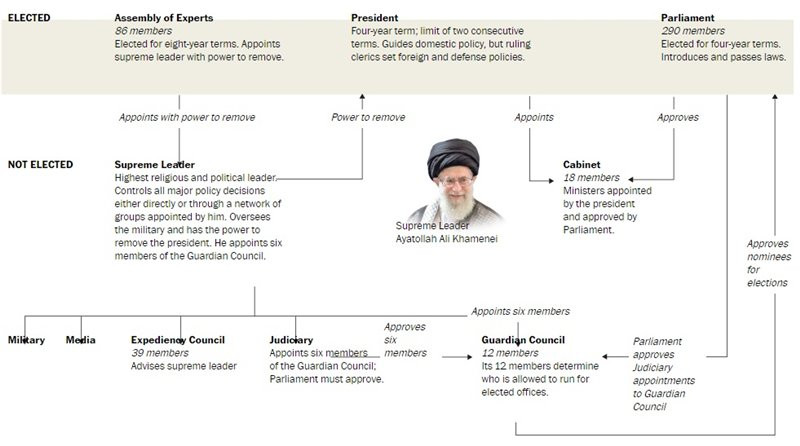
Iran’s political structure
Mexico
Mexico’s Supreme Court of Justice of the Nation has judicial review. The key protection is amparo, which lets individuals seek protection from unconstitutional government action. Mexico’s judiciary is moving toward greater independence, and 1994 judicial reforms are the named example you need to know.
Nigeria
Nigeria has a federal judiciary led by the Supreme Court. It uses judicial review and hears constitutional, election, and federal disputes. Courts have tried to rebuild legitimacy by reducing corruption. Under federalism, Sharia courts in northern states operate within a plural legal system.
Russia
Russia has both a Supreme Court and a Constitutional Court. Judicial review exists formally, but courts do not use it to limit the governing branches. Courts are also used against opposition figures. Alexei Navalny is the standard example.
United Kingdom
The UK Supreme Court is the final court of appeal. The system follows common law and protects civil and human rights, reviews executive legality, and settles devolution disputes. Because of parliamentary sovereignty, courts usually cannot strike down an Act of Parliament. Under the Human Rights Act, they can issue declarations of incompatibility. In the 2019 prorogation case, the Court ruled Boris Johnson’s suspension of Parliament unlawful.
Big Comparisons to Lock In
- Mexico, Nigeria, and Russia all have judicial review, but Mexico’s is increasingly meaningful, Nigeria’s is real but limited by corruption and capacity, and Russia’s is mostly formal.
- Iran and Nigeria both involve Sharia, but Iran is a national theocratic system and Nigeria uses Sharia regionally in northern states.
- UK vs China gives you the clearest rule of law vs rule by law contrast.
- The most important comparison in this topic is always formal structure vs actual operation.
Key Takeaways
Judiciary
The courts and judicial officials that interpret and apply law, resolve disputes, determine legal responsibility, and sometimes review government action
Judicial Review
A court’s authority to determine whether laws or government actions conflict with a constitution or other superior law
Rule of Law
The principle that officials and ordinary people are equally subject to law and that courts can enforce lawful limits on government
Rule by Law
The use of laws and courts by rulers to administer society and control opponents without meaningfully constraining the rulers themselves
Common Law
A legal tradition in which judicial precedents and earlier court decisions help establish legal rules
Islamic Sharia Law
Islamic religious law that underlies Iran’s national legal order and is also applied by Sharia courts in northern Nigeria
Parliamentary Sovereignty
The principle that the UK Parliament is legally supreme, so courts generally cannot invalidate its primary legislation
De Jure vs. De Facto Judicial Power
De jure power exists by law; de facto power is what courts can and do exercise in practice
People’s Courts of China
A hierarchy headed by the Supreme People’s Court that resolves ordinary cases but remains subordinate to the Chinese Communist Party and cannot independently strike down national laws
Chinese Judicial Appointments
The Chinese Communist Party controls most judicial appointments, keeping the courts subordinate to Party leadership
Iranian Judiciary
A court system led by a Supreme Leader appointee in which judges trained in Sharia safeguard a legal order based on Islamic law
Iranian Judicial Leadership Selection
The Supreme Leader appoints the judiciary’s head, who nominates six legal experts for the Guardian Council from whom the Majles selects six
Guardian Council of Iran
A twelve-member body that reviews Majles legislation for compatibility with the constitution and Islamic law rather than serving as Iran’s supreme appellate court
Supreme Court of Justice of the Nation
Mexico’s highest federal court, with authority to review laws and government actions for consistency with the Constitution
Amparo
Mexico’s process through which individuals seek judicial protection from government laws or actions alleged to violate constitutional rights
1994 Mexican Judicial Reforms
Reforms that reorganized Mexico’s Supreme Court, strengthened constitutional review, and created new arrangements for judicial administration
Mexican Supreme Court Appointment Process
The president nominates Supreme Court magistrates, the Senate approves them, and they serve fixed 15-year terms
Nigerian Judiciary
A federal court system headed by the Supreme Court that possesses judicial review but faces continuing corruption, legitimacy, and enforcement challenges
Nigerian Supreme Court Appointment Process
The National Judicial Council recommends candidates, the president appoints them, and the Senate confirms them
Sharia Courts of Northern Nigeria
State-level courts in northern Nigeria that apply Islamic law as one component of the country’s federal and legally plural system
Russian Constitutional Court
A court with formal authority to review laws and government actions that has not used that power to meaningfully limit the governing branches
Russian Judicial Appointment Process
The president nominates high-level judges and the Federation Council approves them, with executive dominance limiting the confirmation process as a check
Supreme Court of the United Kingdom
The final appellate court that protects rights, reviews executive legality, and resolves devolution disputes but generally cannot invalidate acts of Parliament
United Kingdom Senior-Judge Selection
Senior judges are chosen through professional selection procedures and formally appointed by the monarch on advice
Mexican Judiciary in Transition
A judiciary reshaped by reforms intended to increase its independence, professionalism, and effectiveness, though corruption and uneven enforcement remain
Russian Judiciary
A politically constrained court system that reinforces governing authorities and is used to target political opposition
Notes
Judiciary
The courts and judicial officials that interpret and apply law, resolve disputes, determine legal responsibility, and sometimes review government action
Judicial Review
A court’s authority to determine whether laws or government actions conflict with a constitution or other superior law
Rule of Law
The principle that officials and ordinary people are equally subject to law and that courts can enforce lawful limits on government
Rule by Law
The use of laws and courts by rulers to administer society and control opponents without meaningfully constraining the rulers themselves
Common Law
A legal tradition in which judicial precedents and earlier court decisions help establish legal rules
Islamic Sharia Law
Islamic religious law that underlies Iran’s national legal order and is also applied by Sharia courts in northern Nigeria
Parliamentary Sovereignty
The principle that the UK Parliament is legally supreme, so courts generally cannot invalidate its primary legislation
De Jure vs. De Facto Judicial Power
De jure power exists by law; de facto power is what courts can and do exercise in practice
People’s Courts of China
A hierarchy headed by the Supreme People’s Court that resolves ordinary cases but remains subordinate to the Chinese Communist Party and cannot independently strike down national laws
Chinese Judicial Appointments
The Chinese Communist Party controls most judicial appointments, keeping the courts subordinate to Party leadership
Iranian Judiciary
A court system led by a Supreme Leader appointee in which judges trained in Sharia safeguard a legal order based on Islamic law
Iranian Judicial Leadership Selection
The Supreme Leader appoints the judiciary’s head, who nominates six legal experts for the Guardian Council from whom the Majles selects six
Guardian Council of Iran
A twelve-member body that reviews Majles legislation for compatibility with the constitution and Islamic law rather than serving as Iran’s supreme appellate court
Supreme Court of Justice of the Nation
Mexico’s highest federal court, with authority to review laws and government actions for consistency with the Constitution
Amparo
Mexico’s process through which individuals seek judicial protection from government laws or actions alleged to violate constitutional rights
1994 Mexican Judicial Reforms
Reforms that reorganized Mexico’s Supreme Court, strengthened constitutional review, and created new arrangements for judicial administration
Mexican Supreme Court Appointment Process
The president nominates Supreme Court magistrates, the Senate approves them, and they serve fixed 15-year terms
Nigerian Judiciary
A federal court system headed by the Supreme Court that possesses judicial review but faces continuing corruption, legitimacy, and enforcement challenges
Nigerian Supreme Court Appointment Process
The National Judicial Council recommends candidates, the president appoints them, and the Senate confirms them
Sharia Courts of Northern Nigeria
State-level courts in northern Nigeria that apply Islamic law as one component of the country’s federal and legally plural system
Russian Constitutional Court
A court with formal authority to review laws and government actions that has not used that power to meaningfully limit the governing branches
Russian Judicial Appointment Process
The president nominates high-level judges and the Federation Council approves them, with executive dominance limiting the confirmation process as a check
Supreme Court of the United Kingdom
The final appellate court that protects rights, reviews executive legality, and resolves devolution disputes but generally cannot invalidate acts of Parliament
United Kingdom Senior-Judge Selection
Senior judges are chosen through professional selection procedures and formally appointed by the monarch on advice
Mexican Judiciary in Transition
A judiciary reshaped by reforms intended to increase its independence, professionalism, and effectiveness, though corruption and uneven enforcement remain
Russian Judiciary
A politically constrained court system that reinforces governing authorities and is used to target political opposition
