Topic 4.6 Notes – Pluralist and Corporatist Interests
What Pluralist and Corporatist Interest Systems Are
An interest group is an organized group that tries to influence policy. It wants government to act a certain way, but it does not mainly try to win office the way a political party does.
Pluralism and corporatism are systems of interest-group representation. They tell you how society gets into the state.
The core question is simple. Who controls access?
- In pluralism, groups organize on their own and compete for influence.
- In corporatism, the state structures access and works through approved organizations.
This is a common trap on tests. This topic is not about how many political parties a country has. A country can have several parties and still have corporatist interest representation.
Pluralism vs Corporatism
The fastest way to separate them is to track autonomy, competition, and state control.
| Feature | Pluralism | Corporatism |
|---|---|---|
| Who can organize | Groups form independently | State recognizes or sanctions groups |
| How many can represent an interest | Multiple groups | Often one main group per sector |
| How access is gained | Lobbying, courts, legislature, protests, media, research | Formal bargaining with approved groups |
| Who controls participation | Groups have more independence | State keeps more control |
Pluralism
Pluralism usually goes with a stronger civil society and with democratization.
- Autonomous groups form outside the state.
- Multiple groups can claim to represent labor, business, religion, environment, or other interests.
- These groups compete for members, attention, and policy influence.
- The state does not assign one official spokesperson for a whole sector.
A simple way to picture pluralism is as a decentralized network of many groups interacting and competing.
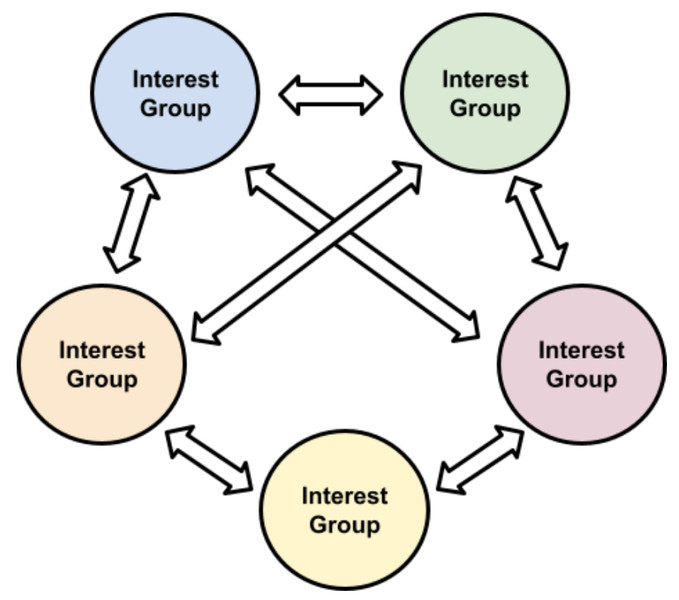
Pluralist interest-group network
Corporatism
Corporatism organizes interests from the top more than from the bottom.
- The state works through recognized sectoral groups such as labor, business, and agriculture.
- A single peak association (SPA) is an umbrella group at the top of a hierarchy that speaks for a whole sector.
- Government bargains with a few approved organizations instead of many competing ones.
- In return for access, subsidies, or privileges, those groups are expected to cooperate and stay disciplined.
Two easy mistakes:
- Corporatism does not mean rule by business corporations.
- Corporatism is not automatically authoritarian. Democratic or neo-corporatist versions exist, though authoritarian regimes often use state corporatism.
How These Systems Shape Citizen Input and Policymaking
These systems change how citizens reach government.
- In pluralism, more voices can get in. Citizens have more independent channels, and competition can check state power.
- Pluralism still does not mean equal power. Wealthy or connected groups may dominate.
- In corporatism, input is filtered through approved organizations. Policymaking can be more centralized and predictable.
- Participation still exists under corporatism, but it is less independent and less spontaneous.
When a source gives you evidence, ask:
- Who formed the group?
- Are competing groups allowed?
- Does access depend on state recognition?
- Can the state filter or monopolize representation?
Mexico as the Key Example of Change Over Time
Mexico is the course’s main case of movement from corporatism toward pluralism.
Mexico under PRI dominance as corporatism
From 1929 to 2000, the PRI and its predecessor parties controlled the presidency and built a party-state network.
Major sectors were tied into that system:
- CTM = Confederation of Mexican Workers, labor sector
- CNC = National Peasant Confederation, peasant sector
- CNOP = National Confederation of Popular Organizations, popular sector
These were not just independent lobby groups. They were linked to the PRI. In exchange for loyalty and vote mobilization, leaders got access, subsidies, patronage, jobs, protections, and nominations. That is state corporatism.
Clientelism reinforced this system. Benefits were traded for support through personal and organizational networks.
Mexico’s move toward pluralism
Democratization and economic liberalization weakened PRI control. Independent unions and civil-society groups got more room to act. Opposition parties and electoral institutions became more competitive.
The turning point was 2000, when Vicente Fox of the PAN won the presidency, ending 71 years of PRI presidential control.
Groups could increasingly go to:
- different parties
- legislatures
- courts
- media
- subnational governments
The AP way to say it is precise. Mexico moved toward a more pluralist system. It did not become a perfectly pure pluralist model.
How to Recognize the System in Evidence
Pluralism shows up when you see independently formed groups, several organizations representing similar interests, public disagreement, and access through many channels.
Corporatism shows up when you see government-approved groups, one recognized representative for a sector, formal consultation with peak associations, benefits exchanged for cooperation, and barriers for outsiders.
Named Mexico examples you should know cold: CTM, CNC, CNOP, PRI, Vicente Fox, PAN.
Key Takeaways
Pluralism (Pluralist Interest-Group System)
A system in which multiple autonomous groups form independently of the state and compete for access to policymakers and political influence
Corporatism (Corporatist Interest-Group System)
A system in which the state structures policy access through recognized or sanctioned organizations representing major sectors such as labor, business, and agriculture
Single Peak Association (SPA)
A state-recognized umbrella organization that serves as the principal or sole representative of an entire economic or social sector
Democratic Corporatism (Neo-Corporatism)
A democratic arrangement in which the state negotiates with major peak associations that retain substantial organizational independence
State Corporatism
Corporatism in which the government creates, approves, finances, or closely supervises the organizations that represent social sectors
Mexico’s Movement Toward Pluralism
The weakening of PRI-controlled sectoral representation as democratization and political competition expanded autonomous groups’ access to multiple political channels
Notes
Pluralism (Pluralist Interest-Group System)
A system in which multiple autonomous groups form independently of the state and compete for access to policymakers and political influence
Corporatism (Corporatist Interest-Group System)
A system in which the state structures policy access through recognized or sanctioned organizations representing major sectors such as labor, business, and agriculture
Single Peak Association (SPA)
A state-recognized umbrella organization that serves as the principal or sole representative of an entire economic or social sector
Democratic Corporatism (Neo-Corporatism)
A democratic arrangement in which the state negotiates with major peak associations that retain substantial organizational independence
State Corporatism
Corporatism in which the government creates, approves, finances, or closely supervises the organizations that represent social sectors
Mexico’s Movement Toward Pluralism
The weakening of PRI-controlled sectoral representation as democratization and political competition expanded autonomous groups’ access to multiple political channels
