Topic 3.9 Notes – Challenges from Political and Social Cleavages
How Political and Social Cleavages Threaten Stability
A cleavage is a social division such as ethnicity, religion, region, or class. It becomes politically dangerous when people organize around it and make demands on the state.
The usual chain looks like this:
- A group has a grievance or feels different from others.
- Parties, movements, or militants mobilize that identity.
- The group demands rights, policy change, resources, autonomy, or independence.
- The government answers with accommodation, integration, repression, or a mix.
- That response affects legitimacy, cooperation, protest, separatism, violence, and regime stability.
The diagram pulls that chain together and shows how different state responses can push politics toward stability or conflict.
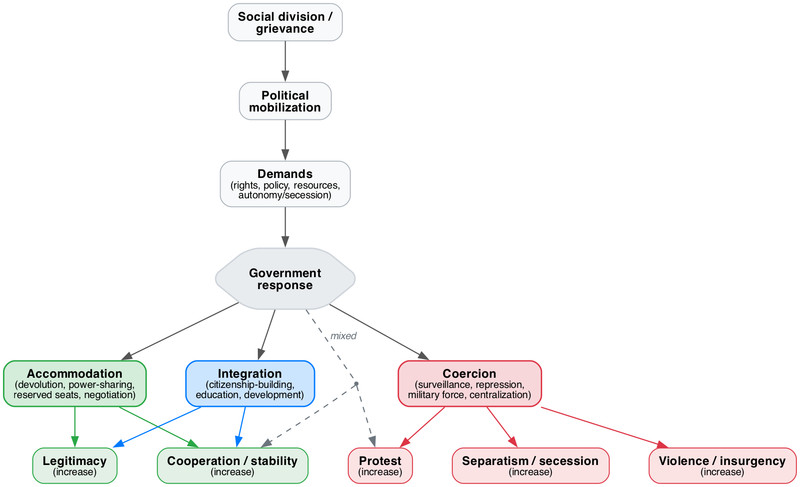
Cleavages, government response, and political outcomes
Some cleavages are much harder to manage than others:
- Territorial concentration makes conflict sharper because a group can claim a homeland.
- Overlapping divisions raise the stakes. If ethnicity, religion, and poverty line up, conflict feels deeper.
- Exclusion from offices or fair treatment pushes groups to distrust the state.
- Weak institutions leave fewer peaceful ways to settle disputes.
- Identity-based leaders can turn fear into political support.
- Blocked participation makes violence or separatism look more useful.
- Outside support gives rebels money, weapons, or sanctuary.
A multinational state is more vulnerable because loyalty to a nation, ethnicity, or religion can compete with loyalty to the state.
Key terms
- Autonomy means self-government within the state.
- Separatism means trying to detach territory from the state.
- Secession means creating an independent state.
- Irredentism means a state or movement trying to annex territory in another state because people there share its ethnicity, culture, or historical claim.
The Four Main Challenges Governments Face
Cleavages show up in a few repeating problems.
Conflicting interests and competition among groups and parties
Groups fight over language, religion, education, jobs, officeholding, and resource distribution. This can be stabilizing if institutions channel bargaining. It becomes dangerous when parties act as ethnic or regional blocs.
- Nigeria has Hausa-Fulani, Yoruba, and Igbo divisions, plus a Muslim north and Christian south. The federal character principle and informal zoning try to spread power around.
- UK politics includes the SNP in Scotland and unionist and nationalist parties in Northern Ireland.
Weak authority and weak legitimacy
Authority is the recognized right to rule. Legitimacy is the belief that the government rightfully should rule. A state can still control people by force while losing legitimacy.
Danger signs include stronger identification with subgroup than state, weak law enforcement, poor security, and rival groups doing state jobs.
- China in Xinjiang and Tibet shows this tradeoff. Surveillance, reeducation, and restrictions can tighten control but weaken voluntary acceptance.
Pressure for autonomy, secession, terrorism, and civil war
Autonomy can reduce conflict, but it can also strengthen regional identity. Repression can preserve territory in the short run, but it may radicalize opposition.
Keep these separate:
- Autonomy demand = more self-rule
- Separatism/secession = break away
- Terrorism = method using violence against civilians
- Civil war = sustained armed conflict inside the state
Encroachment by neighboring states
Weak or divided states invite pressure from outside. Neighbors may invade, back rebels, or intervene for co-ethnics. Transnational identities make that easier.
Course Country Examples
- United Kingdom
Devolution gave power to Scotland, Wales, and Northern Ireland. In the 2014 Scottish referendum, about 55% voted remain and 45% voted leave. Brexit revived tensions. In Northern Ireland, the Troubles pitted republican or nationalist groups against unionist or loyalist groups. The Good Friday Agreement (1998) created power-sharing and lowered violence.
- Nigeria
Biafra tried to secede from 1967 to 1970, causing the Nigerian Civil War. The Niger Delta saw militancy over oil, pollution, and revenue. Boko Haram in the northeast shows terrorism, insurgency, and weak state capacity.
- Mexico
The Zapatista uprising began in Chiapas in 1994 on NAFTA’s start date. The EZLN wanted indigenous rights, land, and local autonomy more than secession. The state used force, then negotiation.
- Russia
Chechnya fought two wars after the Soviet collapse. Moscow framed separatism and terrorism as national security threats and restored control through force and loyal regional leadership under Putin.
- China
Tibet and Xinjiang are officially autonomous, but CCP control stays centralized. Han migration, Mandarin education, development, surveillance, and coercive integration all tighten central control.
- Iran
Kurds and Baloch in border regions have faced repression and armed conflict. Recognized minorities get reserved Majles seats, but Shi’a hierarchy dominates. The Iran-Iraq War, 1980 to 1988, began after Iraq invaded and tried to exploit revolutionary instability.
Government Responses and Why They Matter
Governments usually mix three approaches.
- Accommodation includes devolution, federalism, autonomy, power-sharing, minority rights, reserved seats, negotiation, revenue-sharing, and referenda. You see this in UK devolution, the Good Friday Agreement, Nigeria’s federalism, and Iran’s reserved representation.
- Integration tries to build common citizenship through schools, development, and cross-regional parties. This is shared identity-building, not the same thing as forced assimilation.
- Coercion includes surveillance, bans, arrests, detention, military action, emergency rule, and centralization. China in Xinjiang and Tibet, Russia in Chechnya, and Iran in Kurdish and Baloch regions fit here.
Democracies usually channel conflict through institutions more often. Authoritarian regimes usually centralize and repress more often. Most states do both.
The exam loves this distinction: one outcome can improve while another gets worse. A policy might strengthen territorial control and public order but weaken legitimacy.
Key Takeaways
Multinational State
A sovereign state containing multiple national, ethnic, religious, or territorially concentrated identity groups
Territorial Concentration
The geographic concentration of an identity group, enabling claims to a homeland, regional autonomy, or independence
Political Authority
The recognized right of a government to exercise power
Legitimacy
The belief that a government and its institutions have a rightful claim to rule
Rally-Around-the-Government Effect
Increased support for leaders who present themselves as defenders against a threat to national unity or security
Autonomy
Regional or communal self-government over some affairs while remaining within the existing sovereign state
Secession
The withdrawal of territory from an existing state to establish an independent sovereign state
Irredentism
An effort to detach territory from one state and unite it with another state
Separatism
The broader effort to separate a territory from a state, including demands for independence and sometimes substantially expanded autonomy
Intergroup Conflict
Sustained hostility or violence between ethnic, religious, regional, or other communities
Terrorism
The use or threat of violence, often against civilians, to intimidate a wider audience and pursue political objectives
Civil War
Organized, sustained armed conflict within a state between the government and domestic armed groups or among groups seeking control
Encroachment
Interference by a neighboring state that exploits weakness through invasion, border incursions, support for separatists, proxy warfare, or efforts to detach territory
Transnational Identity
An ethnic, religious, or national identity shared by communities located across state borders
Institutional Accommodation
Recognition, autonomy, representation, negotiation, or resource-sharing used to incorporate group demands into the political system
Integration vs. Assimilation
Integration builds common citizenship while preserving group identities; assimilation pressures minorities to abandon distinctive identities
Coercive Response
The use of surveillance, restrictions, detention, military force, emergency rule, or centralization to suppress cleavage-related challenges
Federal Character Principle
Nigeria’s policy of seeking representation for different states and communal groups in public institutions
Zoning
Nigeria’s informal party practice of rotating important political offices among regions
2014 Scottish Independence Referendum
A legal secession vote in which about 55 percent chose to remain in the United Kingdom and 45 percent supported independence
The Troubles
Northern Ireland’s conflict among republican or nationalist groups, unionist or loyalist groups, and British security forces
Good Friday Agreement
The 1998 agreement that established power-sharing in Northern Ireland and made consent central to its constitutional status
Niger Delta Militancy
Conflict driven by regional grievances over environmental damage and the distribution of Nigeria’s petroleum revenue
Boko Haram
A northeastern Nigerian extremist organization using terrorism and insurgency to impose its interpretation of Islamic rule
Iran–Iraq War
The 1980–1988 war begun when Iraq invaded a seemingly vulnerable postrevolutionary Iran, ultimately strengthening Iranian nationalism
Zapatista Army of National Liberation (EZLN)
A Chiapas-based organization demanding indigenous rights, land, local self-government, and autonomy rather than secession
1994 Zapatista Uprising
An uprising in Chiapas launched as NAFTA took effect, followed by initial military force and negotiations with the Mexican government
Biafran Secession
The 1967 attempt by Nigeria’s southeastern, largely Igbo region to establish the independent Republic of Biafra
Nigerian Civil War
The 1967–1970 war caused by Biafra’s attempted secession, ending with Biafra’s defeat and reintegration into Nigeria
Chechen Separatism
The post-Soviet movement seeking independence for predominantly Muslim Chechnya from Russia
Chechen Wars
Two major wars in which Russia used overwhelming military force to defeat Chechen separatism and restore central control
Notes
Multinational State
A sovereign state containing multiple national, ethnic, religious, or territorially concentrated identity groups
Territorial Concentration
The geographic concentration of an identity group, enabling claims to a homeland, regional autonomy, or independence
Political Authority
The recognized right of a government to exercise power
Legitimacy
The belief that a government and its institutions have a rightful claim to rule
Rally-Around-the-Government Effect
Increased support for leaders who present themselves as defenders against a threat to national unity or security
Autonomy
Regional or communal self-government over some affairs while remaining within the existing sovereign state
Secession
The withdrawal of territory from an existing state to establish an independent sovereign state
Irredentism
An effort to detach territory from one state and unite it with another state
Separatism
The broader effort to separate a territory from a state, including demands for independence and sometimes substantially expanded autonomy
Intergroup Conflict
Sustained hostility or violence between ethnic, religious, regional, or other communities
Terrorism
The use or threat of violence, often against civilians, to intimidate a wider audience and pursue political objectives
Civil War
Organized, sustained armed conflict within a state between the government and domestic armed groups or among groups seeking control
Encroachment
Interference by a neighboring state that exploits weakness through invasion, border incursions, support for separatists, proxy warfare, or efforts to detach territory
Transnational Identity
An ethnic, religious, or national identity shared by communities located across state borders
Institutional Accommodation
Recognition, autonomy, representation, negotiation, or resource-sharing used to incorporate group demands into the political system
Integration vs. Assimilation
Integration builds common citizenship while preserving group identities; assimilation pressures minorities to abandon distinctive identities
Coercive Response
The use of surveillance, restrictions, detention, military force, emergency rule, or centralization to suppress cleavage-related challenges
Federal Character Principle
Nigeria’s policy of seeking representation for different states and communal groups in public institutions
Zoning
Nigeria’s informal party practice of rotating important political offices among regions
2014 Scottish Independence Referendum
A legal secession vote in which about 55 percent chose to remain in the United Kingdom and 45 percent supported independence
The Troubles
Northern Ireland’s conflict among republican or nationalist groups, unionist or loyalist groups, and British security forces
Good Friday Agreement
The 1998 agreement that established power-sharing in Northern Ireland and made consent central to its constitutional status
Niger Delta Militancy
Conflict driven by regional grievances over environmental damage and the distribution of Nigeria’s petroleum revenue
Boko Haram
A northeastern Nigerian extremist organization using terrorism and insurgency to impose its interpretation of Islamic rule
Iran–Iraq War
The 1980–1988 war begun when Iraq invaded a seemingly vulnerable postrevolutionary Iran, ultimately strengthening Iranian nationalism
Zapatista Army of National Liberation (EZLN)
A Chiapas-based organization demanding indigenous rights, land, local self-government, and autonomy rather than secession
1994 Zapatista Uprising
An uprising in Chiapas launched as NAFTA took effect, followed by initial military force and negotiations with the Mexican government
Biafran Secession
The 1967 attempt by Nigeria’s southeastern, largely Igbo region to establish the independent Republic of Biafra
Nigerian Civil War
The 1967–1970 war caused by Biafra’s attempted secession, ending with Biafra’s defeat and reintegration into Nigeria
Chechen Separatism
The post-Soviet movement seeking independence for predominantly Muslim Chechnya from Russia
Chechen Wars
Two major wars in which Russia used overwhelming military force to defeat Chechen separatism and restore central control
