Topic 4.2 Notes – Objectives of Election Rules
What Election Rules Do
Election rules answer three big questions in every system:
- Who can compete on the ballot
- What it takes to win an election
- How representation and accountability are organized after the election
That is why election rules tell you a lot about the regime itself. A democratic system may use rules to widen participation and reduce fraud. An authoritarian or hybrid system may still hold elections, but use rules to filter opposition and protect elites.
The exam loves this idea. The same formal rule can do different political jobs depending on context.
- Ballot access means who is allowed on the ballot.
- Winning rule means how a candidate actually wins, such as plurality, majority, runoff, or geographic spread.
- Representation rule means how votes become seats, such as SMD, PR, mixed systems, or appointments.
- Timing rule means when elections happen and how often voters can respond.
Representation Rules in Legislatures
Proportional representation
Under proportional representation, parties get seats roughly based on vote share, usually in multimember districts. If a party wins 20 percent of the vote, it can win about 20 percent of seats.
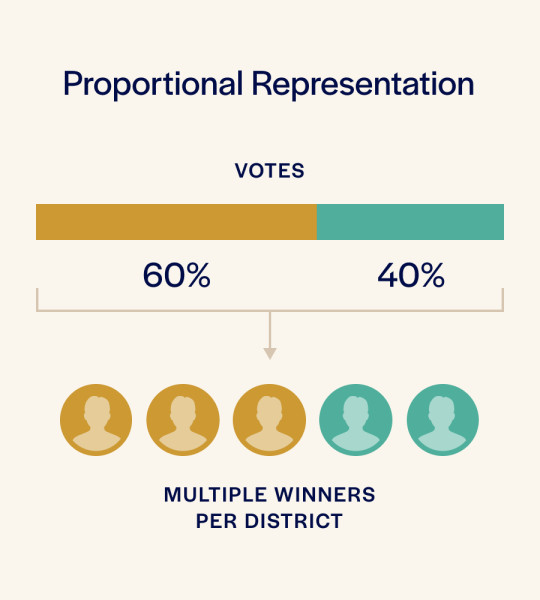
Proportional representation in a multimember district
That is the basic idea in the diagram here. A party with 60 percent of the vote gets about 60 percent of the seats, and a party with 40 percent gets about 40 percent.
PR tends to:
- increase the number of parties in the legislature
- help women and minority candidates, especially through party lists and quotas
- represent voters whose support is spread out, not concentrated in one district
Examples:
- Mexico Chamber of Deputies uses a mixed system with 300 SMD seats and 200 PR seats. Gender rules on party nominations increased women’s representation.
- Russia State Duma also uses a mixed system. Its PR threshold can block small parties and help United Russia, so PR there does not automatically mean open competition.
Single-member district plurality
In single-member district plurality, one district elects one representative, and the candidate with the most votes wins.
This tends to:
- push politics toward two-party competition through Duverger’s law
- create strong constituency service
- make one person clearly accountable for a place
Examples:
- UK House of Commons uses classic FPTP. One constituency elects one MP.
- Regional parties can still win if support is concentrated. The SNP is the standard example.
- Nigeria House of Representatives also uses SMD districts tied to population.
Mixed systems and appointments
Mixed systems combine local district representatives with broader PR seats. In this course, Mexico and Russia are the main examples.
Appointments can widen expertise or protect elites:
- UK House of Lords members are formally appointed by the monarch on advice from the PM and an independent commission. That can add expertise, but the chamber has weak democratic legitimacy.
- Iran Guardian Council has half appointed by the Supreme Leader and half chosen through judiciary nominees approved by the Majles. This protects regime ideology.
- Russia Federation Council members are selected by regional executives and legislatures, not directly elected, which strengthens elite and central influence.
Rules for Winning Presidential Elections
Presidential systems do not all define victory the same way.
Plurality
A plurality winner just needs more votes than anyone else.
- Mexico’s president is elected by plurality of the national popular vote.
- That creates a fast, one-round result, but no majority is required.
Majority and runoff
Some systems want a winner with over 50 percent.
- Candidates compete in round one.
- If nobody gets 50%+, the top two advance.
- One of those two wins round two with a majority.
- Iran and Russia use this system.
- It gives the winner a formal national mandate.
- On the exam, be careful. A mandate means less when real competition is restricted.
Geographic distribution requirement
Nigeria adds a territorial rule. A candidate must:
- win the most votes nationwide
- get 25 percent in two-thirds of the states
That reflects Nigeria’s federal system and major regional, ethnic, and religious cleavages. It pushes candidates to build broad coalitions.
Ballot Access, Group Representation, and Election Timing
Who gets to run matters as much as who gets to vote.
- Iran’s Guardian Council vets candidates and often excludes reformists and critics. Elections happen, but competition is narrowed.
- Mexico’s INE (formerly IFE) was created during democratic transition to reduce fraud and manipulation.
- Nigeria’s INEC is also an independent commission meant to improve credibility, even though irregularities still happen.
In Iran, that vetting power fits into a broader system where elected offices operate alongside unelected institutions.
Rules also shape which groups get represented:
- PR and lower thresholds help smaller parties, women, and minorities.
- SMD can hurt dispersed groups but help concentrated regional groups.
- Mexico’s gender quotas and party-list rules boosted women’s representation.
- Iran’s Majles reserves seats for recognized religious minorities: 2 Armenian Christians, 1 Assyrian/Chaldean Christian seat, 1 Jew, 1 Zoroastrian.
- Russia’s threshold changes and shifts between PR and mixed systems changed opportunities for minor and regional parties.
- Nigeria’s presidential distribution rule indirectly broadens ethnic and regional inclusion.
Legislative terms also shape accountability:
- UK House of Commons up to 5 years, with possible early dissolution
- Mexico Chamber 3 years, Senate 6 years
- Nigeria both chambers 4 years
- Iran Majles 4 years
- Russia Duma 5 years
- China NPC 5 years and indirectly elected
Shorter terms mean voters can reward or punish officials more often. Longer terms give more continuity.
Key Takeaways
Proportional Representation
An electoral system awarding parties legislative seats roughly in proportion to their vote shares; it tends to increase party representation and can increase women’s and minority representation
Party-List System
A form of proportional representation in which parties nominate lists of candidates and receive seats according to their vote shares
Electoral Threshold
The minimum vote share a party must receive to participate in the allocation of proportional-representation seats
Mixed Electoral System
A legislative electoral system combining single-member district seats with proportional-representation seats
District Magnitude
The number of representatives elected from an electoral district
Single-Member District
An electoral district that elects one representative, creating an identifiable representative for a particular geographic constituency
Plurality Voting / First-Past-the-Post
A winning rule under which the candidate receiving more votes than any other candidate wins, even without more than half
Single-Member District Plurality System
A system in which one representative is elected per district by plurality, tending to favor two large parties while strengthening geographic accountability
Absolute Majority
More than half of the votes cast
Two-Round System / Runoff Election
A system in which the top two candidates compete in a second round if no candidate wins an absolute majority in the first
Mexico Presidential Election Rule
The candidate receiving a plurality of Mexico’s nationwide popular vote wins the presidency; no absolute majority is required
Nigeria Presidential Election Rule
A candidate must win the most votes nationwide and at least 25 percent of the vote in two-thirds of Nigeria’s states
Majoritarian Rules
Election rules requiring majority or broadly distributed support, allowing the winner to claim a national mandate
National Mandate
A claim that electoral support authorizes a winner to govern and pursue a policy agenda
Ballot Access
The rules and decisions determining which candidates or parties may appear on an election ballot
Candidate Vetting
Screening prospective candidates to determine whether they may appear on the ballot, potentially excluding ideological opponents
Electoral Regulatory Organization
A body that sets or administers rules governing ballot access, voting, and electoral competition
Independent Electoral Commission
An election-administration body institutionally separated from the incumbent government to reduce fraud and strengthen credible competition
Guardian Council
Iran’s unelected 12-member body that vets candidates and reviews laws; the Supreme Leader appoints six members and influences selection of the other six through the judiciary
Federal Electoral Institute (IFE) / National Electoral Institute (INE)
Mexico’s independent electoral commission, created to reduce manipulation and fraud and make party competition more credible
Independent National Electoral Commission (INEC)
Nigeria’s election commission, responsible for regulating and administering national elections, registering voters and candidates, and reducing fraud
Appointment System
Nonelectoral selection of institutional members, used either to add expertise and diversity or to extend governing-elite control
House of Lords Appointment Process
Members are formally appointed by the monarch, generally on recommendations from the prime minister or an independent appointments commission
Guardian Council Appointment Process
The Supreme Leader appoints six Islamic jurists; six legal jurists are nominated by the judiciary’s head and approved by the Majles
Federation Council Appointment Process
Russia’s regional executive and legislative authorities select representatives to the Federation Council instead of voters electing them directly
Gender Quota
A rule requiring a specified share or balance of women among a party’s candidates or on its candidate lists
Reserved Seats
Legislative seats set aside for specified groups to guarantee them descriptive representation
Term Length
The period for which an official is elected before the office is again subject to election
Term Limit
A restriction on how many terms an official may serve, distinct from the length of each term
Iran Presidential Election Rule
A candidate must win an absolute majority of the popular vote; otherwise, the top two candidates compete in a runoff
Russia Presidential Election Rule
A candidate must win an absolute majority of the popular vote; otherwise, the top two candidates compete in a runoff
Notes
Proportional Representation
An electoral system awarding parties legislative seats roughly in proportion to their vote shares; it tends to increase party representation and can increase women’s and minority representation
Party-List System
A form of proportional representation in which parties nominate lists of candidates and receive seats according to their vote shares
Electoral Threshold
The minimum vote share a party must receive to participate in the allocation of proportional-representation seats
Mixed Electoral System
A legislative electoral system combining single-member district seats with proportional-representation seats
District Magnitude
The number of representatives elected from an electoral district
Single-Member District
An electoral district that elects one representative, creating an identifiable representative for a particular geographic constituency
Plurality Voting / First-Past-the-Post
A winning rule under which the candidate receiving more votes than any other candidate wins, even without more than half
Single-Member District Plurality System
A system in which one representative is elected per district by plurality, tending to favor two large parties while strengthening geographic accountability
Absolute Majority
More than half of the votes cast
Two-Round System / Runoff Election
A system in which the top two candidates compete in a second round if no candidate wins an absolute majority in the first
Mexico Presidential Election Rule
The candidate receiving a plurality of Mexico’s nationwide popular vote wins the presidency; no absolute majority is required
Nigeria Presidential Election Rule
A candidate must win the most votes nationwide and at least 25 percent of the vote in two-thirds of Nigeria’s states
Majoritarian Rules
Election rules requiring majority or broadly distributed support, allowing the winner to claim a national mandate
National Mandate
A claim that electoral support authorizes a winner to govern and pursue a policy agenda
Ballot Access
The rules and decisions determining which candidates or parties may appear on an election ballot
Candidate Vetting
Screening prospective candidates to determine whether they may appear on the ballot, potentially excluding ideological opponents
Electoral Regulatory Organization
A body that sets or administers rules governing ballot access, voting, and electoral competition
Independent Electoral Commission
An election-administration body institutionally separated from the incumbent government to reduce fraud and strengthen credible competition
Guardian Council
Iran’s unelected 12-member body that vets candidates and reviews laws; the Supreme Leader appoints six members and influences selection of the other six through the judiciary
Federal Electoral Institute (IFE) / National Electoral Institute (INE)
Mexico’s independent electoral commission, created to reduce manipulation and fraud and make party competition more credible
Independent National Electoral Commission (INEC)
Nigeria’s election commission, responsible for regulating and administering national elections, registering voters and candidates, and reducing fraud
Appointment System
Nonelectoral selection of institutional members, used either to add expertise and diversity or to extend governing-elite control
House of Lords Appointment Process
Members are formally appointed by the monarch, generally on recommendations from the prime minister or an independent appointments commission
Guardian Council Appointment Process
The Supreme Leader appoints six Islamic jurists; six legal jurists are nominated by the judiciary’s head and approved by the Majles
Federation Council Appointment Process
Russia’s regional executive and legislative authorities select representatives to the Federation Council instead of voters electing them directly
Gender Quota
A rule requiring a specified share or balance of women among a party’s candidates or on its candidate lists
Reserved Seats
Legislative seats set aside for specified groups to guarantee them descriptive representation
Term Length
The period for which an official is elected before the office is again subject to election
Term Limit
A restriction on how many terms an official may serve, distinct from the length of each term
Iran Presidential Election Rule
A candidate must win an absolute majority of the popular vote; otherwise, the top two candidates compete in a runoff
Russia Presidential Election Rule
A candidate must win an absolute majority of the popular vote; otherwise, the top two candidates compete in a runoff
