Topic 1.6 Notes – Change in Power and Authority
Government change vs regime change
A lot of students miss this because the events can look dramatic. The exam keeps asking the same thing in different forms. What actually changed?
- Power means the ability to get others to act.
- Authority means the recognized right to rule.
- Sovereignty means a state’s independent authority over its territory and population.
You also need three levels clear in your head:
- State = the country as a political unit. It can survive many leadership turnovers and even regime change.
- Government = the current leaders and institutions exercising power.
- Regime = the rules for gaining and using power.
So:
- Government change happens when officeholders change but the political system stays the same.
- Regime change happens when the basic rules and institutions of power are replaced.
A quick test:
- only leaders or parties changed = government change
- rules of competition, source of authority, or final institutions changed = regime change
Keep other dimensions separate too. A change can be:
- incremental or sudden
- peaceful or violent
- legal/constitutional or coercive
- mass-supported or elite-led
An election, coup, or revolution is only the mechanism. It does not tell you the answer by itself.
How governments change
Governments usually change more often, more easily, and more peacefully than regimes because accepted procedures already exist.
Elections
In democracies, elections usually replace leaders under existing rules.
- United Kingdom 2024 general election
- Labour won.
- Keir Starmer replaced Rishi Sunak as prime minister.
- The parliamentary system and constitutional monarchy stayed the same.
That is government change, not regime change.
Appointments
Sometimes leaders take office through legal selection procedures instead of a mass election.
- United Kingdom 2022 prime minister changes
- Boris Johnson resigned.
- Liz Truss was selected by the Conservative Party and appointed PM.
- Truss resigned.
- Rishi Sunak was selected and appointed.
Same regime the whole time. Only the leadership changed.
Lines of succession
A succession rule names who takes over if an office becomes vacant.
- Charles III succeeded Elizabeth II in 2022.
- The monarch changed, but the UK regime did not.
Peaceful turnover through accepted procedures usually shows regime stability.
How regimes change
Regime change means the underlying structure of authority changes.
Common forms include:
- monarchy → republic
- civilian rule → military rule
- dominant-party or one-party rule → competitive multiparty rule
- authoritarian → democratic
- secular order → religiously based authority
Sudden regime change
This happens fast when the old order collapses or is overthrown. It often creates uncertainty, so new rulers may lean heavily on coercion.
Incremental regime change
This happens through many small reforms that gradually transform competition and authority.
- Mexico’s ruling party dominated politics from 1929 to 2000.
- The party evolved PNR → PRM → PRI.
- Electoral reforms slowly improved competition and election administration.
- Vicente Fox won in 2000.
Fox’s victory was an immediate government change, but it also marked the culmination of a broader regime democratization.
Not every reform or amendment is regime change. The threshold is whether the basic system gets replaced.
Coups, revolutions, and elections as paths to change
Elections
Elections usually change governments. They can help cause regime change if they end noncompetitive rule or approve a new constitutional order.
Coups d’état
A coup is a sudden seizure of power by a small group, usually military officers or elites.
- always changes control of government
- becomes regime change only if core institutions or rules are replaced
Nigeria 1966
- military officers overthrew the civilian First Republic
- Johnson Aguiyi-Ironsi took power
- a countercoup later brought Yakubu Gowon
- civilian constitutional rule was displaced by military rule
That is clear regime change.
Other Nigeria examples you need:
- 1983 military overthrow of the Second Republic
- 1999 return to civilian rule under Olusegun Obasanjo, a reverse regime transition
Revolutions
A revolution is a broad, mass-supported effort to transform the political system.
Iran 1979
- Shah Mohammad Reza Pahlavi was overthrown
- the coalition included religious groups, liberals, leftists, students, workers, and merchants
- Ayatollah Khomeini returned from exile
- a March 1979 referendum and later constitution created the Islamic Republic
- new institutions included the supreme leader and Guardian Council
That is classic revolutionary regime change. The diagram below is a good reminder that the post-1979 system combined elected offices with powerful unelected institutions.
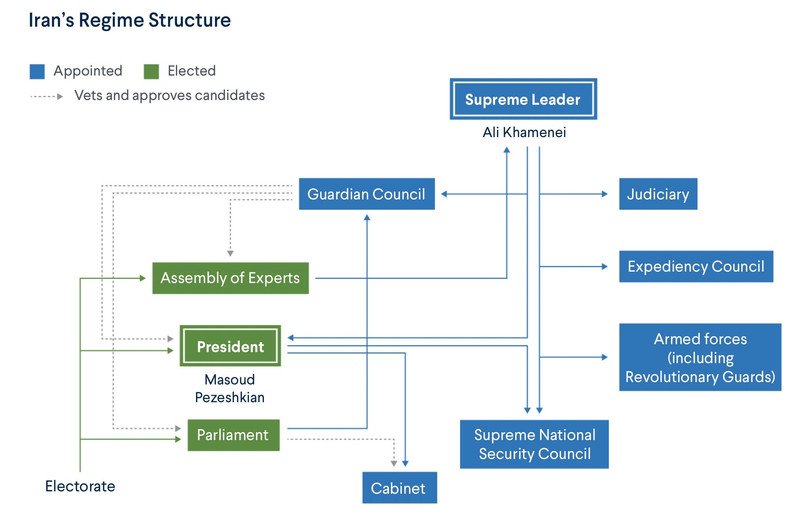
Iran’s post-1979 regime structure
Democratic vs authoritarian uses of power
Democratic regimes usually need less coercion because authority is more widely accepted.
Why?
- competitive elections give people a voice
- constitutional procedures make turnover predictable
- rule of law gives decisions legitimacy
- political losers expect future chances to compete
Authoritarian regimes usually rely more on:
- coercion
- surveillance
- censorship
- restricted opposition
- military or ruling-party control
The nuance matters:
- democracies still use coercive power
- authoritarian regimes still seek legitimacy through nationalism, ideology, religion, constitutions, or performance
Peaceful turnover usually signals strong legitimacy. Heavy coercion may signal weak authority, even if the regime looks stable.
Key Takeaways
Power
The ability to make others act according to one’s preferences through incentives, institutional control, or coercion
Authority
The recognized right to exercise power
Sovereignty
A state’s independent legal authority over its population and territory without external interference
Government Change
Replacement of political officeholders while the regime’s fundamental rules and institutions remain intact
Regime Change
Replacement of the fundamental rules and institutions governing access to and exercise of political power
Coup d’État
A sudden seizure of governmental power by a small group, usually military officers or political elites; it becomes regime change only if fundamental rules and institutions are replaced
Revolution
A broad, mass-supported effort to transform the political system and create a new political order
Iranian Revolution of 1979
A mass-supported revolution that abolished the Pahlavi monarchy and created an Islamic republic combining elected institutions with clerical oversight
Nigeria’s January 1966 Coup
An elite-led military seizure that displaced First Republic civilian constitutional government with military rule, changing both government and regime
Mexico’s Incremental Regime Transition
Successive electoral reforms weakened PRI dominance and expanded genuine competition, culminating in PAN candidate Vicente Fox’s 2000 presidential victory
Government
The current institutions and officeholders legally empowered to make binding decisions for the state
Sudden Regime Change
Rapid displacement or collapse of an existing political order over a relatively short period
Incremental Regime Change
Cumulative reforms that gradually transform a regime’s fundamental rules and institutions
Notes
Power
The ability to make others act according to one’s preferences through incentives, institutional control, or coercion
Authority
The recognized right to exercise power
Sovereignty
A state’s independent legal authority over its population and territory without external interference
Government Change
Replacement of political officeholders while the regime’s fundamental rules and institutions remain intact
Regime Change
Replacement of the fundamental rules and institutions governing access to and exercise of political power
Coup d’État
A sudden seizure of governmental power by a small group, usually military officers or political elites; it becomes regime change only if fundamental rules and institutions are replaced
Revolution
A broad, mass-supported effort to transform the political system and create a new political order
Iranian Revolution of 1979
A mass-supported revolution that abolished the Pahlavi monarchy and created an Islamic republic combining elected institutions with clerical oversight
Nigeria’s January 1966 Coup
An elite-led military seizure that displaced First Republic civilian constitutional government with military rule, changing both government and regime
Mexico’s Incremental Regime Transition
Successive electoral reforms weakened PRI dominance and expanded genuine competition, culminating in PAN candidate Vicente Fox’s 2000 presidential victory
Government
The current institutions and officeholders legally empowered to make binding decisions for the state
Sudden Regime Change
Rapid displacement or collapse of an existing political order over a relatively short period
Incremental Regime Change
Cumulative reforms that gradually transform a regime’s fundamental rules and institutions
