Topic 1.9 Notes – Sustaining Legitimacy
What Sustaining Legitimacy Is
Legitimacy means people broadly accept the government's authority. Sustaining legitimacy means keeping that acceptance going year after year.
A few distinctions get tested a lot:
- Legitimacy is not popularity. You can dislike a prime minister or president and still accept the regime.
- Legitimacy is not stability. A regime can look stable because it uses repression.
- Legitimacy is not obedience through fear. If people obey because they are scared, that shows coercion, not acceptance.
That difference between government and regime matters. In the UK, people may reject the current government but still support parliamentary democracy and the monarchy's constitutional role.
Why legitimacy matters:
- People are more willing to obey laws
- They are more willing to pay taxes
- They are more likely to accept losing elections or policy fights
- They are more likely to accept succession and transfers of power
The core move in AP Comp Gov is causal. A government does something, and that changes how willing people are to accept its authority.
Main Ways Governments Maintain Legitimacy
- Policy effectiveness builds legitimacy when the state delivers security, growth, health care, infrastructure, and order.
- China is the clearest case. CCP legitimacy depends heavily on growth, poverty reduction, and visible state capacity.
- UK legitimacy is reinforced when government handles public services well. The COVID-19 vaccine rollout is a strong capacity example.
- Mexico shows the reverse. Cartel violence and weak public security can reduce legitimacy.
- Political efficacy means people think participation matters.
- Internal efficacy is confidence that you understand and can participate.
- External efficacy is belief that government responds.
- In the UK, elections, Parliament, parties, and devolved institutions give people real channels.
- In authoritarian systems, petitions or local participation may exist, but limited competition lowers efficacy.
- Tradition gives legitimacy through continuity and symbols.
- UK uses monarchy and parliamentary tradition.
- Iran draws on Shia authority and the 1979 Revolution.
- Charismatic leadership ties legitimacy to one leader's image.
- Russia uses Vladimir Putin as strength, order, national restoration, and resistance to the West.
- This is fragile because policy failure hurts the leader, and succession is hard.
- Institutionalized laws matter when rules are predictable and actually followed.
- UK has no single written constitution, but it has strong procedures.
- Mexico gains legitimacy from constitutional rights and courts only when rights are enforced.
- Authoritarian regimes may have constitutions and courts too, but legitimacy drops if rulers ignore them.
What Reinforces or Undermines Legitimacy
Legitimacy gets stronger when the system shows it can manage conflict fairly.
| Reinforces legitimacy | Undermines legitimacy |
|---|---|
| Peaceful conflict resolution through courts, elections, legislatures | Increasing corruption |
| Peaceful transfer of power | Reduced electoral competition |
| Reduced corruption | Poor economy, inflation, unemployment, inequality |
| Economic development | Social conflict and insecurity |
Key examples:
- UK Brexit conflict went through parliamentary votes, elections, and the UK Supreme Court ruling against prorogation in 2019.
- Mexico 2000 strengthened legitimacy when Vicente Fox beat the PRI candidate, ending 71 years of PRI presidential control.
- Nigeria 2015 mattered because Goodluck Jonathan accepted defeat by Muhammadu Buhari.
- Nigeria's Economic and Financial Crimes Commission is an anti-corruption body.
- China's anti-corruption campaigns can help legitimacy, but selective enforcement weakens that effect.
- Iran undermines legitimacy through protests tied to hardship and repression.
- Russia reduces competition through restricted opposition, media control, and managed elections.
- China has no competitive national elections.
- Nigeria faces Boko Haram and ethnic and religious tensions.
- Mexico faces cartel violence.
Devolution, Election Integrity, and Why Both Can Cut Two Ways
Devolution and delegation can strengthen legitimacy when local governments match policy to local needs, increase participation, check central power, and improve minority representation.
They can also weaken legitimacy by creating contradictory policies, inefficiency, regional inequality, resource fights, and separatist pressure.
Examples you need:
- UK uses the Scottish Parliament, Senedd, and Northern Ireland Assembly. The Good Friday Agreement gave Northern Ireland a power-sharing framework.
- Nigeria uses federalism, and some northern states expanded Sharia.
- Mexico has uneven state and local capacity, which complicates anti-cartel policy.
- China allows local experimentation, but uneven enforcement and corruption follow.
- Russia is formally federal, but Putin-era centralization reduced regional autonomy.
Election integrity and protest
When election results are disputed, the political damage can snowball. This pattern helps explain why disputed elections often trigger protest and can spiral into a legitimacy crisis.
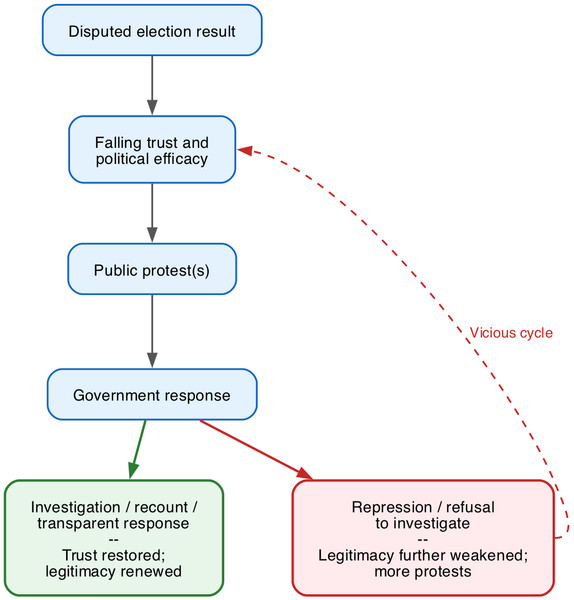
Disputed election legitimacy cycle
- If elections look fair, they renew legitimacy.
- If results look manipulated, trust and efficacy fall.
- Protest becomes more likely.
- Repression or refusal to investigate weakens legitimacy further.
Cases:
- Iran 2009 and the Green Movement after Ahmadinejad's reported win
- Russia 2011-2012 Duma election protests
- Mexico 2006 contested Calderón-López Obrador result
- Nigeria has recurring fraud, logistics, and intimidation concerns; INEC runs elections
- UK is the contrast case because results are routinely accepted
Key Takeaways
Political Legitimacy
The broadly held belief that a government or regime has the right to rule and exercise power
Sustaining Legitimacy
The continuing process through which a government preserves, strengthens, or loses public belief in its right to rule
Political Efficacy
The belief that citizens can understand politics and influence political decisions and outcomes
Internal vs. External Political Efficacy
Internal efficacy is confidence in one’s ability to understand and participate in politics; external efficacy is belief that government responds to citizens
Tradition as a Basis of Legitimacy
Acceptance of authority because institutions are linked to longstanding practices, symbols, rituals, and historical continuity
Charismatic Leadership / Charismatic Legitimacy
Legitimacy based on belief that a leader has exceptional qualities, achievements, courage, or a special ability to represent the nation
Institutionalized Laws
Established, predictable rules through which public authority is acquired and exercised, attaching authority to offices rather than individuals
Rule of Law
The principle that officials and citizens are subject to known, consistently applied laws rather than arbitrary power
Peaceful Resolution of Conflict
Settling political disputes through accepted institutions such as elections, courts, legislatures, or negotiation rather than arbitrary force
Peaceful Transfer of Power
A change in political leadership through established procedures without violence, with incumbents accepting the result
Governmental Corruption
The misuse of public office for private or political benefit; reducing it strengthens legitimacy, while increasing it undermines legitimacy
Economic Development
Improvement in income, employment, education, infrastructure, health, and state capacity that can demonstrate effective government and reinforce legitimacy
Electoral Competition
Meaningful competition in which voters have genuine alternatives and officeholders face a real possibility of defeat
Devolution
The transfer of decision-making authority from the central government to regional or subnational governments
Delegation
The placement of responsibility or authority in lower-level institutions while the central government retains greater power to supervise or withdraw it
Election Integrity
The extent to which electoral procedures and results are accurate, lawful, competitive, fair, and publicly credible
Policy Effectiveness
A government’s demonstrated capacity to make and implement policies, provide public goods, and address problems
Performance-Based Legitimacy
Acceptance of governmental authority based substantially on the results and benefits the government produces
Notes
Political Legitimacy
The broadly held belief that a government or regime has the right to rule and exercise power
Sustaining Legitimacy
The continuing process through which a government preserves, strengthens, or loses public belief in its right to rule
Political Efficacy
The belief that citizens can understand politics and influence political decisions and outcomes
Internal vs. External Political Efficacy
Internal efficacy is confidence in one’s ability to understand and participate in politics; external efficacy is belief that government responds to citizens
Tradition as a Basis of Legitimacy
Acceptance of authority because institutions are linked to longstanding practices, symbols, rituals, and historical continuity
Charismatic Leadership / Charismatic Legitimacy
Legitimacy based on belief that a leader has exceptional qualities, achievements, courage, or a special ability to represent the nation
Institutionalized Laws
Established, predictable rules through which public authority is acquired and exercised, attaching authority to offices rather than individuals
Rule of Law
The principle that officials and citizens are subject to known, consistently applied laws rather than arbitrary power
Peaceful Resolution of Conflict
Settling political disputes through accepted institutions such as elections, courts, legislatures, or negotiation rather than arbitrary force
Peaceful Transfer of Power
A change in political leadership through established procedures without violence, with incumbents accepting the result
Governmental Corruption
The misuse of public office for private or political benefit; reducing it strengthens legitimacy, while increasing it undermines legitimacy
Economic Development
Improvement in income, employment, education, infrastructure, health, and state capacity that can demonstrate effective government and reinforce legitimacy
Electoral Competition
Meaningful competition in which voters have genuine alternatives and officeholders face a real possibility of defeat
Devolution
The transfer of decision-making authority from the central government to regional or subnational governments
Delegation
The placement of responsibility or authority in lower-level institutions while the central government retains greater power to supervise or withdraw it
Election Integrity
The extent to which electoral procedures and results are accurate, lawful, competitive, fair, and publicly credible
Policy Effectiveness
A government’s demonstrated capacity to make and implement policies, provide public goods, and address problems
Performance-Based Legitimacy
Acceptance of governmental authority based substantially on the results and benefits the government produces
