Topic 10.1 Notes – Electrostatics with Conductors
1. What an Ideal Conductor Is and What Electrostatic Equilibrium Means
An ideal conductor is a material where electrons move freely. In electrostatics, we treat metals as ideal conductors because charges rearrange extremely fast.
If an electric field existed inside a conductor, free electrons would accelerate. That motion means you are not in equilibrium. So equilibrium must mean no internal field driving motion.
Electrostatic equilibrium means charges are no longer moving. In a conductor, this state is reached essentially instantly.
From that, four consequences must all be true:
- Electric field inside the conductor is zero.
If , charges would move. - All excess charge resides on the surface.
Charges repel and spread as far apart as possible. - The conductor is an equipotential.
Every point on and inside has the same electric potential. - The electric field at the surface is perpendicular.
Any tangential component would move charges sideways.
Everything in this topic comes back to this one idea: free charges move until they eliminate internal fields.
2. Charge Distribution in Conductors
Where excess charge lives
If you give a conductor extra charge:
- Negative net charge → extra electrons end up on the surface.
- Positive net charge → electrons are removed, leaving a surface electron deficit (modeled as positive charge).
There is no net excess charge inside.
Using Gauss’s law helps you justify this on tests. If you draw a Gaussian surface entirely inside the conductor and equilibrium has been reached:
Then Gauss’s law says enclosed charge must be zero. That’s the formal justification AP likes on FRQs.
Surface charge density and curvature
Surface charge density is
It is not uniform unless symmetry forces it to be.
- Higher at sharp points or edges
- Lower on flatter regions
More curvature means charges are forced closer together, increasing repulsion and increasing the local electric field. That’s why lightning rods are sharp.
Electric field at the surface
Two things are always true at equilibrium:
- is perpendicular to the surface.
- Just outside the surface,
This result often appears when you combine Gauss’s law with a tiny “pillbox” Gaussian surface that straddles the conductor’s surface.
3. The Electric Field Inside and Outside Conductors
Inside
- Potential is constant
- No work required to move charge anywhere inside or along the surface
That equipotential idea explains why polarization works later.
Outside a conducting sphere
For a conducting sphere with total charge , symmetry forces uniform surface charge. The graph below shows how the electric field depends on distance from the center.

Electric field vs. radius for a charged conducting sphere
Notice the sharp jump at . Inside the conductor the field is zero, and just outside the surface it immediately takes on a nonzero value and then decreases like .
Results:
- For :
- For :
Outside, it behaves exactly like a point charge at the center. That’s a classic Gauss’s law setup on quizzes.
4. Conductors in External Electric Fields
Polarization of a neutral conductor
Place a neutral conductor in a uniform external field. In the diagram below, the field points to the right.
Electrons move opposite the field direction:
- One side becomes negatively charged.
- The opposite side becomes positively charged.
- Net charge remains zero.
The induced charges create their own field that cancels the external field inside. The conductor must remain an equipotential, so the internal field must be zero.
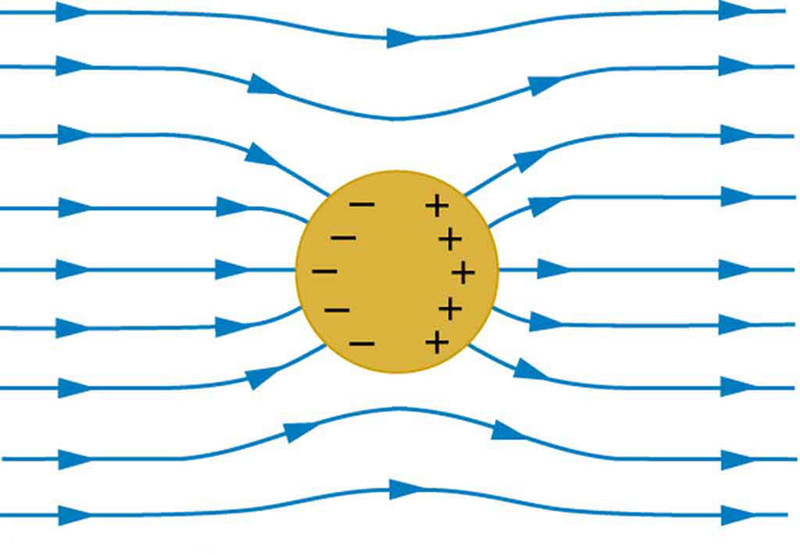
Neutral conducting sphere in a uniform external electric field
Outside, the total field is the superposition of:
- The original external field
- The field from the induced surface charges
For a sphere, this looks like an induced dipole pattern.
Electrostatic shielding
If you surround a region with a closed conducting shell, external electric fields rearrange charge on the outer surface.
Inside the conducting material, .
Inside an empty cavity with no internal charge, as well.
That’s electrostatic shielding. It’s why Faraday cages work and why the inside of a metal car is safe during lightning.
If a charge is placed inside a cavity, induced charges appear on the inner surface, but the conductor itself still has zero field within its material.
