Topic 8.2 Notes – Conservation of Electric Charge and the Process of Charging
1. Conservation of Electric Charge
This whole topic rests on one principle: total electric charge is conserved. Charge is never created or destroyed. It only moves from one place to another.
If you define a system boundary, then:
- The net charge of that system changes only if charge crosses the boundary.
- If no charge enters or leaves, the net charge stays constant.
Mathematically, for two interacting objects:
That equation shows up in disguise all the time on quizzes. If two objects start neutral, the total initial charge is zero. If one ends up with , the other must be .
A more general way to think about it:
In real materials:
- Electrons move.
- Protons do not (they’re locked in nuclei).
So when something becomes positively charged, it lost electrons. When it becomes negatively charged, it gained electrons.
On FRQs, you’ll often need to explicitly say that a change in net charge is due to electron transfer between the system and its surroundings. That wording matters.
2. Ways Objects Become Charged
The net charge of a system can change through friction, contact, or grounding, and its charge distribution can change through induction (polarization).
Let’s separate actual charge transfer from just rearrangement.
Charging by Friction (Triboelectric Effect)
When two different materials are rubbed together:
- Electrons transfer from one to the other.
- One object gains electrons → negative.
- The other loses electrons → positive.
- Total charge of the pair stays the same.
If both objects start neutral, and after rubbing one is , the other must be .
This is direct charge transfer between systems.
Charging by Conduction (Contact)
A charged object touches another object.
- Electrons flow because of a potential difference.
- Charge redistributes until they reach the same potential.
- The second object ends up with the same sign as the original charged object.
Again, this involves real transfer of electrons. The combined system’s total charge is conserved.
Charging by Induction
Here’s where students mix things up. Induction does not require contact.
It relies on induced charge separation plus grounding.
Step-by-step:
- Bring a charged object near a neutral conductor.
- Charges inside the conductor redistribute (polarization).
- While it’s polarized, connect it to ground.
- Electrons flow to or from Earth.
- Remove the ground connection.
- Then remove the external charged object.
The conductor is left with a net charge opposite the nearby object.
The order of steps matters. If you remove the external charge before removing ground, the object just neutralizes again.
3. Polarization and Induced Charge Separation
Polarization means charges shift within an object because of an external electric field.
- Happens in conductors (free electrons move).
- Happens in insulators (bound charges shift slightly).
- Can occur in neutral objects.
- Does not change net charge.
Here’s the idea visually. Focus on the panels where a charged rod is brought near a metal sphere without grounding.
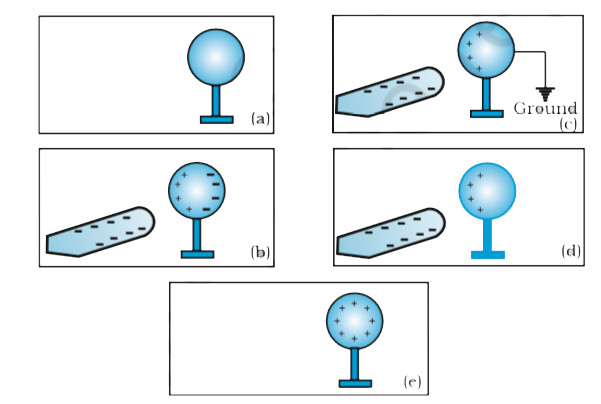
When the negatively charged rod is nearby, electrons in the sphere shift away from it. The sphere is still neutral overall, but it now has:
- Opposite charge closer to the external charge
- Like charge farther away
Because Coulomb’s law depends on , the closer attraction is stronger than the farther repulsion. So a neutral object can be attracted to a charged one.
That explanation shows up a lot in conceptual multiple choice.
4. Grounding and Charge Transfer to Earth
Grounding means connecting an object to a huge, approximately neutral reservoir of charge. Usually Earth.
Earth can:
- Supply electrons
- Absorb electrons
If the object is positively charged:
- It lacks electrons.
- Electrons flow from Earth into the object.
- It becomes neutral.
If the object is negatively charged:
- It has excess electrons.
- Electrons flow from the object into Earth.
- It becomes neutral.
Here’s the key conceptual point: grounding only changes net charge if there is a conducting path. Simply bringing something nearby does not change total charge. It only redistributes it.
On derivation-style questions, always state clearly whether charge is being transferred or merely redistributed. That distinction earns points.
