Topic 11.7 Notes – Kirchhoff’s Junction Rule
1. What Kirchhoff’s Junction Rule Says
Kirchhoff’s Junction Rule comes straight from conservation of charge. Charge cannot be created or destroyed. In a steady-state circuit, it also cannot build up at a point.
At any junction (a point where three or more wires meet):
or equivalently,
Here, current is the rate of charge flow:
So the rule is really saying:
- The rate charge flows in equals the rate charge flows out.
- No net charge accumulation at the junction.
If more current entered than left, charge would pile up at that point. The electric potential there would change almost instantly, pushing charges away until balance is restored. In the kinds of circuits you analyze in AP Physics C (steady state, ideal wires), that buildup does not happen. The currents adjust so they always balance.
This applies to:
- DC circuits
- Time-varying circuits (as long as the junction itself doesn’t store significant charge)
To picture it, think of a junction like a traffic circle: cars in per second must equal cars out per second if no cars are parking there.
2. How to Apply the Junction Rule in a Circuit
Here’s what this looks like in practice.
Step 1: Identify the junction
A junction is any point where three or more conductors meet. You only need enough independent junction equations to solve for your unknown currents.
Step 2: Assign current directions
If directions aren’t given, choose them.
- You are allowed to guess.
- If a current comes out negative, it simply flows opposite your assumption.
This is a huge point on FRQs. A negative answer is not wrong. It’s information.
Step 3: Choose a sign convention
Two common ways:
- Treat currents entering as positive, leaving as negative, and write
- Write directly
Just be consistent.
Example
Suppose three currents meet at a junction:
- enters
- enters
- leaves
Your equation would be:
If and , then:
All incoming current must leave.
Here’s what that situation looks like conceptually:
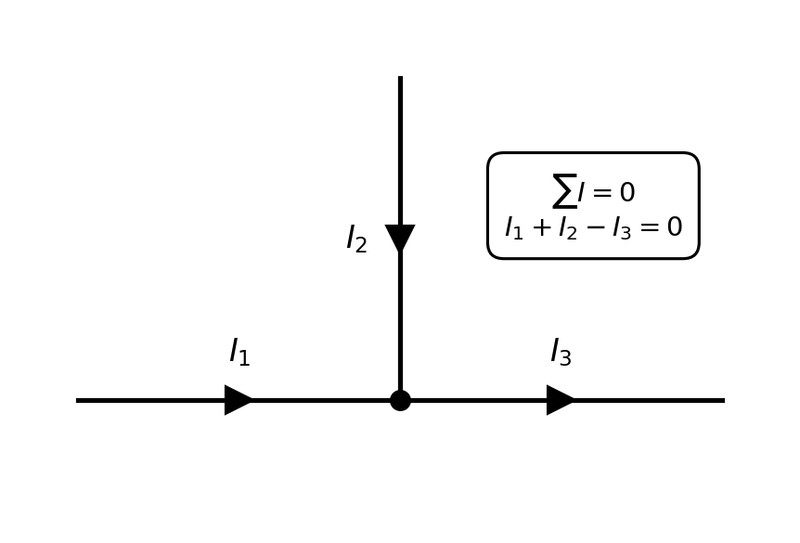
Three-current junction illustrating Kirchhoff’s junction rule
3. Multiple Junctions and Independent Equations
In larger circuits, you’ll often see several junctions.
Important structural fact:
- If a circuit has N junctions, only N − 1 junction equations are independent.
The last one will automatically be satisfied if the others are. Writing all of them often gives you redundant equations.
In real AP problems:
- Junction rule → relates currents
- Loop rule → relates voltages
You usually:
- Assign a current to each branch.
- Use the junction rule to connect those currents.
- Use loop equations to solve for numerical values.
The junction rule ensures current continuity. Current that splits in parallel branches must recombine consistently elsewhere.
4. What the Junction Rule Tells You Physically
Current Splitting
When current reaches a junction and splits into branches:
That’s why in parallel circuits:
- Total current equals the sum of branch currents.
- The branch with lower resistance usually carries more current (via Ohm’s law), but the total still balances.
Current Merging
When branches recombine:
- The outgoing current equals the sum of incoming currents.
If 2 A and 5 A merge, the resulting branch must carry 7 A.
Here’s a clean picture of splitting and recombining at two junctions:
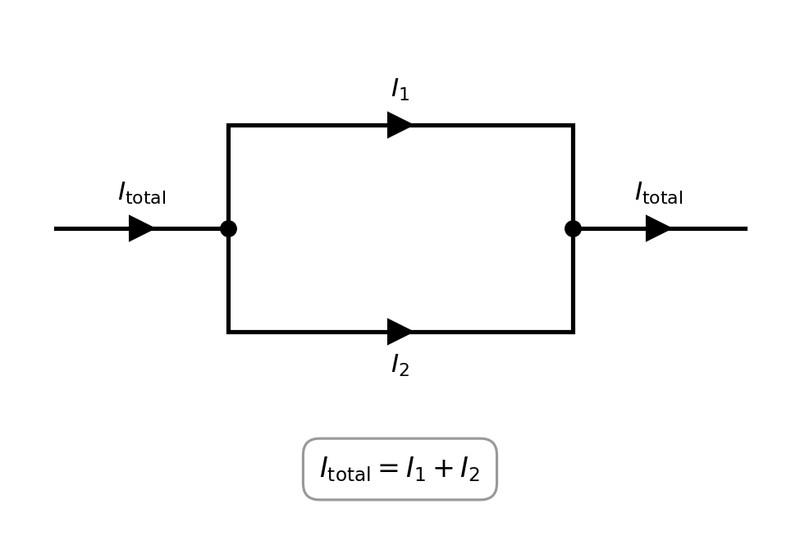
Current splitting and recombining at junctions
5. Common AP Mistakes
- Mixing up the junction rule (currents) with the loop rule (voltages).
- Switching sign conventions halfway through a solution.
- Treating negative current answers as wrong.
- Writing more junction equations than needed and getting stuck in algebra.
- Forgetting that this rule is about charge per time, not voltage.
On FRQs, if you justify Kirchhoff’s Junction Rule, you must reference conservation of charge. That’s the physics principle behind it.
