Topic 8.6 Notes – Gauss’s Law
1. Gauss’s Law
Gauss’s law relates electric flux through a closed surface to the net charge enclosed:
Break that apart:
- is the total electric flux through a closed surface.
- is the net charge inside that surface.
- is the permittivity of free space.
A Gaussian surface is any imaginary, closed 3D surface you choose to apply the law.
For example, imagine a positive point charge surrounded by a spherical Gaussian surface. The electric field points radially outward everywhere, and the spherical surface encloses the charge.
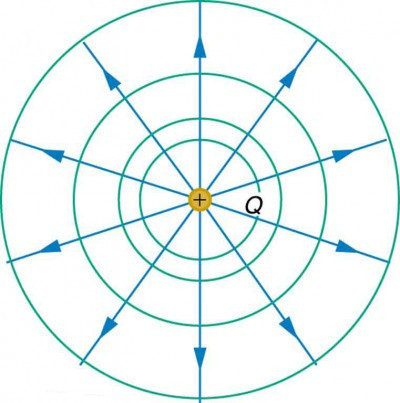
Point charge with spherical Gaussian surfaces
Key properties you need solid:
- Only enclosed charge matters. Charges outside the surface contribute zero net flux.
- The total flux is independent of the size or shape of the surface, as long as the enclosed charge stays the same.
- Gauss’s law is Maxwell’s first equation (electric version). The magnetic version is .
That “independent of size” idea is huge. Bigger surface means weaker field but larger area. The product stays tied to .
2. Electric Flux and Gaussian Surfaces
Electric Flux
For a small patch of surface:
- points outward.
- is the angle between and .
Two cases show up constantly:
- Field perpendicular to surface → , flux =
- Field parallel to surface → , flux = 0
On FRQs, they love asking why flux through certain parts is zero. If the field runs along the surface, you should immediately think “dot product is zero.”
Choosing a Smart Gaussian Surface
You’re allowed to invent the surface. Pick one that matches the symmetry:
- Spherical symmetry → sphere
- Cylindrical symmetry → cylinder
- Planar symmetry → pillbox
The goal is to make:
- constant over part of the surface, and/or
- on some surfaces
Then the integral becomes simple multiplication.
If symmetry isn’t strong, Gauss’s law won’t simplify anything. That’s when you fall back on Coulomb’s law.
3. Charge Density and Enclosed Charge
If charge is spread out, you must integrate to find .
Three types:
- Linear density
→ - Surface density
→ - Volume density
→
Uniform cases simplify:
On tests, the hardest part is usually setting up the correct differential element. For a sphere, . For a cylinder, think in terms of radius and length. Geometry matters.
4. Applying Gauss’s Law to Symmetric Distributions
AP scope: point charges, spherical symmetry, cylindrical symmetry, planar symmetry.
Spherical Symmetry
Use a spherical Gaussian surface of radius .
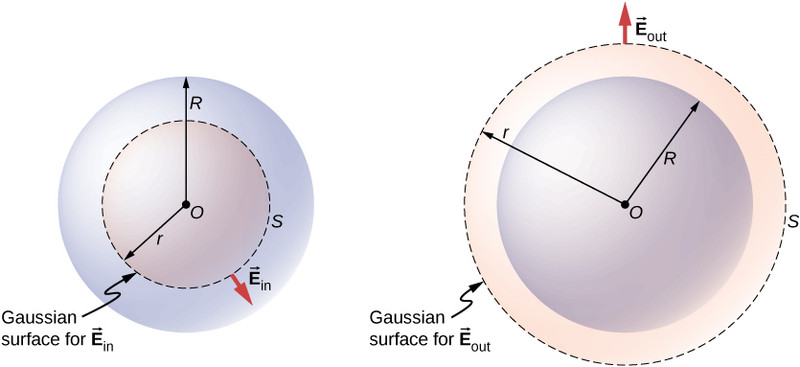
Because is radial and constant on the sphere:
Results:
- Outside any spherical distribution
It behaves like a point charge at the center. - Inside a uniform solid sphere
, so
Students often forget this linear behavior inside.
Cylindrical Symmetry
For an infinite line with density , use a cylinder of radius and length .
Flux only goes through the curved surface:
Field falls off as , not . That difference shows up in multiple-choice comparisons.
Planar Symmetry
For an infinite sheet with surface density , use a pillbox.
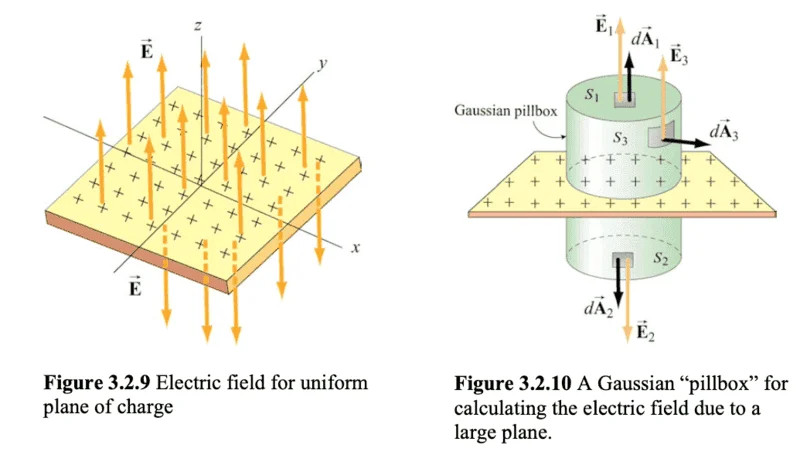
Flux comes through the two flat faces:
The field is constant, independent of distance. That feels strange at first but is a direct symmetry result.
